HomeGuidesWild Hearts
Wild Hearts tips for beginners: 20 things I wish I knew earlier20 handy tips for beginners getting started in Wild Hearts
20 handy tips for beginners getting started in Wild Hearts

What are the top tips and tricks for beginners in Wild Hearts?The new monster-huntingRPGfrom Omega Force and Koei Tecmo may be a bit more streamlined than its closest rival, but there’s still an awful lot to learn inWild Hearts. You’ve got weapons and combos to master, food to cook and eat, gigantic upgrade trees to navigate, and vast open-world regions filled with oversized monsters to defeat. It’s easy to feel a little small and overwhelmed when you’re just starting out on your Wild Hearts journey.
While Wild Hearts has various tutorials which delve into some of the important mechanics, they’re also easily missed, and forego some of the most important lessons that I’ve learned in my first 20 or so hours hunting down giant Kemono with the help of my trusty Karakuri devices. If you want to avoid some of the major pitfalls of many early players, that’s what we’re here for. On this page I’ll walk you through 20 essential beginner’s tips for Wild Hearts, teaching you all the things that I wish I’d known from the beginning of the game.
WILD HEARTS Official Story Trailer | Welcome to MinatoWatch on YouTube
WILD HEARTS Official Story Trailer | Welcome to Minato

1. Cover each region with Hunting Towers to locate creatures quickly
In Wild Hearts, you have the ability to place downKarakuri- giant contraptions which assemble themselves into all manner of useful things. One of the most useful Karakuri is the Hunting Tower, which helps you locate and keep track of giant Kemono (the bosses of Wild Hearts) as they move about the wild.
2. Read the Cyclopedia to prepare for each hunt
This advice should be second nature for fans ofMonster Huntergames: be patient when hunting down your prey. Kemono are very strong and unforgiving creatures, and each of them has a wide variety of unique attack patterns. Not only must you learn these attack patterns in order to avoid a quick death at their hands, but you should also spend time reading up on your target Kemono using the in-game Cyclopedia.
The Cyclopedia contains information on all the Kemono you’ve encountered so far, and gives you important insights into each creature’s strengths and weaknesses. You might learn, for example, that a Kemono is resistant to fire damage, and has a tail that can be severed to reduce its attack range. Don’t throw yourself into each fight recklessly. Instead, research and plan ahead to get the most out of your time with Wild Hearts.
3. Make use of Dragon Karakuri to travel quickly
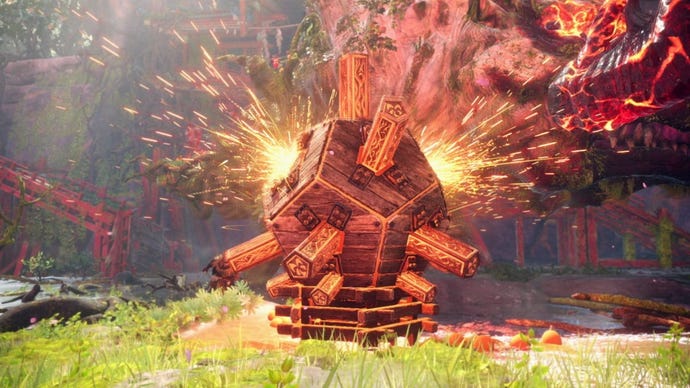
Flying Vines can be used to quickly zipline from one point to another, saving you a huge amount of time. Ditto with later Dragon Karakuri like the Wind Vortex, which propels you upwards with a strong gust of wind - a perfect thing to combine with the Glider Karakuri to cross large flat areas in short amounts of time. Using these traversal contraptions will reduce time spent running from point to point, and is also very important for chasing down wounded beasts before they have a chance to heal.
4. Place Hunting Tents to act as fast travel points
Did you know that you don’t have to respawn at your starter camp each time you die? Another essential Dragon Karakuri, the Hunter’s Tent, can be placed near a Dragon Pit to provide an optional respawn point nearer to where you need to go for your latest quest. You can place down a Hunter’s Tent wherever you can afford it, but you may not be able to place many in a single region, so be tactical and spread out your Tents so you can fast travel efficiently!
It’s also worth mentioning that each region has one secret camping spot where you can place down a Hunter’s Tent for a tenth of the usual price, making it practically free to create.
5. Start quests directly from the main map
That’s not to say there’s no point in talking to characters once you reach the town of Minato. Many of these characters will give you quests of their own - but talking to them will simply reveal the quests as new icons on the main map which you can embark on as you wish.
6. Toggle between chapters at will for easier and harder quests

Once you progress beyond Chapter 1 (which can take a while - there are several bosses to kill along the way!), you’ll find that from the main map you can toggle between Chapter 1 and Chapter 2 using the D-Pad or the buttons in the bottom-left of the screen. Changing chapters will change the quests that are available on each island. So if you want an easier time for a while, then you can always go back to an earlier chapter for a spot of lighter-weight hunting.
7. Use Crates and Bulwarks to deflect attacks
You really need to embrace the way of the Karakuri to excel as a hunter in Wild Hearts. And that means you should work the summoning of Basic Karakuri into your fighting. Crates are excellent for both offence and defence - they can block the attacks of a weaker Kemono like aRagetail, potentially stunning them; and you can also climb them and jump off for a powerful plunging midair attack with any weapon type.
TheBulwarkis even stronger, and the first of many “Fusion Karakuri” - which are Karakuri made out of smaller Karakuri. Place down 6 Crates in a 2x3 formation to create a Bulwark strong enough to stop Kemono attacks that would tear through ordinary obstacles.
8. Use Springs to dodge attacks
Kemono in Wild Hearts can get really damn big. And some of them are very fast-moving too. It can be pretty hard to get out of the way of aSapscourgeand its charging roll attack, even if you do a running slide. One solution is to place down a Spring - a cheap and cheerful Basic Karakuri which will catapult you a short distance in the direction you’re facing when you move over it. These Springs can be placed down in the blink of an eye, and can save you from certain death if you use them right.
9. Set Karakuri Stance control setting to Hold

If you’re finding that seamlessly switching from weapons to Karakuri on the fly is a bit jarring and difficult for you, then I’d highly recommend you go into your control settings and switch the “Karakuri Stance” option to Hold instead of Toggle. This means you have to hold down the button to bring up the Karakuri menu, and - more importantly - the moment you let go, you’re back to running at full speed and using your weapon as normal. I find it much easier to quickly work Karakuri into my fighting with this setting enabled, so give it a try and see which you prefer.
10. Don’t be afraid to craft lots of weapons
Basic weapons are pretty cheap in Wild Hearts, and you shouldn’t hesitate to craft multiple of the same weapon type as you progress through the game. You’ll end up upgrading each one in markedly different ways, so they’ll all become useful in certain situations and against certain foes.
At the very least you should craft one of each weapon type the moment you are able, so you can figure out which you’d like to fall back on as your main weapon for the majority of Wild Hearts. To learn more about the weapon types on offer, check out our guide on thebest weapons in Wild Hearts, and our supplementary primer onhow to unlock new weapons in Wild Hearts.
11. Practice new weapons on training dummies
Outside the starter camp in Harugasumi Way (the first region) and on the shore of Minato, you’ll find a mechanical bear training dummy. Interact with this dummy to start a training routine which shows you exactly how to fight with the weapon type you’re using. It’s a fantastic way to learn the combos, strengths, and drawbacks of using each of the eight weapon types in Wild Hearts, and you should take full advantage of it when you first unlock each one - or to just brush up on your skills before a big hunt.
12. Don’t forget to harvest loot from broken Kemono parts
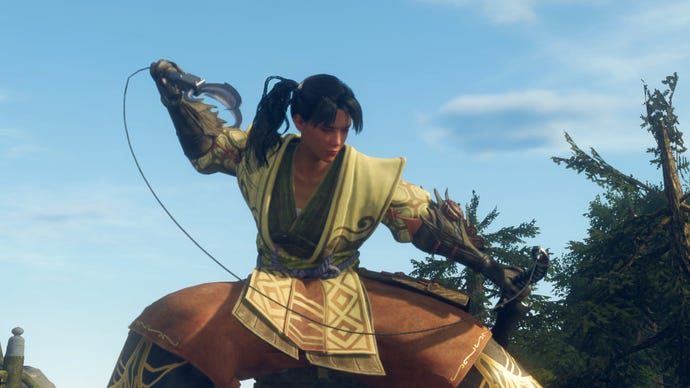
Unlike in Monster Hunter, slain Kemono in Wild Hearts don’t have to be harvested for loot. Instead you just automatically obtain the materials upon the creature’s death.However, Kemono body parts that are severed during the fight, such as the tail or tusks, can often be harvested individually for bonus materials.
It’s easy to forget this in the heat of the moment, but if you’re on a timed quest and you defeat the Kemono, you only get 30 seconds or so before you’re whisked back to camp, and your chances of obtaining those severed part materials disappears forever. So remember to harvest the loot from broken parts sooner rather than later. And if you’re after other materials from small Kemono (likeSimian Yin Organ Gems,Lizard Bloom, andPointed Scales) or the environment (likeOreandSilken Thread), make sure you gather them up before slaying the main boss of that quest.
13. Look out for Hunter’s Arm opportunities
See those glowing spots that appear on the body of that Kemono you’re fighting? As you damage the Kemono, these glowing areas will appear. When you see one, grab onto the Kemono as though it were a cliff rock, shuffle over to the glowing area, and hit the interact button.
This will engage yourHunter’s Arm, allowing you to grapple onto the top of the creature and burst the glowing patch. Doing this gives you a huge amount of extra Karakuri Thread (more than you’d ordinarily be able to carry), and staggers the Kemono, leaving it vulnerable to heavy attacks.
14. Eat and improve food
Food is an important part of the preparation phase of any hunting expedition in Wild Hearts. There’s a lot of food to harvest and cook in this game, and each of them will give you various benefits which persist for quite some time after consumption. You can eat multiple foods until you are full to combine effects and make yourself a lot stronger than if you tried to fight on an empty stomach.
You can also use the Drying Rack and Pickling Jar Karakuri to combine and enhance various foods, making their effects considerably more potent than their fundamental ingredients. Drying and pickling food takes time, so you’ll need to set it going, go off on a hunt, and then pick up your enhanced edibles once you return. But doing this is well worth it, so it’s good to get into a more culinary mindset between fights in Wild Hearts.
15. Upgrade your Tsukumo - they’re useful

Tsukumo are very, very, very easy to ignore - but that’s not what a good hunter does. These mechanical critters are scattered about each region and can be collected, and as you gather more, you’ll find Tsukomo start to help you in fights in small (but sometimes incredibly important) ways. A lot of the time if you’re in a bad spot, a Tsukumo will attract the attention of the Kemono bearing down on you. Others might spread a healing mist around the area which heals you up, while others still might automatically attack the Kemono, sometimes even interrupting the boss’s most dangerous attacks.
16. Human-Path and Kemono-Path armour
One easily missed aspect of theWild Hearts armoursystem is that many armour pieces can be upgraded down two distinct paths: the Human Path, and the Kemono Path. To access these upgrades, go to the armour crafting screen at any Forge, and then switch the tab at the top to either of the two Modification screens.
Not all armour items can be upgraded down both paths, and the differences between the two paths is not always clear. Sometimes a Kemono-Path upgrade will have different resistances to the Human-Path equivalent; other times the amount of armour provided is different. You may also find that certain armour pieces have special effects which only activate with an upgrade down a specific path. Take a look at these upgrade paths and figure out which you’d prefer.
17. Sell easily obtained items in Minato
Don’t sell everything - you’ll need a lot of materials for crafting and upgrading your weapons and armour. But I’d urge you to sell materials and resources that you can find with ease once you actually have need of it. Don’t hoard unnecessarily, basically.
18. Fall damage is all or nothing

You may have played a bit of Wild Hearts, jumped off a fairly tall ledge, and come to the conclusion that there is no fall damage. The truth is that you just haven’t dropped off a high enough ledge. The way fall damage works is a bit weird in Wild Hearts, but basically you can fall a fairly long distance without damaging yourself (you’ll be momentarily stunned, but you won’t take any health damage), but the moment you go beyond a certain height of drop, you’ll be instantly knocked unconcscious.
19. Don’t forget to unlock new Karakuri
20. Destroy Dragon Karakuri when they’re no longer needed
There are two ways to go about this. The first is to upgrade your Dragon Pits, and this is useful, but it’s also pretty expensive. It’s often a better idea, at least in the early game, to simply do some spring cleaning and remove any Dragon Karakuri from past hunting expeditions that you no longer need.

Hopefully these Wild Hearts tips will help you to get your bearings quicker than most when you first step into the beautiful and perilous world of Wild Hearts. There’s an awful lot to learn about the game and this guide only scratches the surface, but if you’ve reached this point, you should be on a much more solid foundation from which to explore everything else that Wild Hearts has to offer.
