HomeFeatures
Why the mysterious love affair between video games and giant elevators may begin with AkiraWhere did they come from? What are they for?
Where did they come from? What are they for?
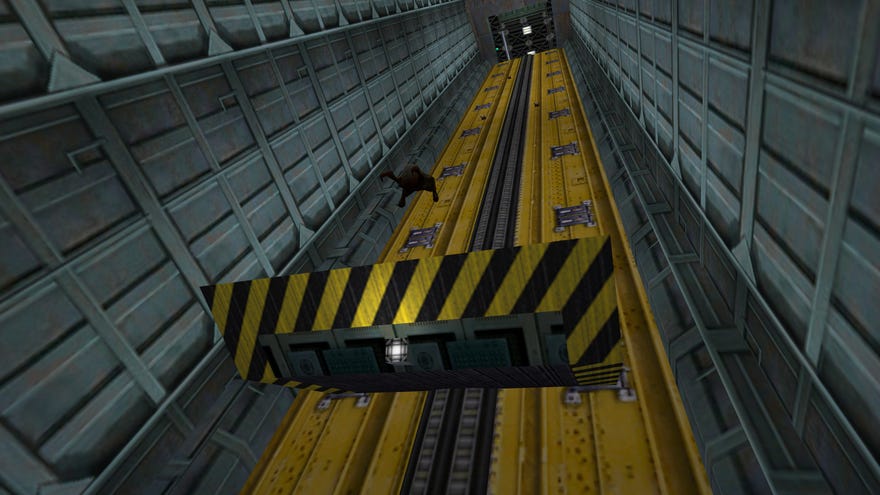
It’s funny how some aspects of game design are so ubiquitous that we stop questioning them, or even noticing them. After decades spent playing video games, I know that if I look behind the waterfall, there’s likely to be some sort of shiny goodie to collect. If I head left rather than right at the start of a level, I’m bound to find a juicy secret. There are conventions. Traditions. I can’t remember a time when games didn’t have giant lifts - and yet, I’m not entirely sure why they’re there. I’m not talking about the regular kind of lifts that you pile into, usually at the end of a level, to transition from one part of the game to another; those ones have historically been used to hide lengthy loading times, like the interminably long lifts ofMass Effect.
What I mean is the lifts that are essentially tennis-court-sized moving platforms, usually with little more than a flimsy guard rail around the edge to stop elevator enjoyers from plunging down the shaft. Even more specifically, I’m talking about the diagonally moving elevators that trundle slowly into the depths, often to some nefarious laboratory. There’s a good example in theResident Evil 2remake, where you fight the final boss on an inclined elevator as it slowly, ever so slowly, descends towards the train that will grant your escape. So where did these giant elevators come from? And why do developers keep putting them in their games? I set out to answer both questions, and went somewhere unexpected.
What’s It Like To Start Destiny 2 From Scratch?Watch on YouTube
What’s It Like To Start Destiny 2 From Scratch?

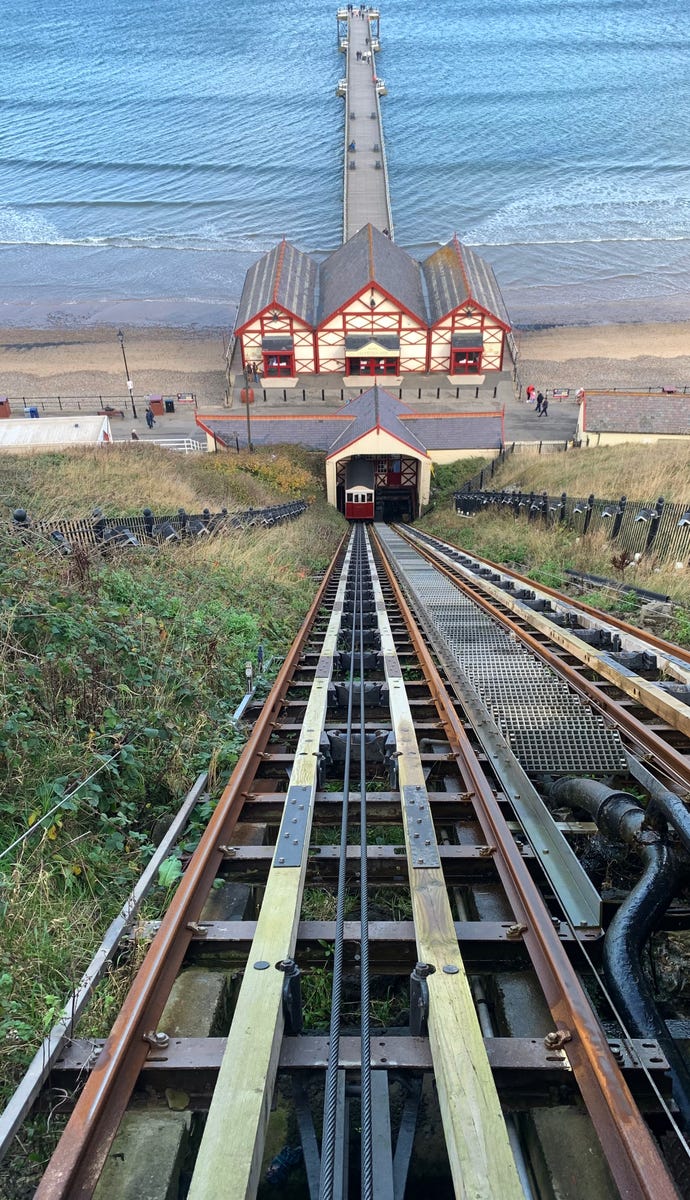
There are loads of these rickety cliff lifts dotted all over the world. The modern equivalent of these is probably the incline elevators that have been popping upat underground train stations. But funiculars and incline elevators aren’t quite what I’m looking for. Big lifts do exist in real life – like thehuge freight elevatorat the Smithsonian National Museum of American History, which is used to haul things like trucks, cars and train carriages for display on the upper floors - but they’re all safely enclosed and stubbornly vertical. The closest thing to a classic video-game giant lift is probably theThree Gorges Dam ship elevator in China. It’s the biggest elevator in the world, but it’s also distinctly wet, and definitely not diagonal. So where did all these diagonal game elevators come from?
Alt also pointed out that it’s extremely common for video games to take ideas from manga. “The thing about games, particularly Japanese games, is that they exist in a symbiotic relationship with manga and anime. WhenI spoke to Uemura-san, the engineer of the NES, he said ‘Once hardware developed to the point where you could actually draw characters, designers had to figure out what to make. Subconsciously they turned to things they’d absorbed from anime and manga. We were sort of blessed in the sense that foreigners hadn’t seen the things we were basing our ideas on.’”
A comparison between the lifts in Half-Life and Akira, via Reddit userllamanateeImage credit:Reddit user llamanatee
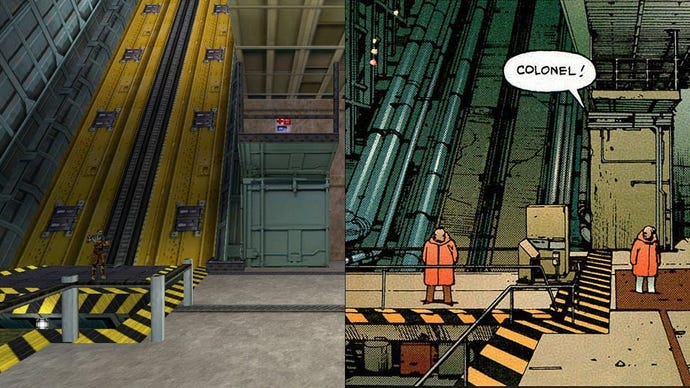
An Akira lift features in the 2016 Rebellion gameBattlezone, slowly raising the player’s tank into the battle arena. “It was intended as a sort of introduction to the game,” May said. “So you get gradually released into the environment.” The original idea was that several players would all ride together on the lift, and be able to move and look around. But this proved too technically challenging, so in the end the lift carried just one player, locked in place. Actually getting the lift to work was tricky, too. May explained that in terms of physics, the player was left at the bottom of the lift shaft, while the camera and the rendering position of the tank simply moved upwards with the lift. Then when the lift reached the top, the physics component was teleported to the top of the shaft. “That was one way you could avoid problems where you’ve got things moving out of sync with each other,” he said. “Classical errors you’ll see with lifts in games involve things like, say, if you drop your gun or lob a grenade or something on to the lift, you’ll often see those fall through the lift or jiggle about on the lift because they’re moving under physics and the lift is hitting them continuously.”
Image credit:Rebellion

So why put something that hard to make in games in the first place? May can think of a few reasons. “There’s the classic one, which is just a kind of gameplay break for the player,” he said. “You used to see that in things like sideways brawlers. You’d fight in a little arena for a few minutes, and then move on.” Then he added the technical reasons: “They give you an opportunity to segue between two different sections of a level without having to keep it all in memory.” In other words, just like those dreaded Mass Effect lifts, giant elevators also mask loading times. Once the lift starts moving, the previous level section can be erased from the computer’s memory and the next section can be loaded in.
There’s also the increasingly common scenario where the lift is a whole level in itself, a dynamic platform that moves through the environment while enemies plunge aboard, challenging you to fight in tight corners. Perhaps one of the most common uses of giant diagonal lifts is to build anticipation, taking you ever upwards (or ever downwards) towards some terrifying reveal or climactic battle. “That is what that lift is all about in Akira,” May noted. “It’s about like, ‘Oh shit, we’re going down somewhere really scary’. That’s why they’ve got all this massive infrastructure: there’s a reason why he’s kept at the bottom of an enormous shaft.”
But perhaps there’s an even simpler reason to include a massive diagonal lift in your game: they look really cool. And the fact that nothing looks like them in real life surely only adds to their allure. Plus, as a shorthand for indicating that you’re about to enter a messed-up and nefarious sci-fi laboratory, they’re right up there with twitching bodies in glass chambers full of green liquid. Then again, perhaps they’re not as fashionable as they used to be in the days when Akira reigned supreme in the collective nerd consciousness. After all, RPS readers recently said theypreferred elaborate corridor architecture to funicular fights.
