HomeFeaturesCrusader Kings III
Why Crusader Kings 3 still feels new-chainmail-fresh after 18 months on the throneWhy bother seeing the woods, when you can check out all these cool trees
Why bother seeing the woods, when you can check out all these cool trees
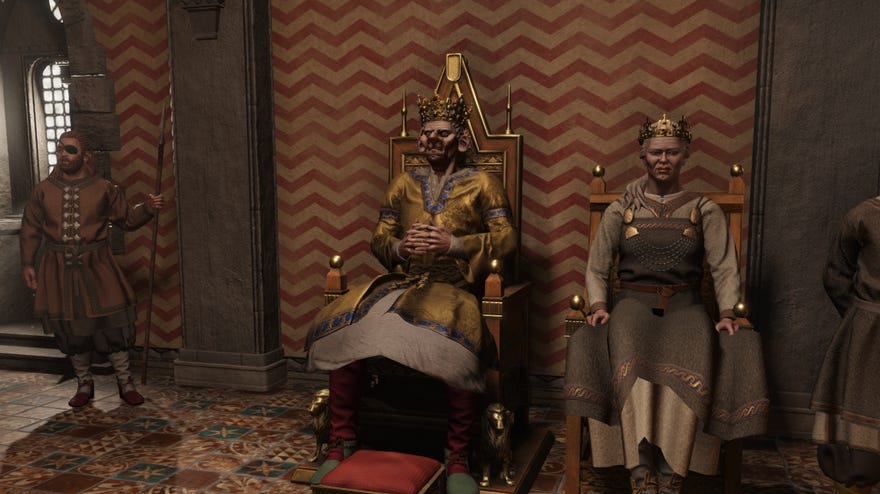
WithCrusader Kings IIIfinally having invaded the console market - presumably, as a result of a club-footed Belgian mystic spending months fabricating a claim to it - now seems a fine moment to step back and see how the game looks, eighteen months into its reign on PC. The answer, with almost embarrassing simplicity, is: “great”.
When it comes to bigstrategy games(or, indeed, big strategy-RPG hybrids such as CK3), it’s generally a lot easier to give a verdict on how they play at launch, than it is to make any sort of informed guess as to how well their initial shine will hold up over time. And since these games areall aboutreplayability in the very long term, that’s a pretty important thing. With constant patching and incrementally transformative DLC drops being the standard model for the genre (and particularly so for Paradox releases), the state of a strategy game on arrival is becoming a less and less useful measure for determining whether it will sink or float.
Crusader Kings III: Release Trailer - Out now on PS5 and Xbox Series X|SWatch on YouTube
Crusader Kings III: Release Trailer - Out now on PS5 and Xbox Series X|S
To give a recent example:Total Warhammer III, released last month, was a game I loved every bit as much as I had expected. But I stopped short of bestest-besting it in myreview, as some of the single player campaign mechanics felt like they had the potential to get a little annoying. Alas, they gotreallyannoying; I’ve not touched the game in two weeks, and I probably won’t touch it again until the Realms of Chaos stuff gets a major rework, or the Mortal Empires patch drops.
I’m fairly confident in saying the “perpetual development” paradigm will probably save Warhammer 3 from ignominy in the long-run. But this idea - that a game never has to have a line drawn under it and declared finished - is a double-edged sword. Last year’sHumankind, fromAmplitude, really impressed me. It was a brilliant piece of design, and while there were a few balance issues still to be squared on day one, its longevity felt like a fairly safe bet. To cut a long story short, it wasn’t, and I can’t help wondering if things might have been different if Amplitude hadn’t built Humankind with the expectation of having infinite tinkering time.
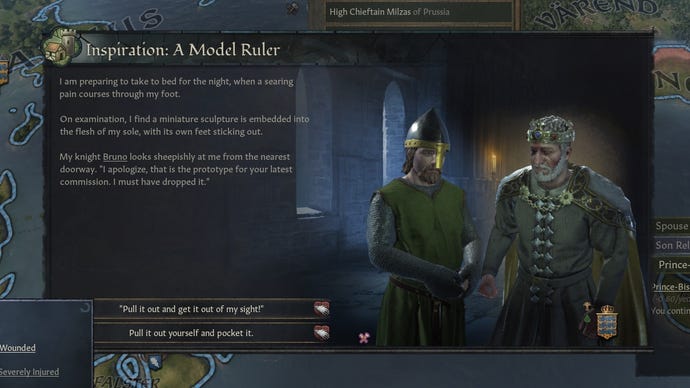
Royal Court introduces not only artefacts, but inspired people who can create them - leading to some fun new mishaps.
And so to Crusader Kings III, which I have probably dipped into at least once a month since its release in September 2020 - a solid “mission accomplished” for a strategy game, if ever there was one.
The game has only had two significant pieces of DLC in all that time - the norse-themedNorthern Lords“flavour pack” in March 2021, and February’sRoyal Courtexpansion, which added… well, royal courts, alongside a significant overhaul of CK3’s culture system.
On paper, this doesn’t sound like much compared with the six expansionsCrusader Kings 2received during the first 18 months of its own release. But the important context to consider here is that four of those expansions (Sword of Islam, Legacy of Rome, The Old Gods and Sons Of Abraham) largely comprised features which were already in CK3 from day one, while a fifth was Sunset Invasion (I don’t care what people say; I loved it).
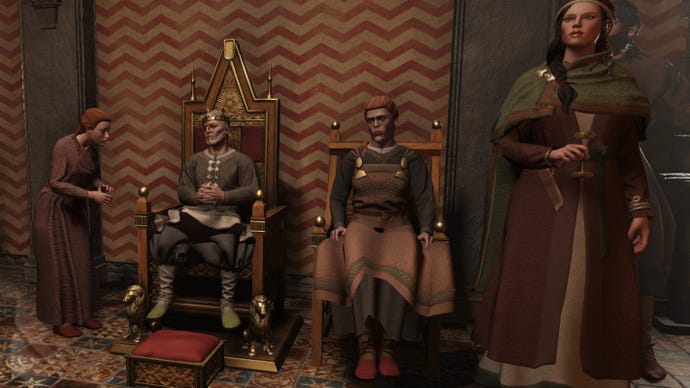
The King of Denmark, spending a truly shit Tuesday holding court.
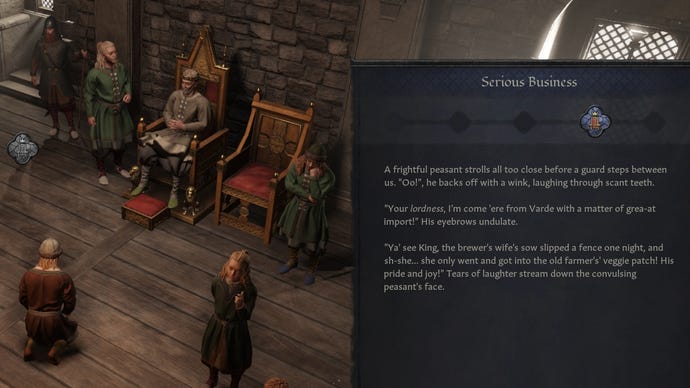
As is often the case when beloved games get much-hyped sequels, the discussion around CK3’s initial release was largely about how it measured up to CK2, and was framed in quantitative terms: “how many of these things, which I currently enjoy doing with the current product, will I be able to do with its successor”. In hindsight, at least for me, the question is now qualitative: “how does the general sensation of playing this game compare with that of its predecessor”. And the answer - “pretty much the same, but a bit more so” - is realistically a best-case scenario.
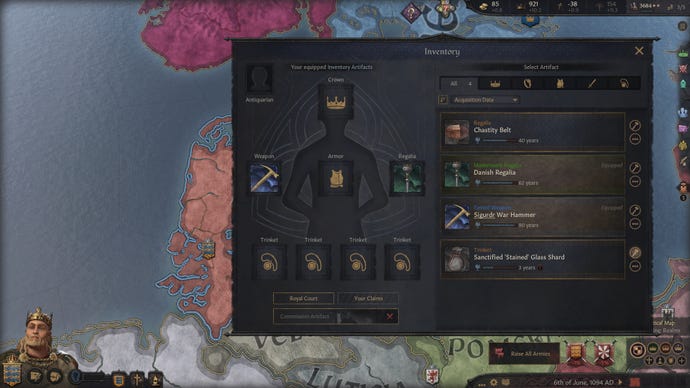
The new inventory system is miles better than the one from CK2’s Monks and Mystics expansion. You can have a chastity beltanda hammer!
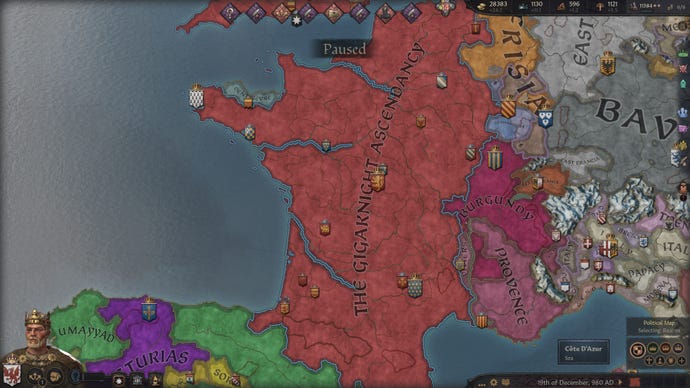
Guess who inherited the Gigaknight genes in this photo.
The other branch of February’s updates, reworking how the game handles culture, has arguably done even more for CK3. One of the big challenges facing any attempt to provide an improved version of the CK2 experience, was the fact that the longer you played, the more apparent it became that the primary hook that kept you coming back was the satisfaction of gathering very many soldiers into a big ball, and rolling it around the map until it was all your colour. Everything else in the game was either a beautiful or absurd distraction from that truth (many of the roleplaying elements), or a regulating factor put in place to stop you “blobbing” too quickly (the whole business of fabricating claims, for example).
Blobbing. |Image credit:Paradox Interactive
Uncharitably, perhaps, you could even argue that the heavier focus on character-focused, RPG-ish stuff in CK3 overall, wasn’t actually that much of a change. For all that I love them, virtually every one of Paradox’s grand strategy games boils down to the process of moving very big things with very small levers, over very long periods of time. And in that sense, perhaps “a full tree of dynasty perks” is just a replacement for “a map that’s all the same colour” in terms of being the big thing that you’re trying to move.
But that’s a pretty fucking miserable way to look at it, IMHO.
And that’s where a state of mega-replayability lies, I reckon, for CK3. When you’re no longer hurrying through the text of an event about Prince Fartlungs learning Danish, because you’re far too horny about invading Sweden in 70 years’ time. Instead, you’re lingering on it, because the writing’s fun for a start, and because you’re honestly more engaged with the young prince’s travails, than you are in long-term Scandinavian realpolitik. In other words, when the levers the game offers you to pull, become more interesting than the things you’re trying to move with them.
