HomeFeaturesThe Cartomancy Anthology
Why all the best game developers play TarotCard mode
Card mode
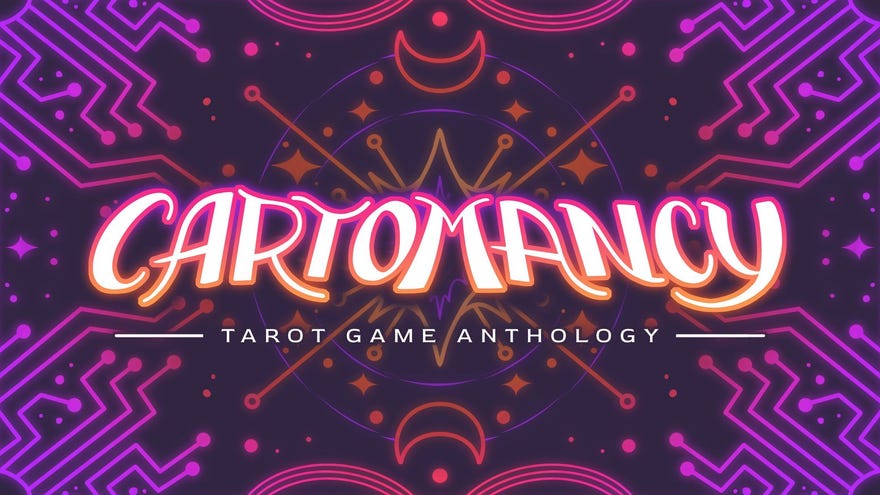
When drawn in an upright position, the Page suggests a flash of inspiration reeled from the mind’s ocean, or a dazzling opportunity. In this guise, he’s been a good friend to Ami Y. Cai, a game creator and illustrator from Kentucky - though in her first Tarot deck, Stephanie Pui-Mun Law’s Shadowscapes Tarot, the symbolism has been flipped around a little, the Page depicted as a mermaid peering into a steaming bowl. “Sometimes sparks come to me through conversations, or while I’m doing something else,” Cai tells me over Zoom. “So when I see the Page of Cups, I know that a creative opportunity is coming my way.”
The Cartomancy AnthologyWatch on YouTube
The Cartomancy Anthology

Every Tarot card has its “reverse” interpretation, however. Draw the Page of Cups upside down, and the joy of insight becomes jealousy and stagnation. “My biggest fear growing up as a creative is someone stealing my idea,” Cai says. “But there’s a downside when you cultivate an idea too long in this secret box - your idea will sour if it’s not given air. So when I see the Page of Cups in reverse, I get the feeling that I need to be more wary of the pros and cons of keeping it private.” It’s a familiar dilemma for artists of all stripes. “If you constantly go to others for feedback, how many of your ideas are actually yours?”
Cai doesn’t credit Tarot with the literal power to determine one’s fate. She treats it as a means of self-illumination and questioning, “of cracking a door that you didn’t realise is there - you can decide to go through the door, you can decide to close the door.” As an Asian American teenager in a “very white-cultured” area, Tarot was a way of exploring both her own heritage and other cultures. “Divination was something my mom was aware of, and Chinese divination is done very differently than in the West. I did a lot of research into how divination has been - I don’t wanna say cultivated, but it’s flourished in different ways around the world.”
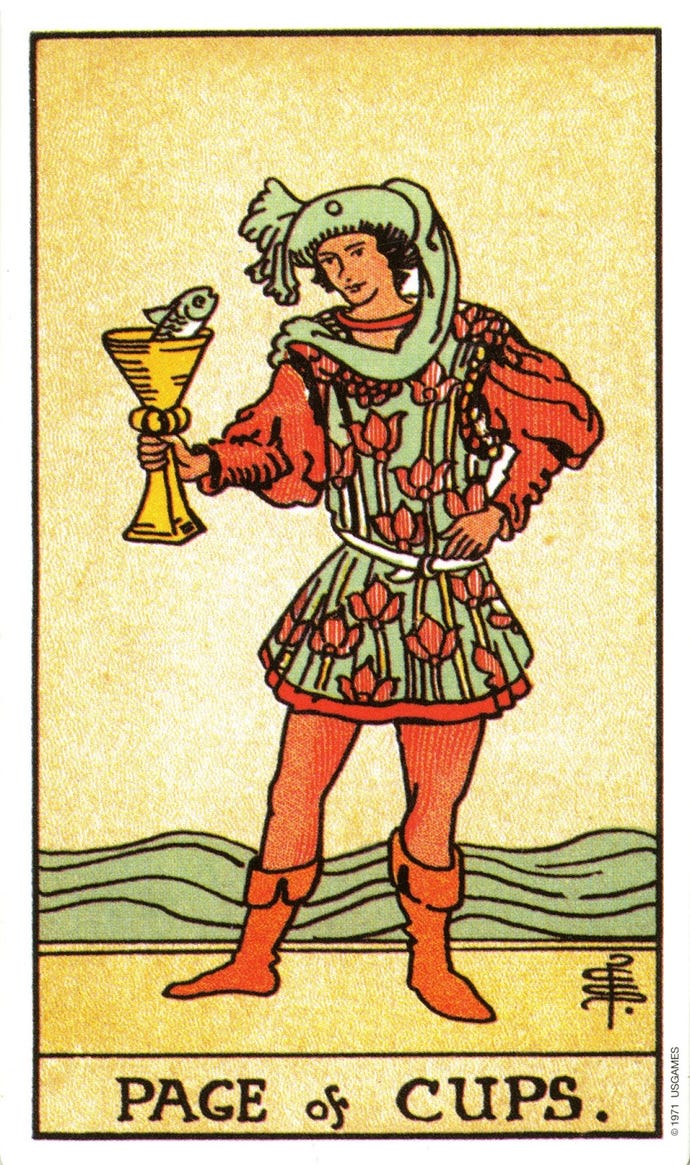
Tarot dates back to at least 15th century Italy, though its precise origins are unknown. Over hundreds of years it has slowly dispersed across Europe and overseas, always changing. Today, there are hundreds upon hundreds of interpretations of the “standard” Tarot’s 78 extremely open-ended card concepts: botanical and animal-themed Tarots; decks based on movements such as Art Nouveau; licensed Tarots for The Nightmare Before Christmas and The Legend of Zelda; satirical decks featuring Nixon and Roosevelt; slapstick decks made up of paintings of rubber chickens.
We associate Tarot with prophecy and personality-reading, but that’s not why Tarot became ubiquitous - it wasn’t till the late 18th century that fortune-tellers and organisations such as the Order of the Golden Dawn began using Tarot as a mystic instrument. The reason for Tarot’s spread is that Tarot is a game. Take away the Major Arcana – a triumphal procession of 22 allegorical face cards – and you’ve got something like the vanilla deck we use to play Poker or Solitaire: four suites of aces, number cards and court cards, albeit with one extra, the Knight.
Some of the character tarot cards from Dragon Age: Inquisition
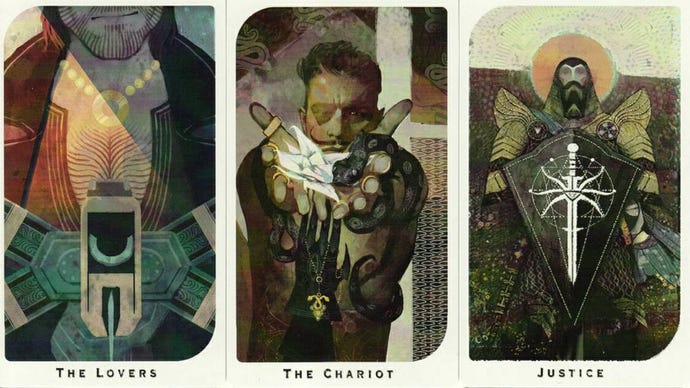
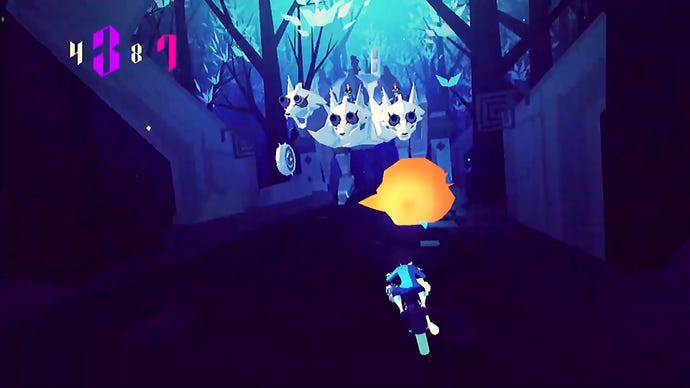
Some videogames riff on this oracular narrative structure explicitly. Sayonara: Wild Hearts, for example, turns the Fool’s journey into an album of musical boss battles (Simogo, alas, declined to be interviewed for this piece, citing a lack of real expertise in Tarot). Others evoke the idea of a live lived through the cards more obliquely. My favourite bits ofDragon Age: Inquisition, for example, are its Tarot-style character portraits, which transform as you get to know your companions and unravel their backstories.
The Cartomancy anthology is based on the Major Arcana alone, which sadly means that Cai’s mate the Page won’t get a credit. Each game is an interpretation of single card. Contributors include Tanya X. Short ofBoyfriend Dungeondeveloper Kitfox, who has teamed up with Brett Ellison to adapt the Emperor card, and Colorfiction, purveyor of mazy, occult train journeys and woodland walks, who is doing Death. It’s a “global conversation”, Cai adds, involving “a lot of marginalised voices – different genders, sexualities, races and locations.”
“Everybody fears the Tower, because it just kind of breaks everything, but it’s also a sort of creative destruction,” says Fasce. “And the Star kind of represents hope, because it comes right after. But I think it’s also about understanding how you deal with trauma and adversity, which I think is a really interesting message. It’s not just ‘oh, I’m hopeful things will go well’. It’s a more mature kind of hope.”
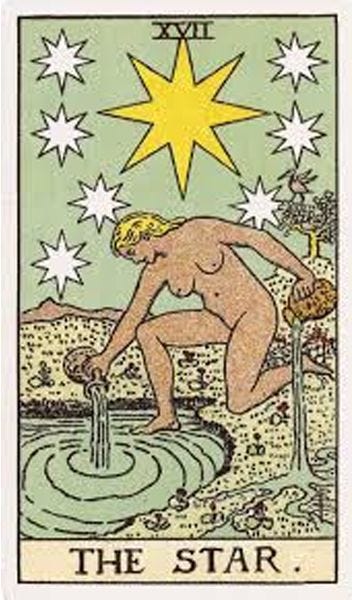
Like Cai, Fasce doesn’t believe in Tarot as a literal means of prediction. “But what I do believe is that these symbols are so universal, that it’s quite easy to just grab at them and make something deep inside you emerge.” The Cartomancy project aside, he uses Tarot as a personal imaginative aid and a pedagogic instrument for aspiring narrative designers. “One of the things that I teach students is to connect dots, put things together that don’t seem related. With Tarot it’s very easy to exercise that skill, because you can do a very simple three card spread and start building a story. It’s not just about discovering cards, but how they bleed into each other.”
Another game developer who teaches with Tarot is Char Putney, whose credits range from vast enterprises such as Balder’s Gate 3 to pungent smallscale works likeVitriol, an eldritch word puzzle developed with her partner Martin Pichlmair. Putney runs interactive fiction workshops in which she sometimes asks people to tell stories with Tarot cards, printing out and snipping up sheet upon sheet of Rider-Waite designs. While she enjoys seeing her students get excited about their discoveries, the point is partly to show that anyone can devise stories this way, and counteract “the sickness of thinking that it’s something pulled uniquely from within, that only belongs to them”.
Putney herself stumbled into the world of Tarot while studying classical and Biblical languages and literature at university. Hebrew proved especially helpful for a budding scholar of the occult. “All the Tarot cards have their own Hebrew letter association - everything to do with the Golden Dawn system of magic. And Victorian English magic is all like, segued through Hebrew verbs for some reason.”
A screenshot from Sayonara Wild Hearts |Image credit:Simogo
In the spirit of Horus, Putney and her partner Martin Pichlmair once cooked up their ownTiphareth Tarotbased on Crowley’s Thoth deck during a gamejam. “We basically remixed all of Crowley’s cards using GPT and a bunch of specific magical numbers that are very relevant to Crowley’s way of thinking and the Thelemite magical worldview.” Putney acted as human intermediary, curating bits of procedurally generated text into gorgeous prose poems, while Pichlmair spawned “not-so-sacred” geometry to accompany them using his own cryptic methods. “Doing that took us the whole weekend, and we went absolutely crazy, eating tortilla chips and drinking wine and cackling.”