HomeFeatures
What 20 years of Tropico has left me wantingWho could have edicted this?
Who could have edicted this?
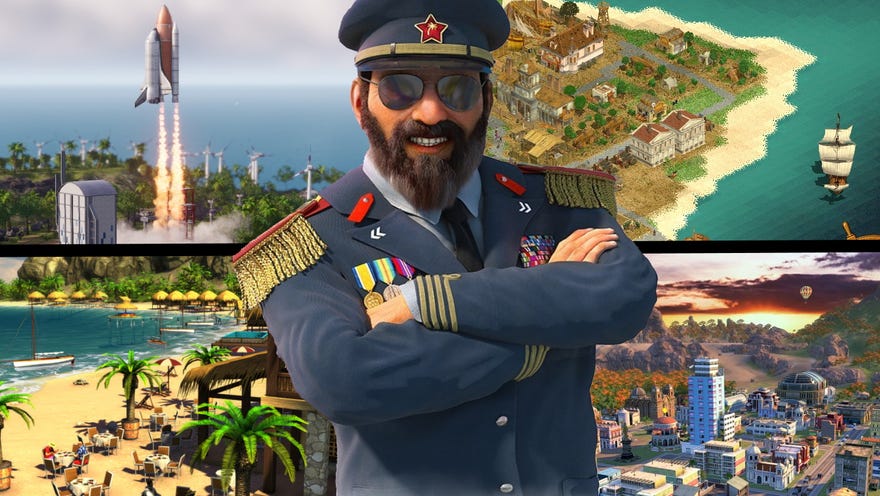
Having namedropped Tropico in the very lastepisode, I discovered two things this week: the happy fluke that it coincides with the 20th anniversary of the first game in the series, and that after years of waiting to use “serendipitous”, it reads far too pompously to open an introduction with it.
It’s a perfect opportunity to bring up why I love the series, because that should counter-balance all the complaining I’m going to do. And I’m hinging it on this: I don’t want Tropico 7. I want anotherTropico 2.
6 Best And Worst Things About Tropico 6 | Tropico 6 ReviewWatch on YouTube
6 Best And Worst Things About Tropico 6 | Tropico 6 Review

It’s a remarkable series when you look at the timeline. When PopTop Software (known for 1998’s Railroad Tycoon II, absorbed into Take-Two Interactive before Tropico was finished, and eventually merged into Firaxis Games in 2006) released the firstTropicoin 2001, the city building genre was on the cusp of a decline. Real time strategy in general was a dormant power throughout the 2000s, and the most ludicrous, yet somehow loudest voices even insisted that the PC itself was finished as a platform. It was a dark time, and Tropico shone all the more for it.
Your choice of ruler doesn’t dictate (oho) how to play, but it will inform it at least. If you start out as a rum magnate, it makes sense to build an economy on sugar farms. The schlubs you rule over are divided into factions, most notably the capitalists and communists, whose demands aren’t all mutually exclusive, but are difficult to reconcile. Maintaining support and control of these factions is another defining facet of the series, but it’s often overlooked how again, it’s the personality and tone that makes them work. Tropico is a game that can reward corruption, assassinations, xenophobic immigration policies, and openly dictatorial regimes. And somehow, despite all of this, the mood is light and jovial.
Sure you might build a capitalist hellhole or miserable stalinist prison town, but the islands invariably make for a gorgeous sight.
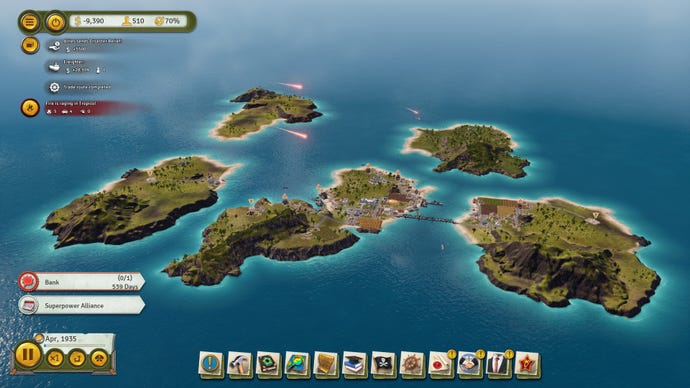
It helps that Tropico is pretty. It’s easy to underestimate the power of aesthetics in a strategy game, but staring at a lush island paradise for tens of hours is hard to pass up, and since the shift to 3D in 2009 inTropico 3, they’re positively gorgeous games. Perhaps more remarkably still, they’ve never felt sneering. “A wacky game about being a dictator of an island in central america!” is a phrase that would probably get my guard up today, but the butt of the joke in Tropico is always the rulers. The crooks and the incompetents and the egomaniacs are ridiculous figures, and so cartoonish that Tropico resists feeling mean spirited or bigoted.
The great personality-driven management games I grew up on, and whose loss some of us lamented for so long, never really went away. Tropico has carried that torch for 20 years, and they’ve got better with each release. But my complaint, see, my complaint is that they haven’t changed enough. Theyhave changed, obviously, especially when 5 introduced multiplayer, and a new era-based structure.Tropico 6added multiple islands to the pile, which as Alec Meerpointed outmakes more difference than you’d think.
But it doesn’t feel like much of a difference over nearly 20 years. They’ve never dropped made a bad game, it’s just that while everyone has a favourite Sim City or Civilisation, if you’ve got Tropico 6, I can think of no pressing reason to try any of the others. Except for Tropico 2 Colon Pirate Cove. However you look at the series, this is the outlier. It’s the ugly one. It’s the one nobody talks about. It’s kind of samey. It’s weird and doesn’t entirely work. It’s the one that highlights a fundamental limitation of the whole design. If I’m being honest with myself, it’s probably the worst overall.Of courseit’s my favourite one.
God, Tropico 2 looks even uglier than I thought in screenshots. It’s better when you’re playing. A bit.
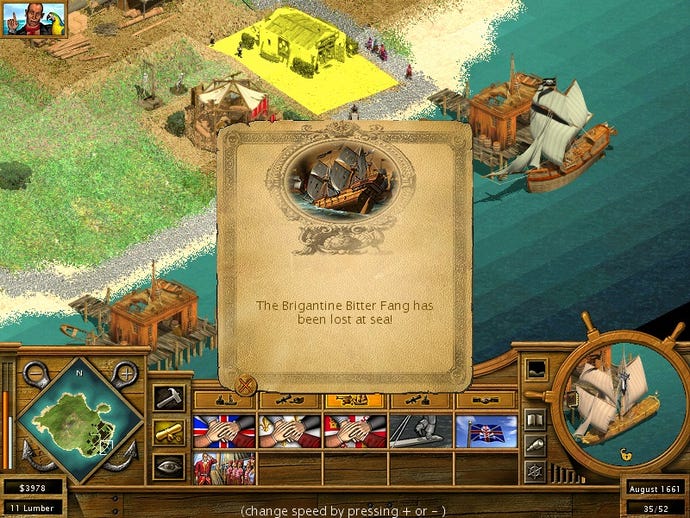
Look, I know I’m biased here. I’vehinted beforeat my love of piracy. I’vecomplainedthat “piracy” in games is invariably not piracy but random pointless murder. I was reading about pirates throughout history even before discovering Black Sails, the best tv series ever made (no, seriously). But it’s not just because of the theme. I love Pirate Cove for being more than Tropico with an eyepatch and west country accent. It did something different not just for the series but for the entire genre.
Where Tropico had factions with different demands, everyone on your island fundamentally wanted the same things. If everyone had food and money the factions would happily intermingle, and it generally paid to provide for as many people as possible regardless of their politics, especially if you were holding free elections.
Thankfully, Pirate Cove inherits the silly, self-aware tone of the original, taking the edge off your entire economy being built on slavery, and your captives are all European nationals, which, well. It’s obviously ahistorical, but at least feels much less uncomfortable than playing a real life plantation boss. You’re definitely the baddies, but moustache twirling baddies with scurvy and a parrot.
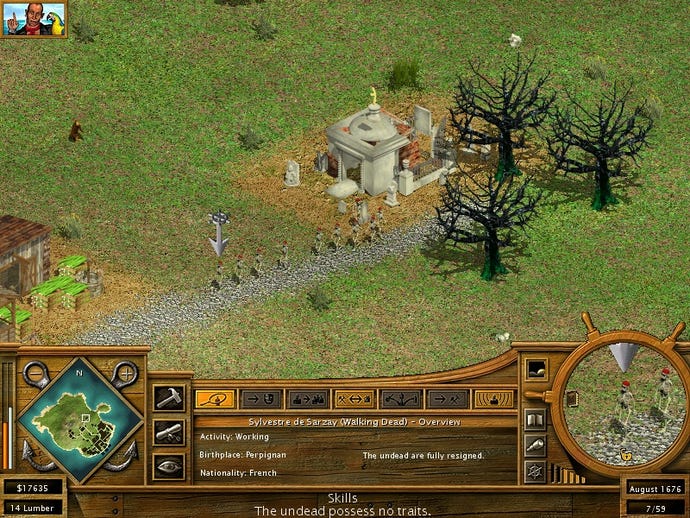
One of Tropico 2’s odder edicts: build a graveyard and resurrect the dead for immortal, totally loyal labour. They’re a bit slow, and cost more each time.
It’s a clever shakeup of the existing faction structure. Sure, its roots show, and the dev team (Frog City Software, who also made the excellent and sorely under-recognisedImperialismgames) clearly struggled to fit some elements into the engine. While your pirates' nationality also influences their needs, in practical terms it makes no difference since, like Tropico’s communists and capitalists, they all want the same thing at the end of the day.
Production chains are less important since most goods are exclusive to high-level pirates who tend to get killed off before long anyway, which has the side effect of streamlining resource variety, making the islands more uniform and dull. Edicts are generally either indispensible or useless, the UI makes finding people a pain in the hole, and Pirate Cove’s bid to make the visuals more distinct from the original left its landscapes rather drab, especially so many years on. But they could only work with what they had, and they succeeded in porting enough of the personality to paper over a lot of the cracks.
And above all it’s the actual piracy that I love about it. That’s the other key difference, see. Your captives are vital because they do all the labour, but aside from basic rations your entire economy is built on sending dudes out in ships to steal what you need at swordpoint. There are so few games about being a real, practical pirate that my plan to write a feature on the ones that do stalled last year because there plain aren’t enough. In Tropico 2, it doesn’t matter how good a builder you are if your pirates aren’t bringing home the goods. And crucially, you don’t have any control over them whatsoever once they’re at sea. It’s pure strategy.
You start out with a little money and a few buildings, and if you’re lucky a small ship. Each ship requires a captain (each based on real or famous fictional pirates like Captain Hook orCalicoJack) and crew, plus some rations and weapons. You can give it standing orders on how to engage, but your only real power is to keep the crew supplied, happy, and - if possible - trained, and to point them to the most profitable and least hazardous shipping lanes. Captains aside, everyone can die. Patrols can return again and again with empty holds and grumpier crews to put even more strain on your popularity. Worst of all, your ships can sink.
It’s this luck factor that’s both its strength and main source of frustration. Once the cannon has sounded a ship’s departure, you get nothing but a periodic sound effect and animation when it fights someone. Until it gets back you don’t even know whether that was a fat merchantman surrendering, or a bounty hunter raking you bow to stern. It’s tense in a way a building game rarely is, and makes turning from months of failure to raking in thousands of doubloons feel wonderful, not least because in your head you’re already translating that cash into new buildings and raids. We were just some bums on an island once, but with this haul we’re ready to build a fleet that could go out there and shove the king’s face in.
Of course, the downside to that is that you can get unlucky. Replacing a sunk ship only for that one to immediately sink too is usually less funny than it sounds, and the failure spiral hard to pull back when piracy is your only source of income, recruits, and captives alike. I don’t see a way for a pirate game to avoid this without feeling sort of hollow, since that’s the nature of the life. But it does expose a persistent limit of the series. In most of the Tropico games, see, you start out with everyone needing 5 or 6 things that you can’t afford, and the first third of the game is a race to prevent one of them from bottoming out. And then… suddenly you’re flush with cash and everyone’s content, but the game’s almost over before you’re really able to go wild.
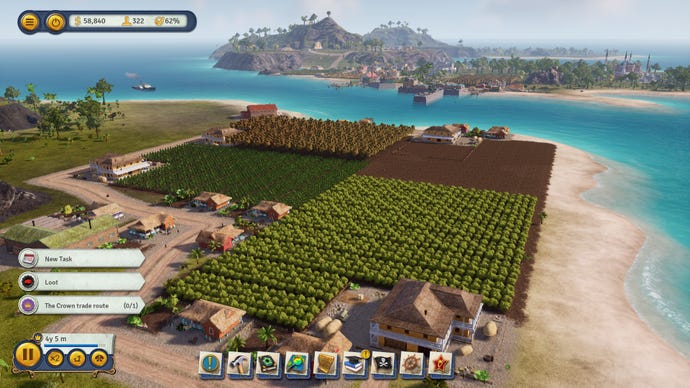
Tropico 6 doesn’t directly reward specialising each island, but it feels natural to segregate sectors to some degree, especially as farmlands degrade less when mixed crops overlap.
There’s definitely room to improve the formula even if you explicitly revisit the age of sail piracy theme, is what I’m getting at. At the risk of sounding cruel, I felt similarly about the last few Tropicos in general. For all their prettiness and advances, they still feel like the same thing again. I miss sending my grumbling pirates back onto their dingy ship to kidnap Spanish nobles for ransom, or menace an English cargo lane with cutlasses and stolen cannons. I miss hitting a rough spot not because of a random event but because of a dry spell, because my pirates ran afoul of a French brig. God help me, I miss the chance that I could stack too many chips into one ship and ruin everything. It wouldn’t even have to be pirates again, nor based on gambling everything for a chance at something more. But for all its flaws, I miss the Tropico that gambled.
And that’s why my most persistent feeling about the Tropico series is one of disappointment. To be clear, each individual game taken on its own merits is good enough that you won’t go wrong playing any of them. But I want theseriesto reach for the stars again. We’ve done the wacky Hispanophone dictators five times, and sure it’s been fun. But Presidente, I believe some of your people are calling for a spin-off next time.
