HomeReviewsTwelve Minutes
Twelve Minutes review: not quite enough timeSynchronise watches
Synchronise watches
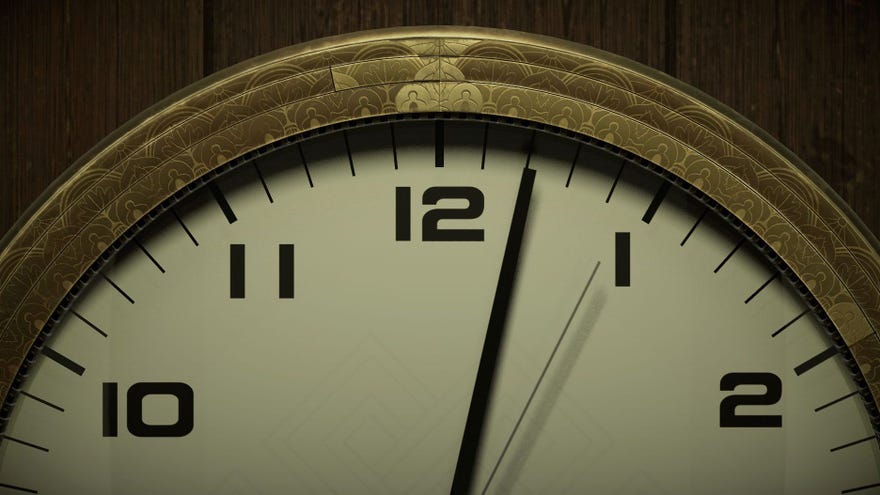
Our experience of time isn’t fixed. If you’re told you’ve got two minutes to put away the washing then it doesn’t feel like any time at all. If a stranger is staring at you on a train, however, unblinking and silent, then you realise that two minutes is, in fact, an eternity. 12 minutes would seem like a luxurious amount of time in many contexts, but when you have that amount of time to incapacitate a cop, untangle a murder and escape a time loop, all from your one-bedroom flat, it turns out it’s quite short.
Twelve Minutes Review | A Time Loop Game That’s Too Restrictive And Super WeirdWatch on YouTube
Twelve Minutes Review | A Time Loop Game That’s Too Restrictive And Super Weird

It’s hard to talk about most of Twelve Minutes without spoiling it, because it’s a very tight little piece of narrative clockwork. Everything happens at a set time and you have to work around that, so when Twelve Minutes is at its best, you feel like George Clooney in a very specific and weird kind of heist movie. Objective one is stop the unstoppable Willem, who may as well be the Terminator when you first encounter him. But once you figure out how to get him down, there’s more to do, and the plot will twist in front of you in ways you don’t expect. Like seriously, this game gets super weird about half way through, and I appreciated that about it.
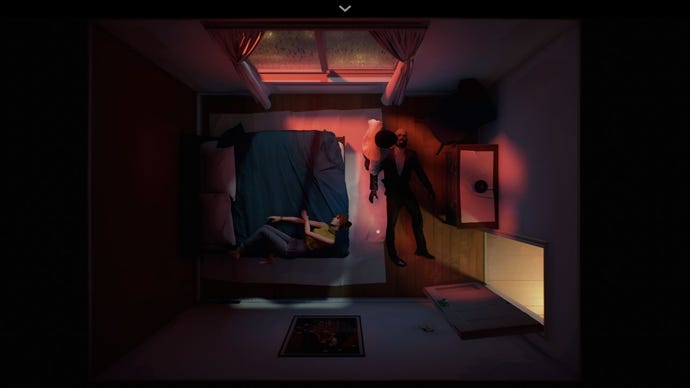
There’s a bunch of very good, clever detail besides the cast, with new things popping out at you as you explore and try to solve your odd problem. The top-down view makes you feel curiously voyeuristic, and works well with the pointy-clicky controls. After a while you realise Ridley’s incidental throwaways as you potter around - “We need to clean out that closet” or remarking on the unexpected thunder - are subtle nudges in the right direction. There are sound cues, like footsteps in the flat above, that you subconsciously note as time indicators. The writing accounts for you trying things in different ways or in a different order, so you’ll encounter different bits of dialogue or events as a reward for experimenting.
Kind of, yes. The problem - and it’s an unfortunately large one - is that Twelve Minutes doesn’t give you enough leeway to get things only a slightly wrong. If you screw up your run at a “correct” playthrough, even in what you think is a tiny way, that’s it. Start again, bozo. Make sure you collectbothmugs. Make sure you do action X out of sight of your wife. Don’t bother mentioning event Y too early, or you can’t do anything else until it happens. I went through my entire scripted process, and was chatting to Dafoe cop, when I realised I hadn’t collected something I needed from another room. Problem was, I couldn’t just go and get it; insta-fail. I’m sure some people will enjoy deliberately getting things wrong just to see what happens, but when you have a specific goal in mind and don’t quite hit it, watching the outcome of that run is less fun than you might expect.
You can use some things to solve puzzles in unexpected ways. Get that lateral thinking hat on.
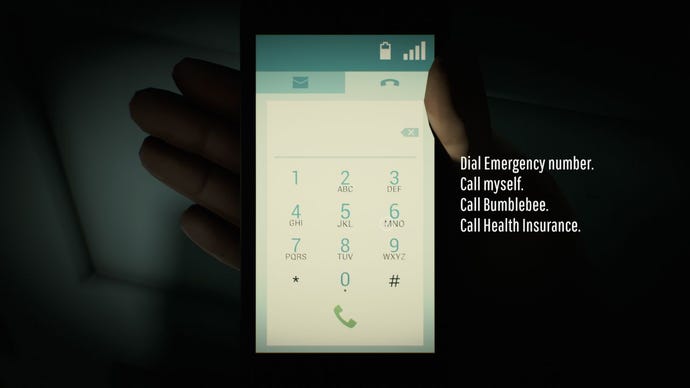
It’s tough because this game is, in many respects, layered and interesting. The nature of it, with its tiny cast, small space and short timespan, has the makings of a great locked room mystery, too. But I think there has to be a sweet spot in there somewhere that allows you time to be playful without entirely removing the threat of a time limit, and for me, Twelve Minutes juuuuust misses it. When Iinterviewed director Luis Antonioearlier in the year, he talked about how the game is really about empathy, and it’s true that in many situations in this game, the way to progress is to make the empathetic choice. At the same time, though, that lack of wiggle room makes it difficult to find the time and space to actuallybeempathic as well. There’s a moment where your McAvoy husband can ask his Ridley wife to dance, for instance, but ask her too late or after certain conversations and she’ll decline. The moment has passed, and often you don’t want to burn that extra time on later runs.
There are also some things in life that simply don’t inspire empathy in the first place, and nobody would have a go at you for that. One of them comes up in the game, too. I won’t spoil it, but if your mate brought it up down the pub, I’m quite confident you wouldn’t go, “Yeah, if I were in your shoes I think I’d do the same.” I actually think it’s an interesting story choice, especially because you really don’t expect it to go to that kind of place, but it also didn’t challenge my capacity for empathy in the slightest because my response was basically, “LOL, no m8”. The point where this comes up doesn’t actually mark the end of the game, but it did massively throw me out of it for the rest of the run time. I’m sure someone will write a think piece about how it all plays out and what it means. But buddy, it won’t be me.
