HomeReviewsTiny Tina’s Wonderlands
Tiny Tina’s Wonderlands review: neurotic humour and the precise gun magic you’d expectTone it down
Tone it down
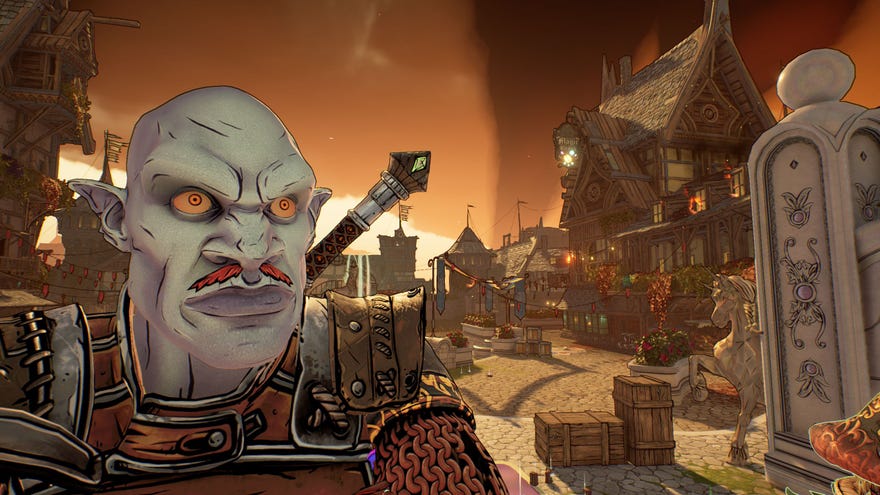
The comedy ofBorderlandsis like a high-recoil submachine gun. Hit and miss. In poorer moments, it falls into the trap of the sketch show, flogging a perfectly fine jokehorse to the point of putrefaction. In richer moments, it flips your expectations with a huge scene-changing gag that solicits a hearty giggle.Tiny Tina’s Wonderlandsis more mix for the bag. It’s a loots-be-shoot with a moreish loop urging you onward, boasting characterful art design and thick-lined scenery goading you to pause for yet another snap in photo mode. For Borderlikers, the gun compulsion and farty japes will be enough. It exists as a handsome world to roam through with pals, half-listening to dialogue while Paula chews toast and Jeremy complains about work. As that, Tinalands is fine. It is also 100% not for me.
The big hurdle first: I find Tiny Tina hard to stomach. She’s redeemable in the few scenes in which she softens, where it becomes clear she’s a lonely and over-excitable kid. But most of the time she’s a noxious slang abuser growling the word “babaaayyy” over and over. It takes patience to get past how baseline annoying she can be. She’s less a character and more a joke deliverer, and her relentlessly manic nature is emblematic of the script as a whole.
Which Character Class Should You Pick In Tiny Tina’s Wonderlands? (Beginner’s Guide)Watch on YouTube
Which Character Class Should You Pick In Tiny Tina’s Wonderlands? (Beginner’s Guide)

It is low brow, high tempo. In a world where every sentient being has no volume control, it’s the quieter gags that make me smile. At one point a barkeep shows you a kiosk where you can change your character’s appearance, “in case you need to change anything fundamental about your entire being,” she says. One character is described as a “half-bard”, a solid joke at the fantasy genre’s expense. Enemies blurt some great lines on death (the catch being you will hear them a hundred times). And once in a while there’s a punchline of dramatically stupid proportions, usually functioning as the climax of some long multi-tiered quest. The superior script-flips got me laughing. But there are a lot of duds and nose-whistlers in between.
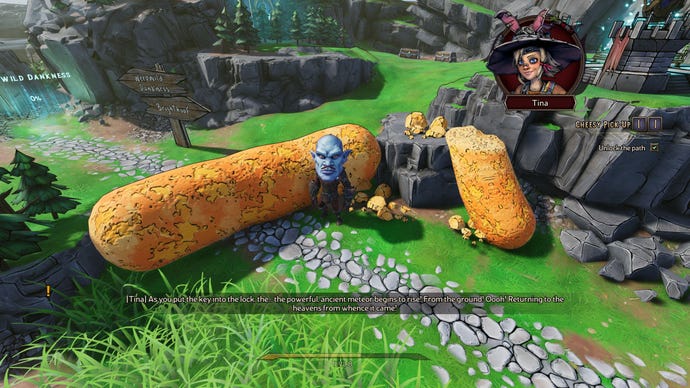
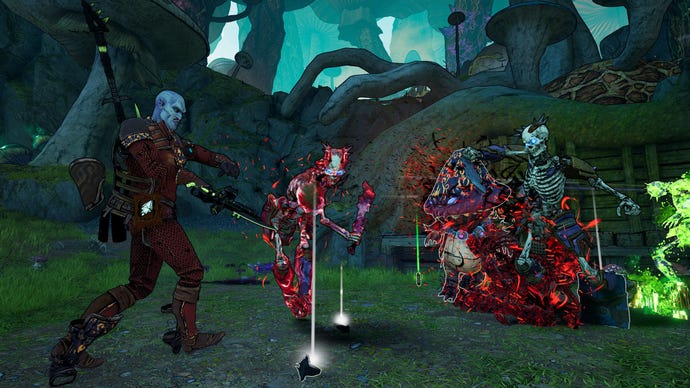
This is still Borderlands after all, no matter how many medieval cobblestones you stain with goblin blood. Outside of a cutesy overworld map, a few random battles, and its theme flip from outlandish sci-fi to child-dictated fantasy, the formula of shoot, loot and scoot has received subtle changes. Loot pinatas burst out of the heads of minibosses or pop out of spinning bonus dice in hidden alcoves. There’s a lot of guns on the ground - loot as litter - and much menu-hopping and inventory tinkering, meticulously marking all the junk to sell at vending machines later.
The 18 quintillion guns of Borderlands (or whatever the unfalsifiable number is up to now) prompts a lot of hasty gun-testing. The trade-off for finding a sniper rifle that flips upside down to become a megashotgun, or a gun that turns into a bat when you reload, is a kind of firearms fatigue. As I dipped in and out of inventory menus to keep up with all the bullethoses and spellblasts, I remembered that Borderlands can be overeager, even tiring. At the very least, it’s crying out for a “pick up as junk” option a laThe Division 2. And yet, for all the guns and powers available to you, none of it dramatically reinvigorates the way I play.
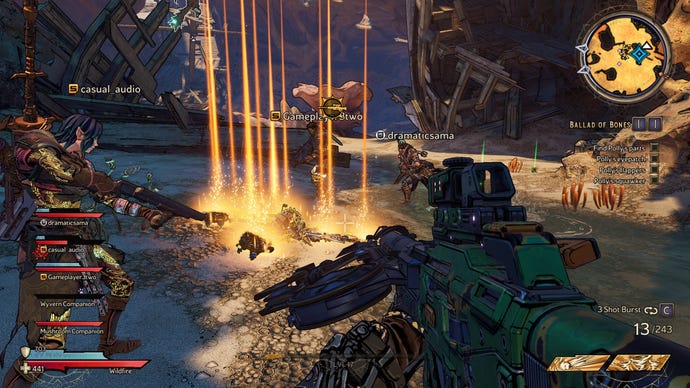
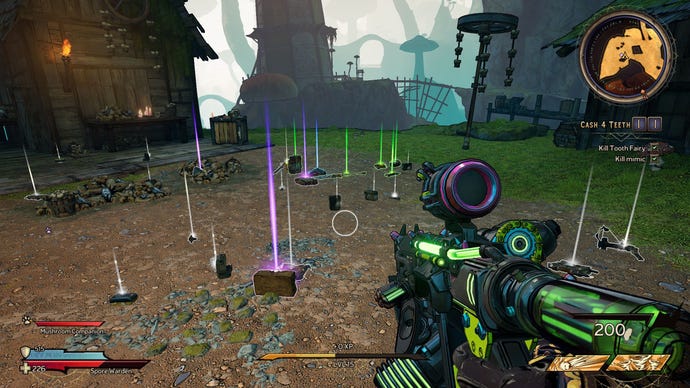
If you want to stay sane, you learn to eventually dismiss entire colours, the white items become obsolete, the green items become pointless to even look at, and so on, until only sparkling purple catches your eye, glittering gold. In game design at large, this is another of the increasingly popular psychological fish hooks that we can plainly see sinking into our skin if we stop to look. Borderlands is heuristics writ silly. I’m not above offering my frontal lobe to that kind of voluntary manipulation (this is a video game, I do it all the time). I only find Tiny Tina’s brand of it a little too transparent and overwrought.
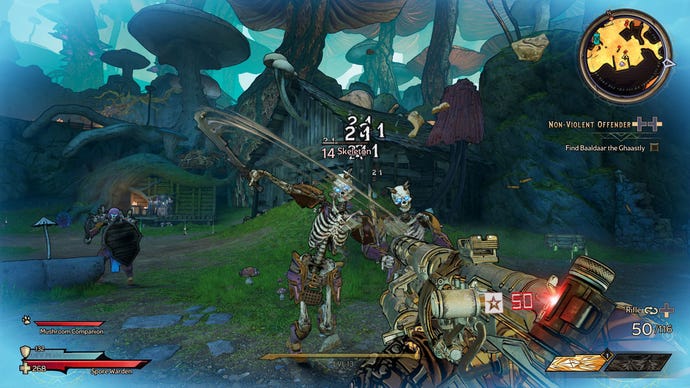
Enemies blorp into existence with equal magicality. That’s thematically justified (Tina summons bridges from thin air, why not bad guys) but I’ve never liked a tele-appearing baddie. It’s a quick and convenient way to keep shooting happening in a game that is essentially about cleaning up. But for my tastes these are further marks of transparency. Signals, intentionally meta or not, that you are grinding up the loot ladder in a video game. Far from losing myself for an evening of enjoyable junk food, I can feel myself sitting in the chair, my lip slowly getting chewed. As looter shooters go, I prefer the more manageable tooling-up of The Division series, and its readable and uncluttered encounters. Or the feeling of movement and blasting inDestiny 2, nigh-unsurpassable. Borderlands popularised the numberblood shooter but I’ve always leaned towards others for their less chaotic pace.
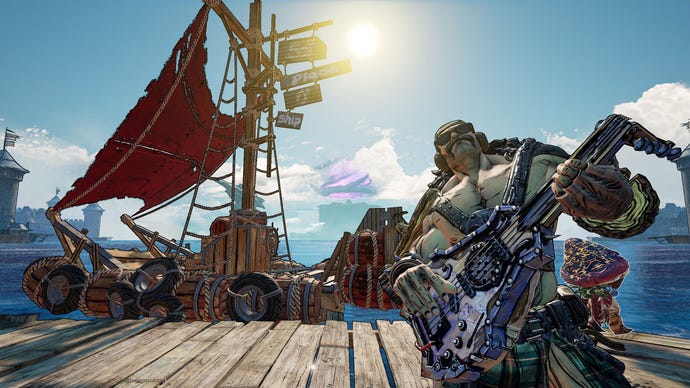
After about 20 hours of blasting I did find myself warming to it, not enough to see it to completion but enough to reach a point of understanding. This is a shooter to get stoned to, a game where you can put down the pad in the middle of a fight to answer the door as your mates dart around while you pay the Deliveroo man for pizza, because who even cares if you die? For example, there’s a mission with that half-bard (whose other half is “barbarian”) in which he takes you on a speedy skelly-killing rush through the forest, and I found myself letting go, underthinking it for once. Not because I enjoyed this character (he was SHOUTY CAPSLOCK BRO and kind of insufferable) but because I finally matched the game’s tempo.
This is not for the slow, the methodical, those desiring to investigate corners or play a shooter over many small sittings. No, this is for bingeing. Borderlands games are designed to be unthinking scrambles across the landscape, barely pausing to shoot something unless you care enough to see what it drops. In some quests, I could feel myself meeting the game on its own fractal-brained level.
But it doesn’t last. I’ve bounced off Borderlands in the past because it lacks some underlying motivation. These games often feel okay moment to moment. But at the end of a long session I usually wonder why I’ve just spent three hours upgrading from gun to gun as if they are new iPhones. The chase for the next bazooka feels more hollow the longer it goes on, and the scattershot humour only pushes me further away. The deeper issue is that comedy is about upending expectation. Yet Borderlands games are built to a rigid formula, often the butt of its own metafictional jokes.
So I won’t consider myself a late Borderlands convert, chalk up another bounce. Tinalands is that neurotic friend of a friend who worries they need to be manic-funny all the time, when really you’d rather they tone it down.
