HomeFeatures
The Rally Point: What the XXXX is going on?Sometimes we just want to Experiment and Exist, all right?
Sometimes we just want to Experiment and Exist, all right?

As I entered a second hour of trying to hammerDistant Worlds Universeinto a playable state on Windows 10, two thoughts occurred. The first is that I hope the upcomingDistant Worlds 2is the 4X I want. The second was more troubling: What do I want from a modern 4X game?
I might as well put this upfront: I don’t think I want the same thing most players do. Let me relate both why I admireDistant Worlds, and why I don’t think its sequel will do what I want.
The basic idea is as it always is. You start with a single settlement, in this case a planet, and must build scoutships and resource extracting facilities on your planet and other bodies within your star system. You’ll turn many of those resources into ships that can expand and protect your holdings, and often take them from AI sides doing the same. Meanwhile, more abstract resources gradually unlock new technology… you know the deal.
Top 12 Best Strategy Games to Play on PCWatch on YouTube
Top 12 Best Strategy Games to Play on PC
This means you’re searching for key resources, adapting ship designs based on what’s available, and building mining stations for specific purposes, not just eating everything in sight. It also means that a lot of your conflicts are over tangible resources tied to a specific place. And while in your typical 4X that really means, “I want the +2 bonus this square gives”, here it’s: “I need a source of nekros stone to manufacture better life support systems,” or, “I have to hold this fuelling station to keep my border fleets ready”.
I don’t mind if DW2 looks workmanlike, as long as ship captains can still become alcoholics after rough battles.
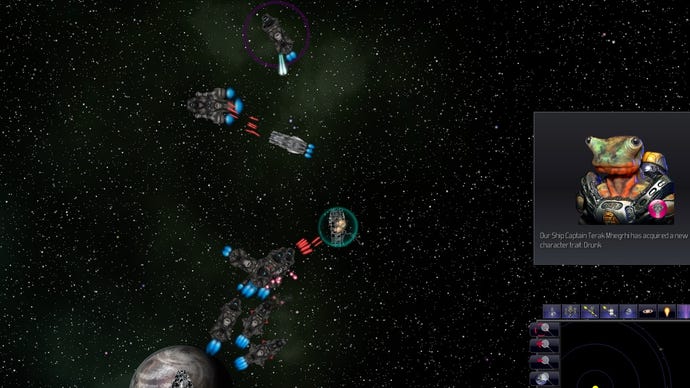
What all this means is that DWU is enormous and brilliant and very complicated and overwhelming even to an experienced player. To mitigate that, its other most fascinating idea is delegation. You can, at any time, set any aspect of running your empire to the AI. You can focus entirely on managing warfleets, or ship design and research, or hand over everything except espionage. It enables the kind of macromanagement thatMaster Of Orion3boldy attemptedbut failed at in 2003.
Distant Worlds’s ground battles were lacklustre but that’s genuinely fine. There’s such a thing as too much detail.

But as much as I appreciate Distant Worlds, and as hopeful as I am for its coming sequel, it still falls short for me in one key area: it’s a race. It’s still about being the most aggressive expansionist conqueror in the universe, while everyone else fights for the same title. One of the most memorable games I had of it was when I refused to develop warp technology, confining myself to a single system for hours, researching everything else and watching an endless stream of miners thrust their way between the local moons and asteroids, and traders visiting from worlds I’d only ever know as pinpricks in the sky and stories from abroad.
I suppose what I want is different Xs. Experiment, maybe, or exist. Or just for development and progress to mean what they do, not as manifest destiny but as an evolutionary process. Building an organism that fulfills a niche among others, not one that obliterates everything for the hell of it.
It’s a tall order, but not as outlandish as it may sound. As early as 1999 we hadSid Meier’s Alpha Centauri, whose factions were expressly designed to lean into certain roles and ideologies. More impressively, SMAC remains a rare example of a 4X in which rival AIs will actively help if you align politically and make the right overtures, instead of waiting for their moment to suddenly turn on you in envy or contempt. I played a memorable bout as the industry-heavy Hive, allied with the nerdly University, in which we became so friendly I was voluntarily stationing my troops in their cities to protect them, and they showered me with free technology unprompted.
Endless Legend’s clans can’t start wars, but they can definitely finish them.
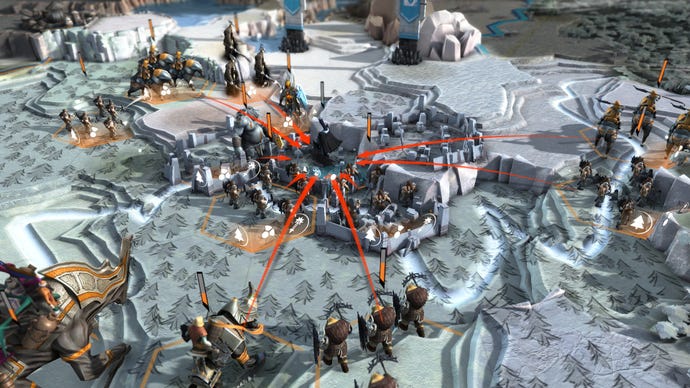
The same studio,Amplitude, have talked a big game about howHumankindwill approach history and nation-building differently, and Nate certainly thought it was doing some novel thingsin his preview. I’m hopeful that this might extend to pursuing goals and roles other than “crusher of all” or “acquirer of most Winner Points”. I’m not even primarily thinking politically here. Give me an80 Daysstrategy game, maybe.
Endless Legend remains absurdly gorgeous. It enhances the roleplaying a little, too.
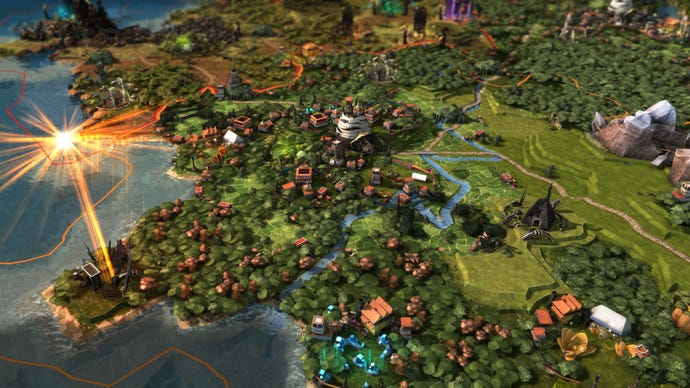
The 4X feels on the cusp of a comeback, and I’m hopeful that between the upcoming Humankind, Distant Worlds 2, and the CK2-inspiredAlliance of the Sacred Suns, the genre might get the revival that turn-based tactics did from Firaxis’s XCOM. There’s certainly an audience for more experimentation, and smaller devs in particular have been taking a stab at it. I’d even countShadow Empirehere; although it’s resolutely a wargame, its character management and sci-fi world generation and exploration marked it out with the kind of personality I’m asking for even if it played the conquest contest straight. I feel like between all these offbeat designs there’s potential for something revolutionary. But it still feels like the genre’s resurgence is yet to come, precisely because the definition has become too prescriptive. Either way, we ought to be in for a decisive 18 months.
