HomeFeaturesAge of Empires IV
The Rally Point: What do we want from a modern RTS?We must gather more thoughts!
We must gather more thoughts!
It’s been a few weeks since I came down on the side of basically likingAge Of Empires 4. Lukewarm praise, perhaps, but it seems to be doing well, and that makes me glad. We’ve needed an RTS revival for ages, right? And this one is good, if a bit safe.
For the last few weeks I’ve been puzzling over the lingering feeling that it could have been more ambitious.Whydo I think it could have pushed the trireme out further? Is it possible to make a modern RTS that captures the best of the classics without simply rehashing them? Has it even been done already and gone unrecognised?
Let’s start with clarification: yes, “Real-TimeStrategy” technically includes all manner of games, fromEuropa UniversalistoRimWorld. Game taxonomy is irrational and esoteric, let’s not get into it. Today we’re considering the descendants of Dune 2,Starcraft, andTotal Annihilation. Games where you peer down from your sky-throne and yell at little guys until they build a base that will produce more and better guys, who’ll go out and kill your rivals and blow up their base. Games where you need to mine more crystals and build more turrets, and, if I’m feeling sour, games that make me complain they’re really about clicking on a hundred things just to stay level.
Age of Empires IV - Developer Multiplayer MatchWatch on YouTube
Age of Empires IV - Developer Multiplayer Match

I’ve long accused publishers of abandoning the RTS in the 2000s, but I kind of abandoned it too. I might say it had become stagnant, with too many attempts to blindly copy Starcraft (or worse,Warcraft 3, which was the same but fiddly, generic, and self-serious), just as older efforts blindly copiedCommand & Conquer.
But is that even true? I look back today and see too many interesting games to easily list, but most of all I see that many developers were already trying to move the genre on, years before I started complaining that they weren’t.
I wish I’d played Rise Of Nations in its day. “Global Socialist Iroquois Confederacy” tells itself, honestly.

And yet, it runs into the same problems. I’ve lost more than one game I should have won handily because a war entered an attritional period and I got bored of pumping out and directing an endless line of troops. Though villagers are excellent at making themselves useful instead of waiting for orders, soldiers are prone to running off on their own, and battles still tend to come down to amassing a large enough blob while hoping you’ve hit the right numbers to unlock guns first.
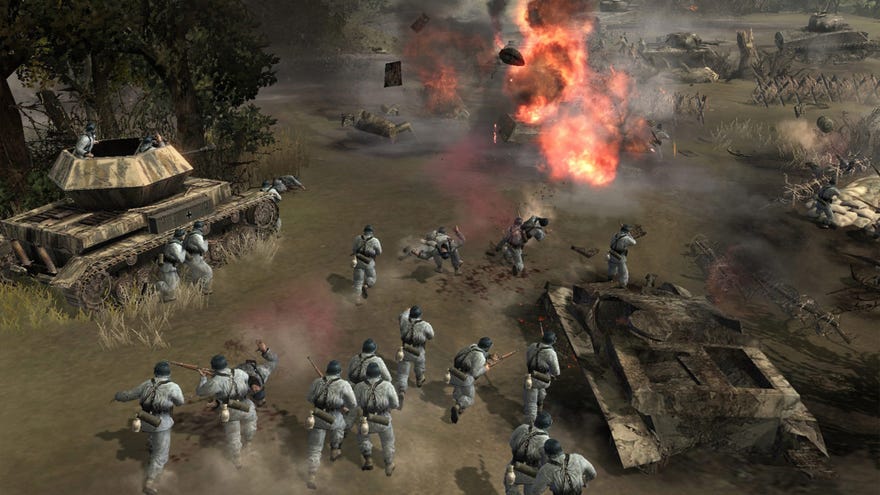
And yet… Men Of War isn’t really a Dunelike. Oh, it’s family, sure, but if you haven’t built the army yourself, you’re really playing something more like Panzer General. You’re a caretaker. Middle management. But I do think persistent units add a lot of depth. Enter, of course, Homeworld, which gave us fully 3D space combat and construction, and a terrific story that made preserving as many ships as possible narratively as well as strategically vital. Every ship holds some of the last of your people inHomeworld. Every death is one less pair of hands pushing back against total genocide. Everything you build will come with you for as long as you can protect it. It matters so much more when the story really puts you in that role.

But that, too, can’t be right for every RTS. Not only because it removes some strategies and play styles from the table (contrast, say, the kamikaze trucks of Command & Conquer Colon Generals, yet another game whose innovations went largely unappreciated), nor because it adds the anxiety of possible pyrrhic victories to every skirmish. But because, well, all these genre step-siblings kind of demonstrate that there isn’t the same audience there used to be.
I don’t mean nobody wants an old school design with modern trappings - consider the success of Starcraft 2, Deserts Of Kharak, or Age Of Empires 4 - but that they always had more than one audience. Some people just aren’t that bothered about narrative or campaign structure, or have no interest in single player at all. And for all my sour whinging about what competitive online games can be like, that’s totally valid. It’s only really an issue precisely because so many of the biggest successes covered so many bases. Starcraft is the perfect example, with its memorable and challenging (deargod, those last few Protoss levels in Brood War) single player campaign endearing it to me just as much as to those with a trillion hours spent perfecting their defiler micro. And then of course, there are the oft-overlooked players who enjoy both. It’s hard not to pity any game developer faced with a genre that demands they make an already complex game somehow satisfy everyone.
Even within one fanbase, there’s potential for a schism. Sometimes I think I want another Total Annihilation; massive, spectacular battles with a wide variety of robots, each with some use, and an economic game about automated, raw input and output streams rather than tracking a balance sheet. I’m definitely not alone either. Even discounting Supreme Commander, there areatleastthreefan remakes that prioritise different elements of a near 1:1 recreation. Even within that framework it’s hard to tell what’s needed.
Perhaps I owe devs an apology, because many of them have been trying to refresh the RTS for the whole time I’ve been insisting they should. Much of that has simply resulted in new subgenres as those multiple audiences were no longer stuck together playing different halves of a release. Hell, even the success of Total War was partly due to attack-move lovers sidestepping over to a genre emphasising positioning, formations, and scale instead of production and momentum. And I’m surely not the only Age Of Empires 4 player who felt the attractive town buildings deserved more than being ignored while the player zooms around from barracks to battle 25 times a second.
I’d hoped to use this column to come to conclusions about some things. I know how I feel about 4X games, and simultaneous turns, and why I dislike XCOM so much. But when it comes to the RTS, it’s taken me all this pondering to realise that for all my complaining, I don’t really know whatIwant, much less what anyone else does. I can’t say there’s not enough demand for retro-inspired designs, and I can’t say there aren’t enough new ideas when there are half a dozen more unmentioned experiments and spin offs in my notes (I’m sorry I still haven’t written about you,Achron. You’re just too incredible and also too bad to face replaying). But it still feels likesomethingis missing. Some missing link game everyone will one day point to as the bridge to a new generation of Tiberium bothering sims. So I am for once throwing myself at your mercy. What’s the future of the base-building RTS, readers? Has it been and gone? Is everyone playing it already and nobody’s told me because it’s funny?
Actually if it’s that last one, keep it up. I’m proud of you.
