HomeFeatures
The Rally Point: Ostriv, Workers & Resources, and where town builders ought to go nextCreative commons
Creative commons
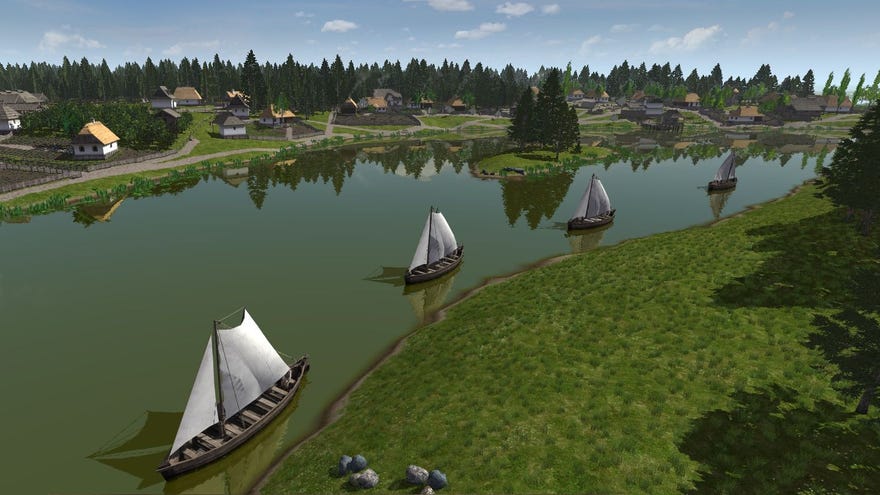
Let’s be clear about one thing: whatever else I say today doesn’t deny that building games are in a great state right now. Within just the last few years, we’ve not only had many releases, but an impressive proportion of well-designed, enjoyable games made with obvious care and enthusiasm. Things, in a word, are good. And yet I keep coming back toOstriv, andWorkers & Resources. Neither are out of early access yet. But they’ve had me contemplating the nature of a settlement, and the complex relationships between people, leaders, and the land itself, where so many of their peers feel like a dispassionate excercise in placing tokens.
Building games are doing well. But they could be doingmore.
Workers & Resources: Soviet Republic Update #9Watch on YouTube
Workers & Resources: Soviet Republic Update #9

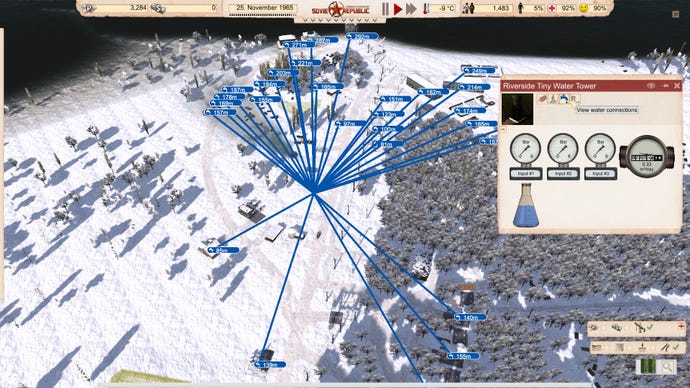
The solution is a distinctly socialist one. Unemployment is bad in workers and resources because too much of it means people get bored and frustrated. Like real people, they want to be doing things.Someunemployment is a good thing not because it lets you use the threat of destitution against the people, but because it’s a buffer of potential labour that helps you expand. And those people will be absolutely fine, because they automatically get free homes, food, clothes, and anything else within reach. It’s this that makes it such an interesting game conceptually. Its complex and rewarding logistics would be enough to distinguish it, but adding this fundamental philosophical shift changes the very nature of the game once you understand it.
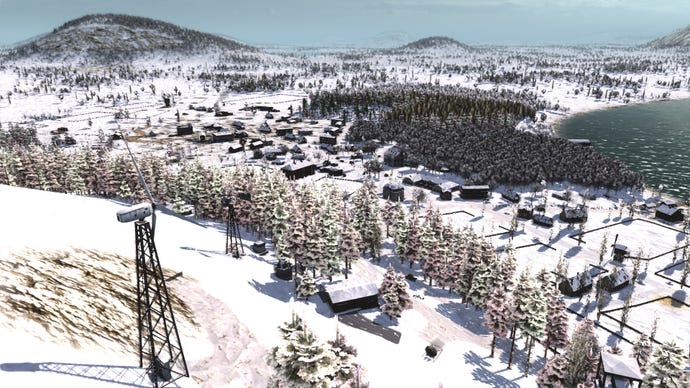
I’ll concede here that the most recent system added to the game was crime and justice, which includes the potential for prison labour. That obviously changes things more than a little. W&R isn’t about fully revolutionising our concept of simulated societies, but it’s not trying to be, nor does it need to in order to mark out a path that could lead us beyond “place more police stations”.
Obviously, this isn’t meant to be real. You have great power over these people’s lives, for a start, and the way workers live their lives is bizarre and esoteric enough to be a huge hurdle for learning how to play it effectively. They’re emphatically not real people, and in any case, 3DVision’s subtle touches of wry humour make it pretty clear they’re not presenting this as reality. It’s not a naive, contrarian reaction to American cultural dominance, but a form of ostalgie that expresses something it’s easy for us in the UK or Canada or France to overlook: the Soviet era isn’t an abstract idea to the people who live in its wake. Those were real events, real societies, real people and real buildings, and they’re an important part of the memory and culture of half a continent. Look no further than the heaps of mods that simply add a local shop some Czech person remembers from their childhood, or a whole range of Armenian buildings.
It’s this, not just the logistics, that make it a trailblazer for the genre. Workers & Resources isn’t harking back to a golden age, it’s just working from a shared history most of us in the West are unfamiliar with, and tend to dismiss as somehow separable from everything else that makes up a culture.
Of course there are other elements to city builders, and many excellent ones focus on different things entirely, but those elements are recognised as grounds for exploration already. There aren’t that many that re-evaluate the core concepts. Hell, many are still working off the incredibly specific ideological template that Sim City established 33 years ago.
Even Ostriv, my other fave, is a conventional villaging game in several regards. The 18th century Ukraine setting is a novel one, but describing how it works on paper doesn’t get across that it feels different. Some of this is down to the detail put intobuilding. As Alice O pointed out when playingFarthest Frontier, making every resource physically present changes how you relate to a village. Each hunk of meat, every bucket of water, every lump of coal must be physically carried about, and will even be visible on the ground if they drop it for some reason.
That tangibility invites you to pay closer attention to the details and the physical lives of the people. In Ostriv something as mundane as a house is a delight to sit and watch in real time over 20 minutes, in a way I haven’t enjoyed as much since the original Settlers. It’s a game best played slowly, relaxing, even simply watching everyone do what you’ve asked while you have a light lunch. In the middle of important things, you might pause to watch an old feller coming back from the market with a basket of 10 onions and some radishes. It makes you want to look out for them. In both W&R and Ostriv, making people happier is a natural goal, not merely something to stop complaints.
It’s the houses, however, that have marked Ostriv out as intriguing philosophically. Specifically, the gardens. Multiple generation households are the norm here, not the artificial suburban nuclear family that even some medieval themed village builders loosely default to. There is pressure to expand, as young people want to marry and move into homes of their own, but even newcomers will come into town on a cart with their parents and sometimes five or six children. They want homes, not “property”. People move in as little families, to a house of their choosing, and if you give them a garden they make it their own.
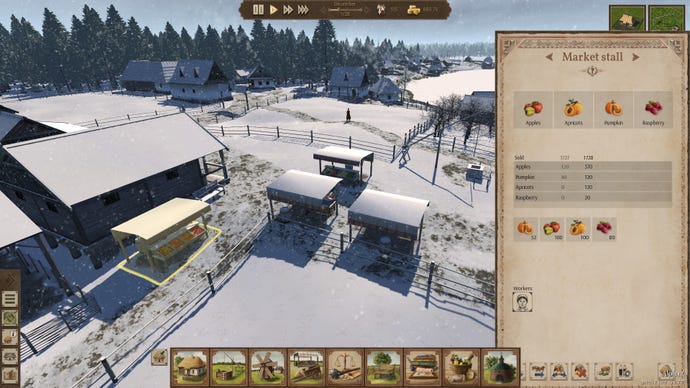
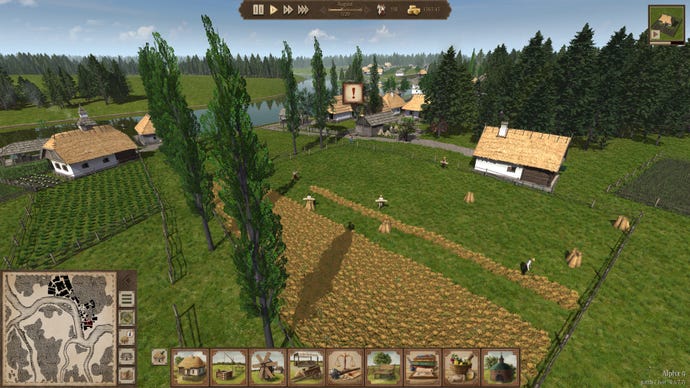
It sounds like such a small thing, but then I started to work with it and realise what it meant. When you place a house, you can stake out garden space around it. It’s granular in shape and size, and the house itself can be moved and rotated within it, making them all slightly different. And once people move in, they’ll plant food, splitting their space into multiple plots and growing whatever they want. There are a few dozen crops, and they’ll even rotate them every year, with no input from you. In fact, you can’t influence what they do at all, because it’stheirgarden. Occasionally, you might even find a family that’s built a line of beehives instead (and these will remain behind if they move out, because of course they would). Nor can you grow any of the crops they can, because the fields you designate are for something else.
You represent the leader, see. Your crops are the staples, the common things that work in large fields rather than small family plots. You provide the flour, the potatoes, the famous Ukrainian sunflower oil, hemp and cotton. In a typical builder, your people are morons and will angrily starve to death rather than do anything for themselves, so it’s on you to provide all the food. In Ostriv, people can and will largely feed themselves. Give them some market stalls though, and they’ll sell their excess, allowing you to make a little money reselling it to those without gardens (who, as recompense, pay no land tax), and those who grew different crops. Your potatoes and flour can go here too, but instead of being the only thing keeping your idiot people alive, the produce from public farms is mostly there for trade, for emergencies, and to feed animals, which in turn are a public good.
It’s a village that works to support itself. People get wages, and pay for food, goods, and land, but anyone without money can be immediately helped out from the public purse with a click, and there’s no reason not to. Nobody’s here to get rich, and although you probablycouldsqueeze them, everything about Ostriv’s design and tone says that the idea is to take care of everyone together, not to hoard money. That’s what a village is. It’s what any settlement should be. That’s the whole point of humans coming together in groups. And it demonstrates that this isn’t a question of “capitalism vs communism”, either - Ostriv has trade and commerce just like almost every human society. You can have those without also having everything neoliberalism shackles them to. We can have cities without skyscrapers, homes without miserable nuclear suburbs, wealth without poverty, production without exploitation. We just don’t yet.
There aren’t many games that will have me reading up to refresh my memories of theUlster Customor various historical land laws, but between W&R’s all-for-all command economy and Ostriv’s humble, co-operative freeholders, I’ve developed a severe thirst for new models of building game. For all their high standards, very few other games have felt like they’re really looking at what building a village or city is about. Land, people, and leadership are pillars of human society with rich and varied relationships, and the genre that ostensibly focuses on them could really explode if we really start thinking about what they mean.
I wasn’t kidding when I said standards are high right now. Even a partial list won’t cover all the good stuff out there these days. But it’s a start!
