HomeFeatures
The jolly co-operation of localising Dark Souls“‘Hollow’ was a big one.”
“‘Hollow’ was a big one.”
Image credit:FromSoftware
Image credit:FromSoftware
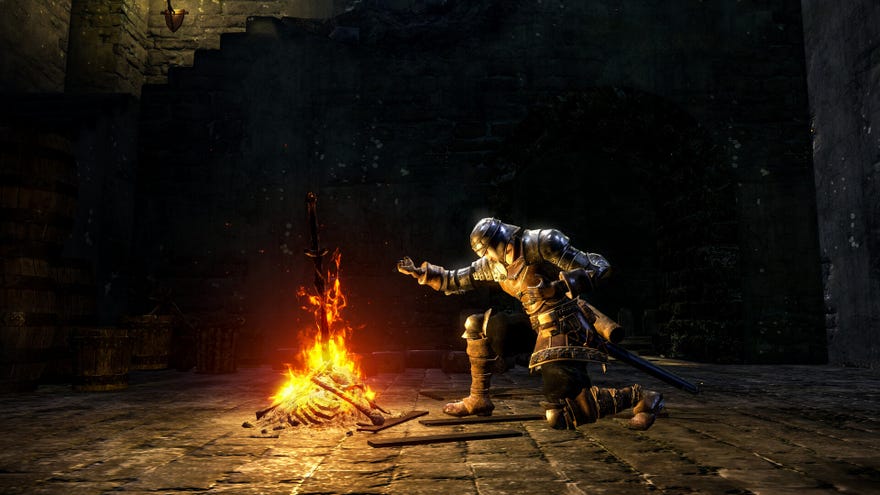
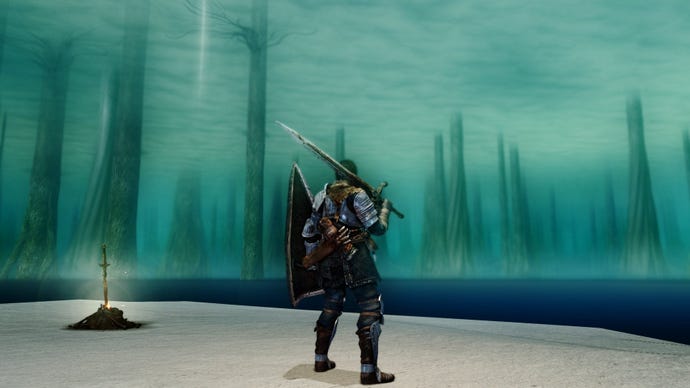
While series creator Hidetaki Miyazaki wrote the script for Dark Souls, the English version is full of terms and phrases Morris himself devised with Miyazaki’s input and oversight: a handful have made their way back into the original Japanese. It was Morris who named the archtrees, for instance, rather than just calling them “giant trees”, and he who suggested capitalising “Age of Ancients”, breaking the timeline off into formal periods. He also shortened the line “the world was yet to be defined” to “the world was unformed”. Tiny details - but in a FromSoftware game, tiny details have long afterlives. Dark Souls players still argue about the nature and purpose of archtrees, with some suggesting that they are portals to neighbouring realities.
ELDEN RING – Overview TrailerWatch on YouTube
ELDEN RING – Overview Trailer
As the intro continues, fog gives way to fire - “and with Fire came Disparity. Heat and cold, life and death, and of course, Light and Dark. Then from the Dark, they came, and found the Souls of Lords within the flame.” “Disparity” is among the Souls words that haunts me the most, possibly because it sounds a bit like “despair”. It’s one of Morris’s favourites, too, marking the division of that primordial totality into warring pieces.
Fascinatingly, this division is mirrored in the act of translation. “The Japanese language does not state plurality as regularly as English,” Morris notes, “and so the Souls of Lords may have been translated as the Soul of a Lord, but the appearance of Nito, the Witch of Izalith, Gwyn, and the pygmy tells us that several actors discovered multiple Souls of Lords.” Thus, translating Dark Souls from Japanese to English can be said to perform the game’s own creation myth. Moving between languages splits the one into many.
The mysterious archtrees |Image credit:Bandai Namco/FromSoftware
Translating anything from Japanese into English is a feat of “brain flexibility”, Morris says, because Japanese is such an unusual language. “Even English and Chinese are closer to each other than either is to Japanese.” For one thing, Japanese contains a lot of very specific wording “to signify your status relative to who you’re speaking to, a lot of ways to pay respect and to skirt around an issue or to soften something”. English has equivalents for this, but they’re much less poetic and subtle. “Japanese people very rarely say ‘I’ or ‘you’,” Morris says. “It’s almost always implied, but it just sounds rather blunt, to say ‘what do you want to do?’ or ‘do you want to eat this?’ It doesn’t sound cultured, or it sort of grates on the ears if you translate English like that literally.”
Questions of status are certainly important to Dark Souls' famously enigmatic NPCs, who range from princes and their courtiers to beggars and exiles. As a rogue Undead, recently escaped from asylum, the player is right at the bottom of the ladder; your sin, in the eyes of many bosses, is straying beyond your allotted station.
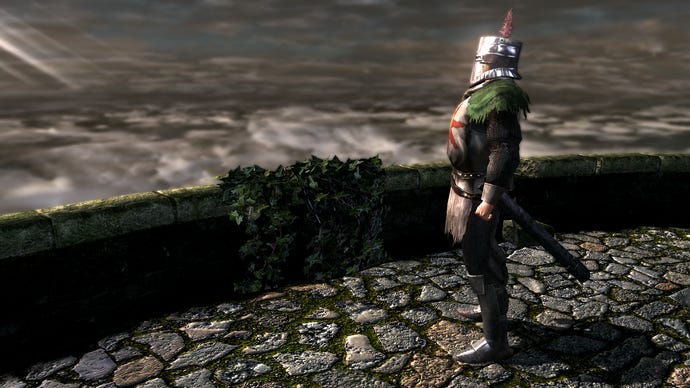
It makes for a pervasive grimness, but also, comedy. Take fan favourite Solaire of Astoria and his legendary catchphrase: “The sun is a wondrous body. Like a magnificent father! If only I could be so grossly incandescent!” The line is often cited as Souls writing at its most scintillating, which perhaps misses that it’s a bit a joke about upper-class mannerisms. “The main point here is that Solaire was clearly an earnest, ambitious man of faith with the purest of intentions, but he is also extremely socially awkward,” Morris says. “His language had to indicate both a proper, knightly pedigree but also an aloof disconnect - a tendency to get lost in high concepts and visions of grandiosity. Monty Python made light of some deeply serious people, and perhaps it is no coincidence that Solaire appears to have borrowed from their wardrobe.”
Solaire. Praise the sun. |Image credit:Bandai Namco/FromSoftware
Another, more functional difficulty was blindness to context. Frognation didn’t always know where in each game a line would occur, or even the exact identity of the person speaking. “Could this actually be a woman? We assumed it was a man. Could this place actually be right next door, in which case the language has to be slightly different? We thought it was far away. There’s lots of little things like that where it could be interpreted two or more ways.”
Miyazaki has incorporated some of Morris’s more adventurous English translations back into the Japanese wording. Very infrequently, Morris has also been able to contribute some novel phrasing of his own – an unusual word choice, or a blend of two words where there isn’t an exact equivalent in English, even the occasional piece of death dialogue, sugested if he’d built up enough familiarity with the character. “There are maybe 100 lines like that over the course of a couple of games.”
Morris is naturally wary of speaking on Miyazaki’s behalf about many of these choices, not least to avoid spoiling the lore. “I know that he wouldn’t want to define this or that - it’s kind of a rabbit hole, I suppose, to start that conversation after the game is done. He also appreciates and enjoys the fact that players have taken so much time and energy, defining it on their own terms and coming to their own conclusions.”
He’s prepared, however, to talk broadly about some of the trickier words, including a few that are fundamental to Souls mythology. “‘Hollow’ was a big one. You read the Japanese and then you read about what it means, and then there were so many possibilities, but very few that really seemed to work. It’s one of those cases you’re thinking about for days in the shower and on the train, trying to come up with something that will fit.”
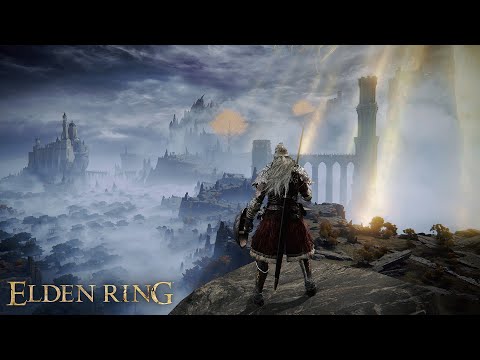
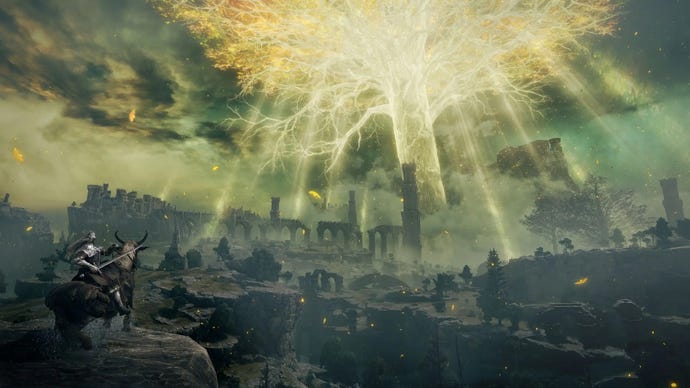
The world of upcoming Elden Ring, strange in its own, new way.
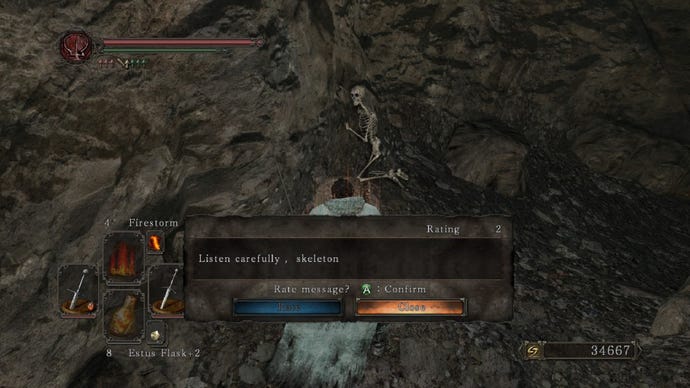
The messaging system’s words and phrases had to clear and straightforward, but without detracting from the setting and ambience. Morris has a few specific regrets, such as the phrase “I can’t take this…” - a popular choice outside boss chambers. “[The translation] is correct, but the language is too plain here. If I translated this today, I would rethink it to make it more world-appropriate while retaining the meaning.” That said, there are obvious advantages to letting players ruin the mood with silly or unsavoury graffiti. “I can’t tell you precisely what Miyazaki’s thinking was on that, but I feel like in this very bleak and desperate world, it’s one of the things that give you a little bit of hope.”
Morris’s latest gig is, of course,Elden Ring. He can’t discuss the game for fear of breaking NDA, but it clearly builds on many of the themes and tropes above: metaphysical divisions, oddball knights, ancient trees and a backstory that is no longer just indebted to western fantasy, but thrashed out in partnership with the author of Game Of Thrones. These are Miyazaki’s personal enthusiasms, but they have evolved through interaction with many others, from George R. R. Martin through kindred spirits like Morris to untold legions of players, coating these broken realms in bizarre or beautiful phrases.
