HomeFeatures
The first CRPG is a min-maxing hell you can - and should - breakLet me tell you how to play Ultima 0
Let me tell you how to play Ultima 0

Your most important resource in Akalabeth is food, as running out for even one turn will result in a game over. It doesn’t slowly drop your health, it doesn’t cause negative effects, it just kills you. Nowadays, survival mechanics so extreme only exist in mods and dedicated subgenres, but in early ’80s RPGs this used to be the norm, and Akalabeth is riddled with classic mechanics that have since been abandoned. Other examples include first-person dungeon exploration, an unbalanced class system, and a control scheme stuck between CRPG, dungeon crawler, and text adventure.

But there’s at least one element of Akalabeth that is still relevant today. Most of the game, from character creation to dungeon crawling, is incomprehensible without help, and looking for it on the internet always reveals an amount of knowledge that doesn’t feel appropriate for human minds. There' s no playing Akalabeth just like they did in 1979; it’s too late for that. What youcando is break it, as they did in 1979. After all, you just have to follow instructions. Which I’m going to explain to you now.
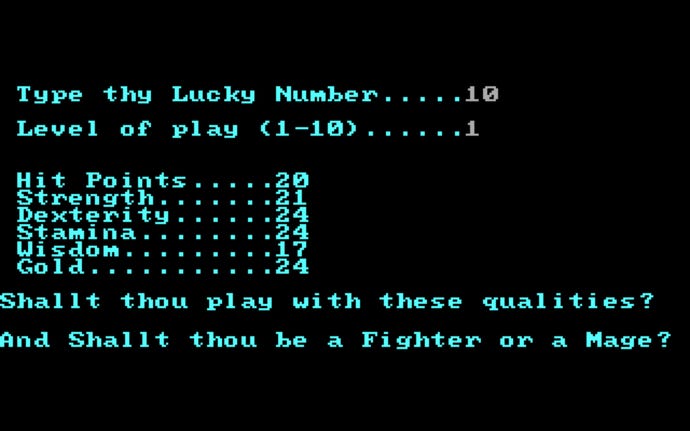
Your first Akalabeth playthrough will likely end with a hero who starved to death before finding a single dungeon. Travelling around the barren world map costs food, and it’s not cheap either. This uniquely dangerous risk of starvation will likely be the end of many heroes after your first, even as you start buying all the food in the shop. The solution to the puzzle is to stick with the same favourite number - which, it turns out, is responsible for generating the game’s map. This allows you to use the layout of the overworld to your advantage, minimizing movements between the shop, the dungeon and the quest giver’s hut.
My, what an easy-to-read world map

The last decision you’ll make is the most important, so much so that it isn’t a choice at all. There are two available classes, and while the warrior gets marginally better weapons, the mage is the only one who can use magic amulets with ease. Magic in the world of Akalabeth works in weird and convoluted ways. Amulets can move users up and down dungeon levels without using one of the hidden ladders. They can even kill an enemy instantly. But even that’s nothing compared to what the transformation spell can do.

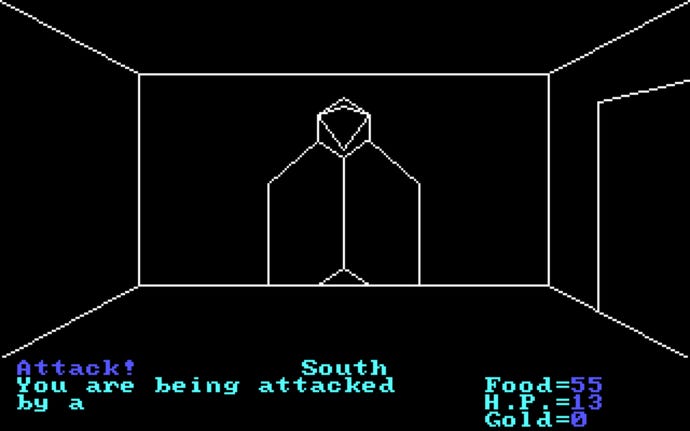
Some players might think that beating Akalabeth this way on your first through is cheating. It’s not necessarily a wrong approach to the game, but it’s not how the game is supposed to be played either. But is that so different from basing yourBaldur’s Gate 3character on someone else’s build? From following the advice of experienced players for your next World Of Warcraft character? RPGs are often based on complex systems that are rarely taught before the start of the game, and Akalabeth is no exception. Reconciling with those systems, from character creation to the best combat strategies, is part of the appeal of the genre. Some players study the manual, some go through trial and error, and others like using a guide. This goes for Akalabeth as much as for any modern game.
In Baldur’s Gate 3, which is based on the 5th edition of Dungeons & Dragons, the challenge comes from the complexity of its tabletop counterpart, and while the mechanics of Akalabeth are simple, the explanation itself is what’s much lacking. The solution that unites them is to imitate the strategies of other players, min-maxing your way through the game and skipping the intricacy of its system.
The most familiar interaction we can have with a game so different from our modern standards is to break it. We might not understand how or why we’re doing it, but that’s fine. Contrived and unintended though it may be, min-maxing your way through Akalabeth as a hench lizard wizard is how to play it like it was played back in the 70s.
