HomeReviewsThe Finals
The Finals review: the most exciting new multiplayer shooter in yearsI hope it blows up
I hope it blows up
Image credit:RPS/Embark Studios
Image credit:RPS/Embark Studios
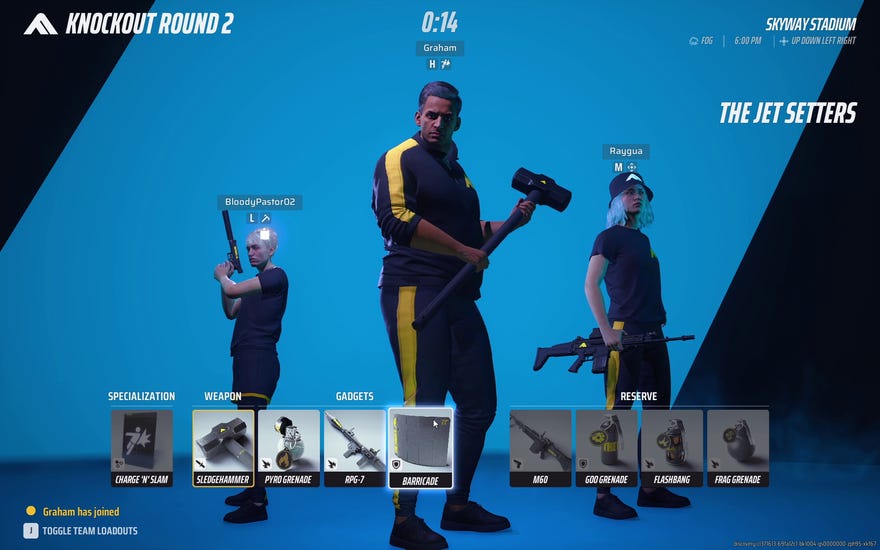
The Finals' real master stroke, I think, is that it has found a design that lets it be generous with power - even while containing an unlock system, a battle pass, and a not insignificant skill floor. Those things aren’t an obstacle between you and the childish joy of smashing the world to bits.
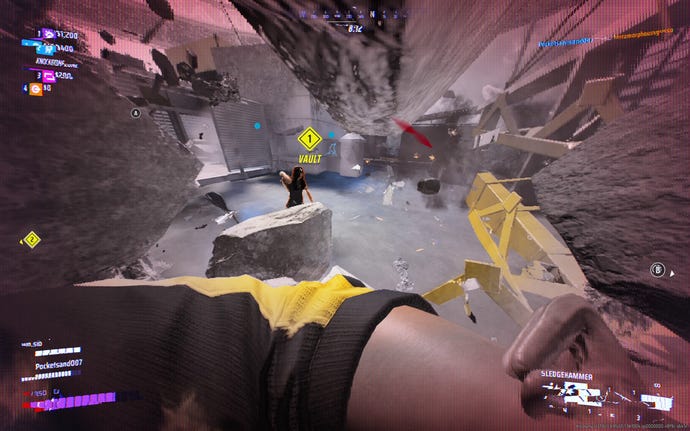
Nearly everything in one of The Finals’ levels is destructible and every player has easy access to methods of causing that destruction. Players choose from light, medium or heavy character classes, who each have access to a different (but overlapping) selection of weapons and gadgets. Pick the light class and you’ll start with breaching charges, which can be placed and later detonated to take out walls, floors or ceilings. Pick the heavy class and you can use a sledgehammer to pound through any surface, achieve the same affect with a rocket launcher, or trigger a special ability to Juggernaut your way through everything in your path.
There is huge strategic potential in this destruction, which I’ll get to, but there’s no wrong moment to blow something up. Some men just want to watch the world collapse in physically simulated pieces, and I am one such man. Every time a building receives enough damage for the whole thing to collapse, I’m delighted regardless of context.
This kind of level deformation could easily destabilise an entire game design, I think, as chokepoints vanish and sight lines extend. The Finals keeps a tight grip on players thanks to its Quick Cash/Cashout mode, in which teams of three race to collect a vault or vaults and deposit them at a cashout station. Vault cracking takes a short while, and depositing takes much longer, during which rival teams are able to ‘steal’ the process. Whoever has control of the cashout at the moment it finishes receives the $10,000 award, with $20,000 or more needed to win the match.
Bank It
These cash vaults provide a focus point for every player in a match, turning those cashing out into defenders and everyone else into an attacker. The freeform destruction serves a purpose for both parties. A defender might break some ziplines to make reaching the cashout harder, then blow up some of the attacker’s cover. Attackers, meanwhile, can technically approach from any angle. It’s common to see the floor blown out from underneath a cashout machine, for example, causing it to tumble into a less entrenched position.
In my experience, a cashout will change hands at least once during the couple of minutes it takes to complete, and often several times. A team that loses a cashout and is wiped will often have enough time to respawn and rush back to reclaim their prize. The result is that every victory is hard-fought and every match is littered with dramatic peaks - reversals, rooftop chases, clutch shootouts, and last-second steals.
The heavy class can unlock a flamethrower which is great for forcing enemies to flee. |Image credit:RPS/Embark Studios
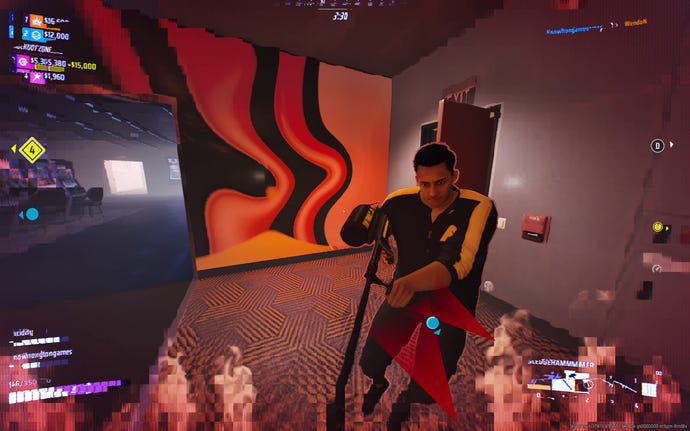
At this stage, it’s maybe worth pointing out that The Finals, despite its recognisably human characters, realistic urban environments, and arsenal of pistols, shotguns and AK47-alikes, takes place within a virtual reality simulation. This allows the video game to be video gamey where it would be fun to do so.
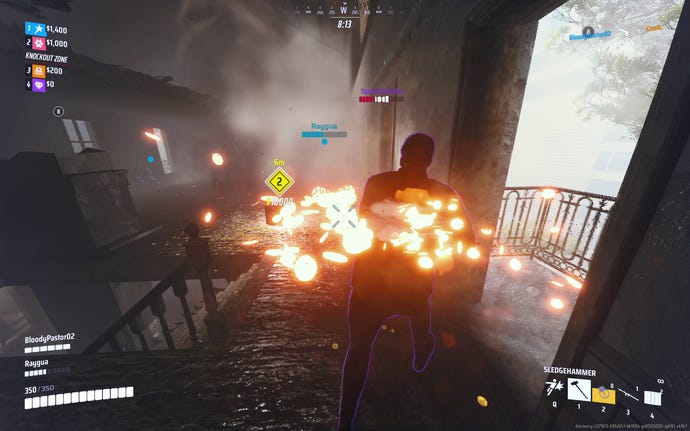
Enemies turn into gold coins as they take damage and die. |Image credit:RPS/Embark Studios
Matchmaking
Tournament mode strings several rounds together, assuming you win and progress (towards, eventually, the finals - geddit?), while Quick Match enters you into a standalone match. There is an issue with how often that’s a match in-progress however, particularly given you’re obviously filling a gap on a team that previously had less than a full complement of players. It’s often a recipe to be dropped onto the inevitably losing team in a match with just a couple of minutes to go. I can still have fun in those matches - see the rest of the review for why - but it’s still less gratifying than being involved from minute one.
So that’s my central thesis. The Finals sets you loose with a set of verbs so fundamentally fun that it feels, at times, like a toy box, and despite the technological flourish of a destructible world, like a throwback to a different era of multiplayer shooters. I don’t want to lean too heavily into the idea that The Finals works for the ways in which it resists more modern design ideas, however, because the reality is that it is a free-to-play game, and it does have unlocks and a battle pass and paid cosmetics. And I think those things work, too.
The unlock system, meanwhile, relies on an in-game currency called VRs, earned through playing matches. Unlock progression shares more withTeam Fortress 2than it does Call Of Duty, however. You’re not going to be working your way through 25 different shotguns until you attain the clear best. Instead, each class has just one shotgun available, and new weapons and gadgets instead enable entirely new methods of play.
The Light class, for example, starts with a semi-automatic machine gun and the grappling hook as a special ability (plus a collection of grenades and the breach charge). You’re fast, a hit-and-run pest for enemies at close range and useful for running cash boxes across rooftops, but vulnerable due to low health as compared to the other classes.
Being able to run across the map without ever touching the ground is a fantasy all on its own. |Image credit:RPS/Embark Studios
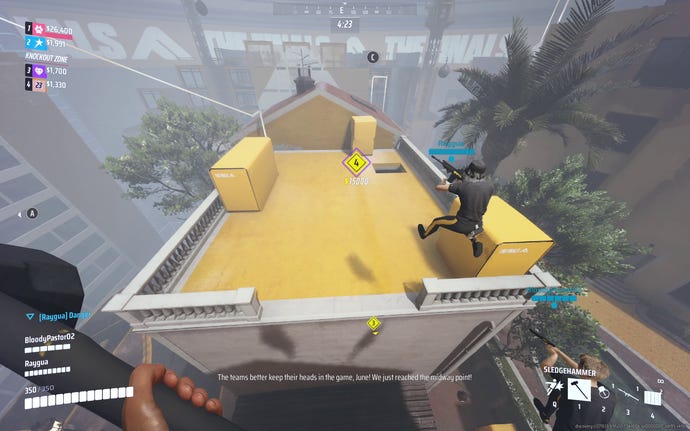
The first weapon I unlocked was a sniper rifle. It paired well with the grappling hook, letting me reach vantage points where I could pick at enemies and then flee to a new position when they started firing back or destroyed the rooftop I was standing on.
Later I unlocked invisibility, which takes the place of the grappling hook, and the dagger, which becomes your primary weapon. You’re entirely invisible when stationary, slightly visible when moving, and fully uncloaked the moment you attack - but if you score a backstab with the dagger’s alternate attack, it does huge damage. With these unlocks combined, my entire strategy shifted to one where I would flank enemies to get behind them, or hide invisibly in corners when defending cashouts and only reveal myself when an enemy went for the steal.
To spell it out: that’s the Light class shifting from Team Fortress 2’s Scout, to Sniper, to Spy with just a handful of unlocks. Valve’s shooter successfully captured the most common multiplayer FPS archetypes, and through its unlocked tools The Finals does too, letting you similarly transform Mediums and Heavies into analogies for Medics, Soldiers, Demomen and more.
The heavy’s charge ability is great for surprising enemies behind cover. |Image credit:RPS/Embark Studios
It’s worth noting that all of this could change. Right now, The Finals is new enough that its meta hasn’t settled, and you’ll see all character builds and team constructions whether you’re playing a quick match or a more serious tournament. I can imagine that players might discover in the coming weeks and months that a Heavy must always carry a Dome shield, a Medium always a turret, and so on, which might make it suddenly frustrating for new players running behind the progression curve, but I’m hopeful that the starting set of items are useful enough and the dispensing of credits rapid enough that it won’t prove a serious issue. (And for now, I’m inclined to ignore players convinced that this or that ability is overpowered and in urgent need of being nerfed.)
Those are worries for another day. For now, The Finals is the most exciting multiplayer shooter launch I’ve played in years. It’s a clever blend of old-fashioned generosity and new-fangled technology, and it’s exciting enough at its core to offer delight and drama no matter your unlocks or skill level. I’m going to play it right now.
