HomeReviewsThe Fertile Crescent
The Fertile Crescent review (early access): a bite-sized chunk of phenomenal RTS designAge of pomegranates
Age of pomegranates
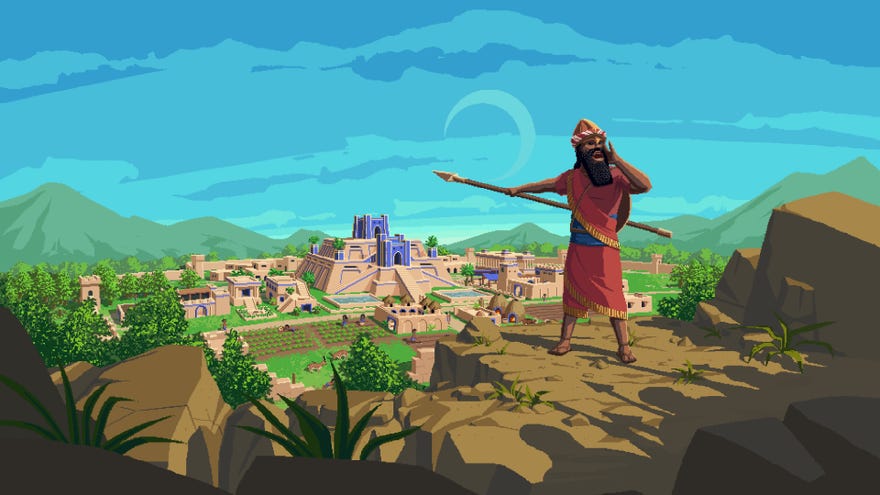
Now, since Age of Empires 2 is one of my favourite games of all time, you might think I’m biased here. And of course I am, to some extent, because that’s just how liking things works. But while I’ll admit that a degree of indirect nostalgia helped ease me into TFC, the game had started impressing me in its own right around a minute after I left the title screen.
TFC: The Fertile Crescent | Early Access Launch TrailerWatch on YouTube
TFC: The Fertile Crescent | Early Access Launch Trailer

Here is a rough transcription of my thought process, from the moment I started my first game, up until the penny dropping: Oh, right: pixels. Fair enough. Little mesopotamians; hello mates. Can you… yes, you can build a town centre. Done. Right, those things are basically shouting at me in the visual language of fruit trees, so let’s send you there to get food, while you couple of lads can chop wood. Oop, no population space… let’s stick a house there. Hello, scout: can I right click you around the mini-map? Yes… hmm. This is a lot like Age of Empires, isn’t it? Which reminds me… shit! I’ve not queued up any new villagers yet! Where’s the button? Why isn’t it here? Where’s… plopping sound… Good lord, they’regeniuses.
Here’s a bit of competitive AoE2 wisdom in a nutshell, to contextualise. The more villagers you have, the more resources you can gather, and the more chance you have of winning. So for every second that your town centre is ‘idle’ (not producing villagers), while your enemy’s town centre is not, you are falling behind. To play at any kind of competitive standard, you pretty much have to ensure your starting town centre has zero idle time - which means learning to compulsively interrupt whatever else you’re doing, every few seconds throughout the entire first half of the game, in order to select it and manually queue villagers. It is absolutely maddening, but you soon learn to gloomily accept that this is simply the way things must be.
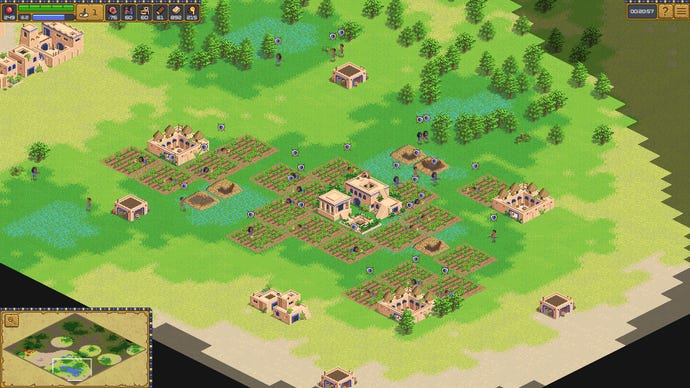
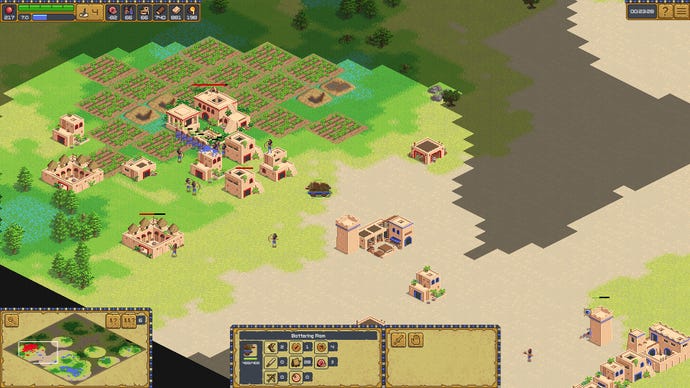
Thankfully, it also gives you plenty of strategic decisions to make, with the brainspace it has freed up for you. Largely these decisions are about resource management, and it’s here that the game departs very significantly from the AoE playbook. The clue, I suppose, is in the name of the game. The Fertile Crescent is, overwhelmingly, about the production and consumption of food. Usually, the historical theming behind a strategy game is precisely that: theming. Atmospheric set-dressing, from which the mechanics of the actual game are completely divorced. But with a stroke of real elegance, TFC manages to run a ruleset that thoughtfully reflects the history it’s playing with.
To be horrifically glib about it, the rise of human civilisation was about the development of food surpluses, tied in with the adoption of settled agriculture. The more spare food there is, the more time people have to think of more efficient ways to produce food, and the bigger the food surpluses become. Eventually, with enough spare food, you can afford to feed professional soldiers, priests, bellends with fancy hats, Ea-nasirs, etc, etc.
TFC models this in a way that sounds extremely simple on paper. The greater your food surplus, the quicker you produce both villagers and research (there are other bonuses too, I think). But the more villagers you have, the more food is needed. Furthermore, if you want a military, you have to first divert villagers to the harvesting of non-edible resources, and then hire blokes who will guzzle pomegranates without ever lifting a finger to farm the things. And if you want a research rate capable of reaching bronze weapons before your enemy, you have to hire priests. Priests just sit there having ideas, while scarfing wheat non-stop like Jabba the Hutt, and genuinely gave me a vivid new perspective on the dawn of human urbanisation.
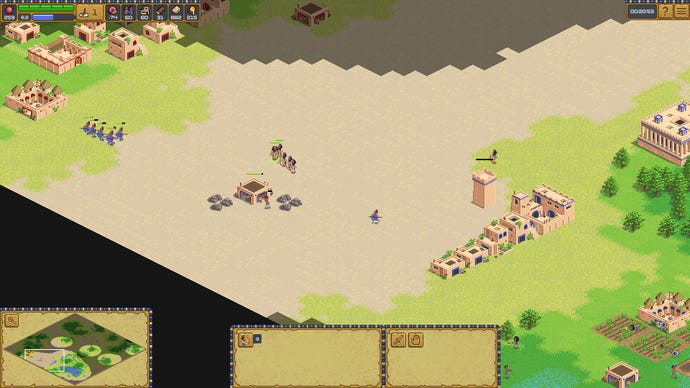
As I said at the top, you definitely shouldn’t expect a vast amount of feature breadth from TFC. There’s only one map type, for example, and only one civilisation to play as so far, plus a small enough roster of buildings, units and techs that you can see it all in one half-hour game. Crucially though, thanks to the graceful dilemmas baked into the game’s resource modeling, there are an impressive number of different, but equally viable, strategic approaches you can take to it all.
At present, there are two single player modes: a horde mode where your growing settlement has to fend off timed waves of bastards coming from the map’s edges, and a skirmish mode where you duel a single AI opponent situated on the map with you. Currently the skirmish AI is solid, at least while you’re learning the game, although I think I’m starting to see seams in its behaviour which I’ll be able to pick apart once I’m more practiced. Luckily, the horde AI is a cheating bastard which I struggle to defeat even on the easier difficulty settings, so there’s challenge there for the foreseeable future.
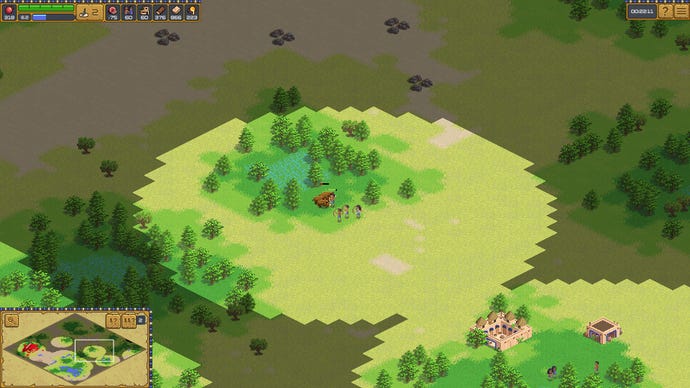
Being completely honest, even with the fun still to be had in experimenting with different growth curves and the like, I can’t see myself staying engaged with the current single player content for more than another dozen games or so, at least until more content is added. Multiplayer, however, is a different story. The fact that TFC offers multiple, wildly different ways of building up a functional military settlement could well be the foundation of a thrilling multiplayer situation: one where players are having to make creative use of scouts and their own intuition to work out what tack their opponent is taking, before coming up with a plan to counter it.
There’s a certain amount of this big-picture strategy stuff going on in multiplayer AoE2, which is why I grew to love it. But then, there’s also quite a lot of “who can follow a rigid build order fastest, therefore spaffing fifteen knights into the enemy town centre and instantly winning”, which is why I eventually grew to… not love it. Watching any kind of a meta develop for TFC is going to be an interesting business.
I just hope things get that far. Because while multiplayer offers a lot of potential for TFC even this early in its early access run, and functions very smoothly in terms of matchmaking and connection, finding an actual opponent is a vanishingly rare event. There are, sadly, very few people on the servers so far, and I’m pretty sure the lion’s share of multiplayer games happening right now are being arranged on Wield’s Discord server. Still, that will hopefully all change if this game gets even half the attention it deserves. On which note, I urge you to grab yourself a pomegranate, sell someone a load of high quality copper, and have a go.
