HomeFeaturesNexus 5X
Stellaris Nexus shrinks and speeds up Stellaris to mostly exhilarating effectThe fourth X is for aXeleration, actually
The fourth X is for aXeleration, actually
Image credit:Paradox Interactive
Image credit:Paradox Interactive
Image credit:Paradox Interactive
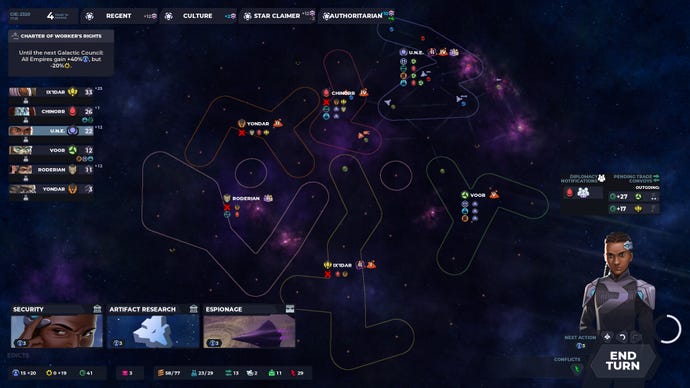
This is all coming out in a rush. But hey, that’s Stellaris Nexus - a 4X game on fast-forward, which takes the structure, narrative stylings and key mechanics of older sisterStellarisand tries to cram it all into the average lunchbreak. Is it a success? I’m a little undecided, but I’m enjoying how the game’s act of shrinkification throws the genre’s core workings into sharper relief.
Image credit:Paradox Interactive
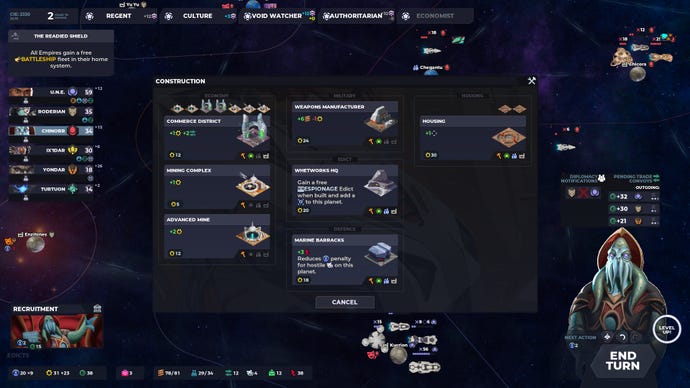
If the turn time limit is the blunter means of accelerating the 4Xing, the clever bit, for me, is how the game streamlines what happens inside each turn. It borrows tricks from cardgames while placing the emphasis on one particular resource, Support, which functions a bit like Action Points in turn-based CRPGs. Broader actions such as researching a tech, sending out a scoutship, or building a planetary structure take the form of cards, drawn semi-randomly each turn. The unpredictability can be irritating, of course, but the benefit is that you spend less time mulling your approach, because the options are constrained in advance - though there’s a Politics card you can discard to draw another of your choosing.
Each of these broad actions cost Support points, and each successive action costs more, which imposes a soft cap on what you can do in each turn, and gets you into the habit of pinning down priorities. You earn Support points each turn, but you’ll earn fewer of them for every planet you conquer, which convincingly models the bureaucratic unwieldiness of larger empires, while encouraging you to expand warily, even if the other players aren’t putting up much resistance.
Beyond Support, the game offers up a familiar spread of 4X resources, including Research points earned from universities and the like, Materials from factories for building and spaceship construction, and Credits that serve as a wildcard, letting you buy stuff rather than spending Materials or Support.
Image credit:Paradox Interactive
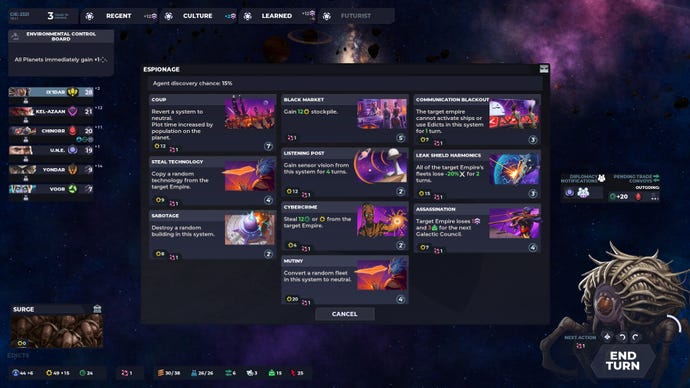
Image credit:Paradox Interactive
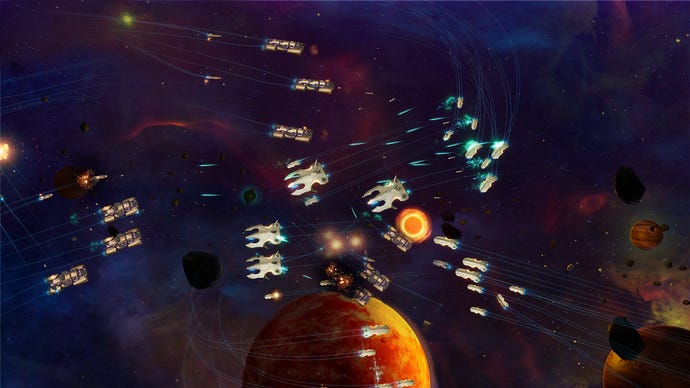
Lastly, and for all the relative snappiness of the presentation, the claim that you can play a round of Nexus in under an hour hinges on every player having a solid, existing grasp of the rules. The UI does a reasonable job of digesting everything - you can zoom out from planets to view them as a cluster of icons and building slots - but you’ll definitely need to play a few rounds before the broad strokes become second nature. Jump into a random online game without chugging through the tutorials, and you’re likely to feel overwhelmed. I, for instance, still have no idea what the Ix’Idar do with their precious pheromones, though I only have my brainless expansionist tendencies to blame for that.
As pick-up-and-play friendly as the game’s visual language can be, there’s a fair wodge of sci-fi terminology to chew through in descriptions for technologies and so forth. At its most overwrought, it feels like Nexus would work better if it weren’t a Stellaris game, and were able to communicate itself in a more abstract, less worldbuildy way. The parent franchise brings with it an expectation of lore that trips the game up, and threatens to mire it between genres. Still, the proof there will very much be in the 4X pudding, and I’m looking forward to my next plateful.
