HomeNews
Starfield’s “are planets planets” debate recalls the amazingly weird cosmology of Elder ScrollsPlane or planet?
Plane or planet?
Image credit:brandokid25 / Bethesda
Image credit:brandokid25 / Bethesda
Here, let me shrug on my stolen boffin’s labcoat and try to give you an overview. Starfield seems to portray space according to a classical Newtonian understanding of astrophysics, give or take a few dollops of outright wizardry, with neatly distinguished celestial bodies forming solar systems that resemble glowing beads on wire hoops. For all Bethesda’s talk of “punking” NASA, it’s quite an everyday and well-travelled representation of outer space that already risks being conflated with a billion competing simulators on Steam (a quick shout-out here for one of my personal favourites, the submarine-adjacentObjects in Space).
Khajiit has dubious astrophysics trivia to share, if you have coin. |Image credit:Zenimax
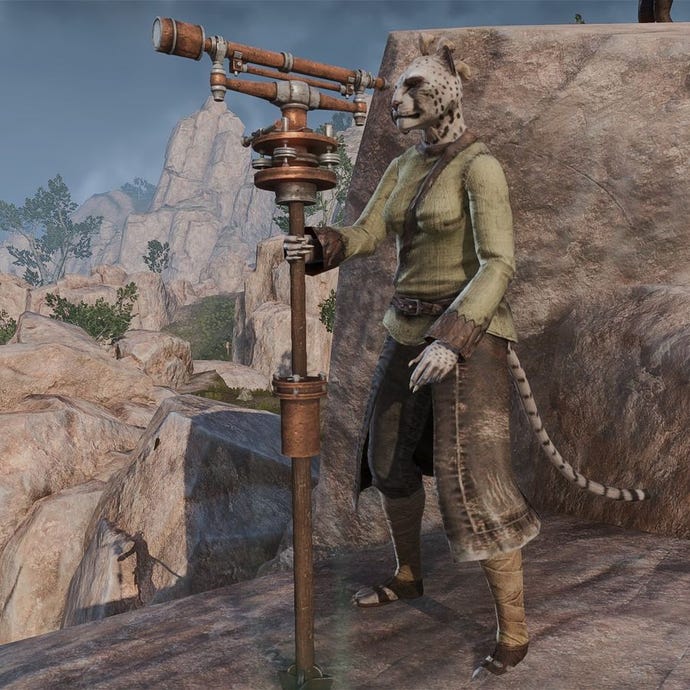
“Outer space” in the Elder Scrolls universe is… well, who knows, frankly. Itstraddles a faultlinebetween contemporary science, astrology and geocentric cosmological models from before the days of Copernicus, while pinching esoteric ideas from all over.
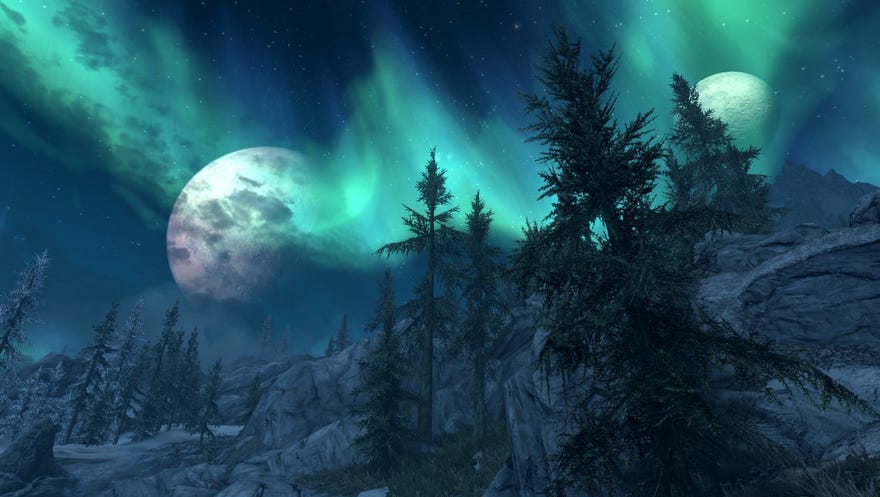
Look up while foraging for nirnroots inSkyrim, and you might think you’re gazing into another terrestrial night sky, albeit with too many moons. According to the game’s lore, however, what you’re actually looking at is a delusion born of your puny brain’s inability to comprehend Oblivion, the voidish realm of the devilish Daedra, which surrounds the mortal plane of Mundus. Those moons? They’re perpetually dying celestial spirits, their skin flaking away in the course of a lunar cycle that is actually a process of decomposition. Those stars? They’re tears in the outer fabric of Oblivion that spill radiance from the magical realm of Aetherius. The largest of those holes is, of course, the sun - it marks the place where the creator god Magnus fled Mundus after wearying of his own handiwork.
I can already feel the Elder Scholars of Reddit smacking my typing fingers with a ruler, creaking in my ear that I’m making a hash of the details here. My respectful retort to these wizened theorycrafters is that confusion and debate about the precise nature of an Elder Scrolls night sky is part of each game’s allure. As Morrowind’s lead designer Ken Rolstonwrote in 2012, this is the kind of thing that makes your fantasy world feel properly worldly, and brings your fanbase to a profitable simmer: “your setting should always be filled with franchise mysteries. And people in the setting should constantly argue about the Truths of those mysteries.”
Image credit:Bethesda
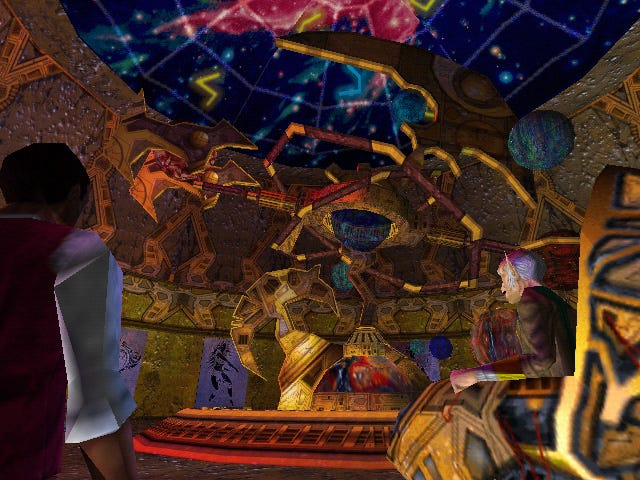
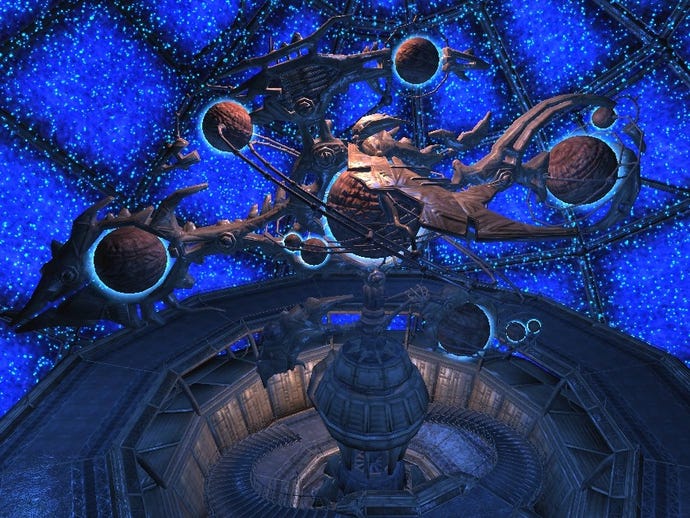
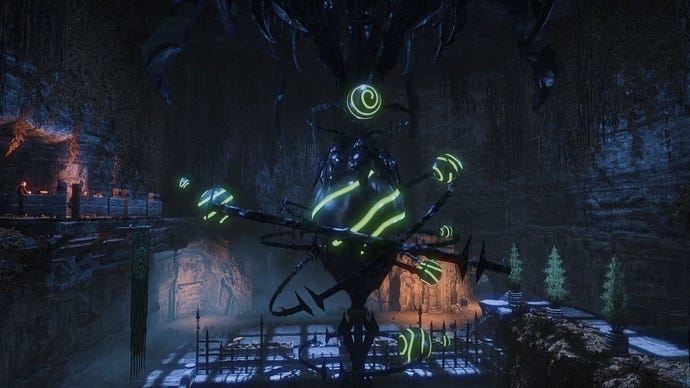
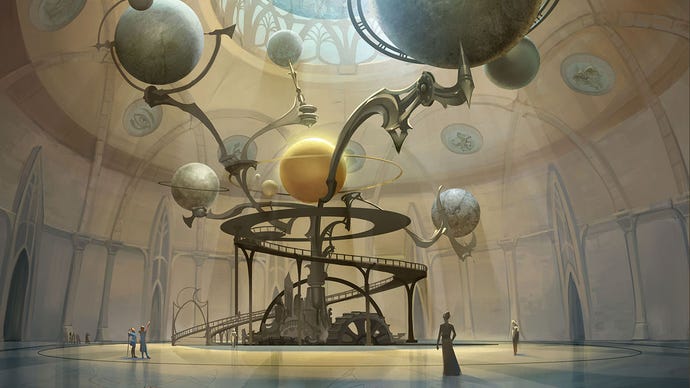
There’s a nice frission between the stranger cosmological models in Elder Scrolls and the elements that seem based on normie outer space. There are gobbets of lore and locations that loosely reinterpret real-world missions to Earth’s orbit and beyond. Take Elder Scrolls: Battlespire, a poorly-regarded dungeon crawler set on a kind of fantasy International Space Station, dedicated to the training of wizards. It’s parked in a “slipstream realm” between various planes of Oblivion, which calls to mind the concept ofa Lagrangian point.
There are even Elder Scrolls astronauts, of a sort. Consider the Sun Birds of Alinor, a group of Aldmeri explorers who supposedly sailed to Aetherius on ships of crystal and frozen sunlight. Modders have attempted to fill in the picture: one of the more ambitious Skyrim mods isAethernauticsfrom trainwiz, developer of the very Elder Scrollsy space simUnderspaceand the accursed originator ofThomas the Tank Engines in Skyrim. This sizeable unoffical add-on sees you journeying to other plane(t)s in an “aethership” of Dwemer construction.
To orbit belatedly back to the “do Starfield’s planets have invisible walls” controversy, Bethesda’s head of publishing Pete Hines hadthis to saywhen asked whether you can explore whole planets after landing on them: “Yup, if you want. Walk on, brave explorer.” Which seems at first to clarify the situation, but remains open to interpretation - so are there map boundaries or aren’t there, Pete? - and I sort of prefer things that way.
While Starfield appears to be taking a relatively cut-and-dried, this-means-that approach with its worldbuilding, I’d love the game to channel some of the speculative energy and ambiguity that makes Morrowind, in particular, such a thrill to return to. Perhaps it could come about as part of storylinesinvolving its three in-game religions, or in the course of hunting Artefacts as part of the main questline. It might address one of the more substantial complaints directed at Starfield, ahead of review – itsnumbing emphasis on scale for its own sake. What better antidote to such dreary AAA-game maximalist thinking than a healthy dollop of mystery?
