HomeFeaturesWorld of Goo
RPS GOTY Revisited: 2008’s World Of Goo still offers more fun than nearly any puzzle game sinceLove, from the Sign Painter
Love, from the Sign Painter
Did your science teacher ever let you play around with non-Newtonian fluids? If not, my condolences. You missed out on some of the greatest fun you could have at school. I remember holding a big ball of starchy goo, balling it up and turning it over and over in my hands, marvelling at its strange rigidity. And then I’d stop playing with it, and watch with childish glee as the slop slowly seeped through my fingers, its form reacting immediately and satisfyingly to my touch.
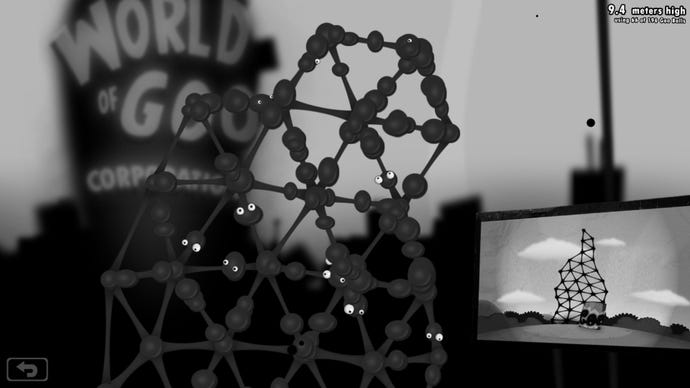
I felt that same glee when I played Tower Of Goo Unlimited back in 2005 - the prototype that would three years later becomeRPS’s game of the year for 2008. It was well and truly a prototype, a single level with the aim of building the highest possible tower out of sticky balls that were connected via long strands of wobbly guck. It was silly, and messy, and confusing, and marvellous, and I realised very quickly that I needed a proper game like this in my life as soon as possible.
World of Goo - Official Nintendo Switch TrailerWatch on YouTube
World of Goo - Official Nintendo Switch Trailer

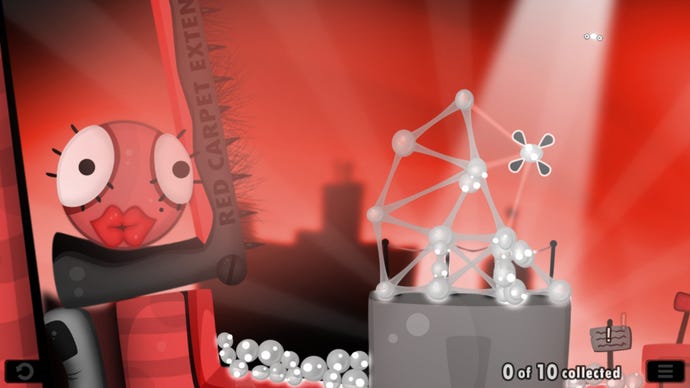
World Of Goo, like its prototype, is a physics-based puzzle game. Each level puts you in charge of a group of remarkably cute sentient balls of goo, and your aim is to get the goo up to the pipe at the end of the level, where they’ll be sucked up to safety. To get there, you need to drag and drop the goo balls so that they connect to one another, forming gooey structures such as towers, bridges, pendulums, and more. The goo’s structural integrity isn’t great, so a lot of the time you’ll need to either build slowly, constantly shoring up the foundations of your structure, or else work very fast, stacking goo upon goo in an attempt to outpace the physics simulation’s propensity to have your structures buckle and collapse under their own weight.
The game is divided into a handful of chapters, and every few levels in each chapter introduces a new type of goo ball or mechanic. There are pink helium balloon-like goo that can lift your structures to new heights. Then there are green velcro-like goo, which can be detached from their structures at will, allowing you to reform existing structures. Later on you’ll find even more exotic types, like flammable goo, or goo which you can fire from point to point like an arrow. And each chapter makes good use of the steady dripfeed of new mechanics, giving you the space to play around with each one, and then posing problems which can only be solved with a proper understanding of how each Goo works.
It’s rare for a puzzle game so physical and mouldable to have those “goodness, how clever and elegant!” moments, which are what tends to keep me playing most puzzle games. I’d much more readily expect to be met with the genius of a level-designer when solving a puzzle in games likeHexcellsorBaba Is You, because the building blocks of those games are logic and rules. The building blocks of World Of Goo are, quite literally, goo. Stretchy, squeaky, adorable goo. The message of each level is less about “look how clever I am”, and more about “look how much fun you can have here”.
That doesn’t mean the levels of World Of Goo aren’t clever. Particularly in later chapters the extra mechanics force you to think in completely different and frequently fascinating ways. I’m not going to spoil every single surprise that the game has in store for new players, but I will say that the later levels where you start stacking goo blocks instead of balls are some of my favourites in the entire game. Cleverly combining the lego-like stacking of blocks with the plasticine-like stretching of goo structures makes for some really interesting puzzles, and gives 2D Boy plenty of opportunity to add more character to the game’s adorable titular protagonists.
As for the soundtrack, the only negative thing I can say about it is that it’s too short. You don’t have to go very far into the game before you hear the same bits of music repeated from earlier levels. That’s not really a bad thing, though, because each piece is so delightful, so alive with whimsical wonder. Kyle Gabler’s score for World Of Goo runs the gamut from merry and uplifting to frenetic and tense, but never loses that quirky, playful, ever-so-slightly-sinister fantasy feel.
It’s at this point that I remember Katharine asked me to revisit not only World Of Goo with this write-up, but also the decision to elect it game of the year in the first place. Does it still hold up as the best game of 2008? Well, look. World Of Goo isn’t one of my favourite games ever made. It’s not even the game I had most fun playing in 2008. That accolade goes to the perpetually contentiousSpore. I was part of the minority who considered Spore to be a good game worthy of my time - but I could see even as a 13-year-old that the entire experience was lopsided. Spore was a great big wonderful smashed pavlova of ideas, where some parts of the meringue are perfect and others have clearly collapsed under the weight of all the fruit stacked on top.
To me, World Of Goo feels simultaneously as though it could have been made this year, and also undeniably, quintessentially 2008. Part of that is because it’s a stylised 2D puzzle game, and those don’t really go out of date like a big-budget first-person-shooter might. But I think it’s also because World Of Goo forms such a large part of my definition of that year. Without it, 2008 wouldn’t have been nearly the year it was for games.
