HomeFeaturesWarhammer 40,000: Rogue Trader
Rogue Trader is the first Warhammer 40K game I’ve played that feels genuinely epicA review-in-progress of Owlcat’s latest CRPG
A review-in-progress of Owlcat’s latest CRPG
Image credit:Owlcat Games
Image credit:Owlcat Games
In the grim darkness of the far future… I will finish my review of Owlcat’sWarhammer 40,000: Rogue Trader. It turns out that trying to complete an estimated 100-hourRPGduring the run-up toThe Game Awardsis too much for this humble Scriptor. There are still many more tabletop-style planetary maps to discover and plunder, many more character levels to scale, and many more cursed artefacts to tamper with before my protagonist, the closet Chaos worshipper Bruschetta de Plonque, can pronounce herself mistress of the Kronos Expanse - assuming the Inquisition doesn’t claim her first. But after 20 hours of the game, I can absolutely say that I’m looking forward to the next 80. While it doesn’t have the cinematic swagger and raw anecdote-generating capacity of obvious rivalBaldur’s Gate 3, Rogue Trader has mystique and depth to spare, both in terms of its grotty narrative and its exceedingly busy combat and levelling systems.
Image credit:Owlcat Games
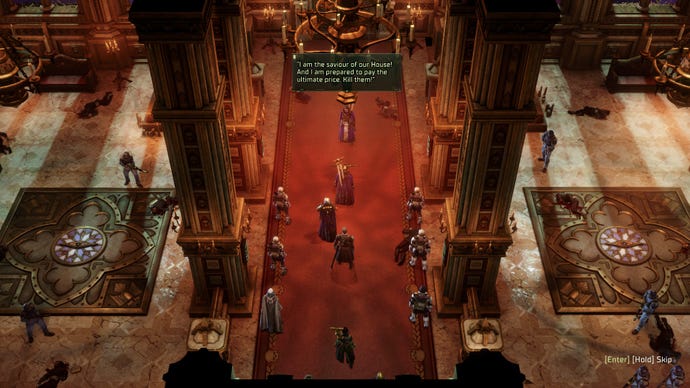
Above all, that’s because it gives you enough license and leeway that those stories actually have time to evolve. As the titular Rogue Trader, you have limited permission from the God-Emperor to pursue personal glory, amass a power base consisting of a private voidship and planetary colonies, and experiment with Chaotic forces and other heretical pursuits that would otherwise be deemed grounds for execution - as long as this works out to the benefit of the Imperium eventually.
Image credit:Owlcat Games
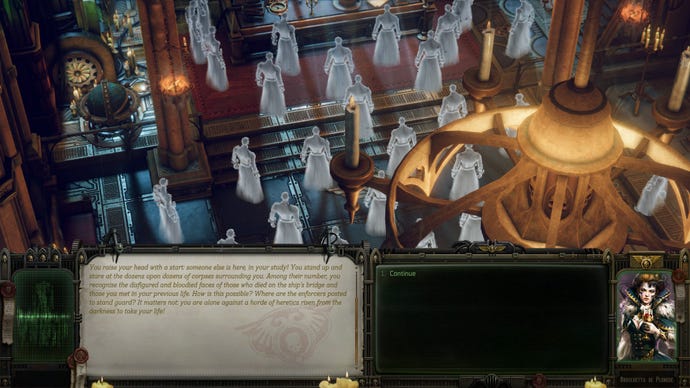
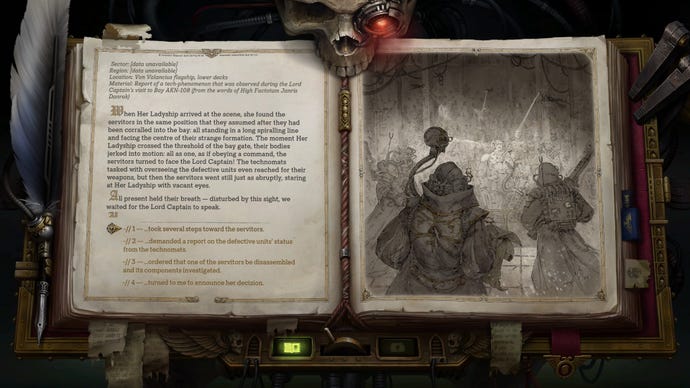
My character Bruschetta is, I think, pretty obviously a Wrong ‘Un. She’s a spaceborn aristocrat with contagious bad luck that is alternately helpful and a hindrance in combat. Character creation includes a choice of Triumphs and Darkest Hours that comprise your backstory: Bruschetta’s Darkest Hour is that her family library contains a mysterious tome that has somewhat wrecked her mind. The game also gives you a choice of voice-actors – naturally, I’ve picked the “mad” one which causes Bruschetta to say things like “they will see, oh yes, THEY WILL SEE” when I assign movement orders. But all this misbehaviour has earned me little more than worried looks from Argenta, my group’s ultra-pious Sister of Battle, and some occasional scolding from my Seneschal, Abelard, a stalwart graduate of the Imperial Navy.
Image credit:Owlcat Games
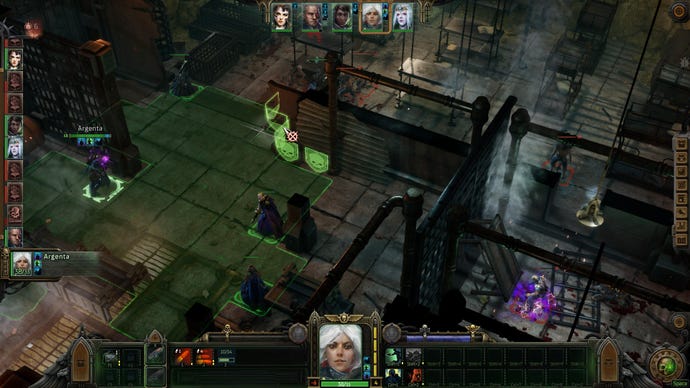
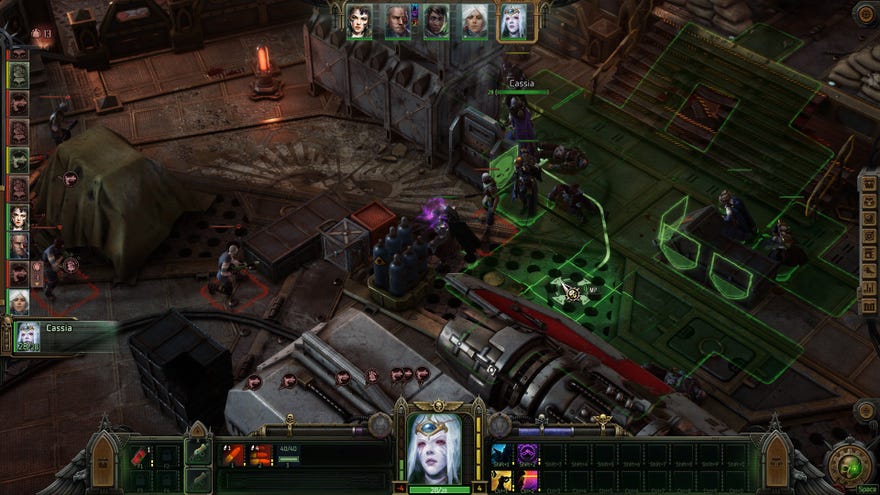
I’m also enjoying the game’s turn-based combat system, though I do have notes. It’s a slightly rickety but engrossing balance of simple and bewildering. On the one hand, this is essentially a game about moving people into full or half-cover and flanking opponents who are trying to do the same. Overarching mechanics include reactive attacks of opportunity when people try to move away during melee, the risk of friendly fire, especially when firing a burst, and a set of class-specific, potentially match-winning Ultimates that become available when you gain enough Momentum from kills or conversely, take enough of a beating.
It almost seems intuitive, from a distance. But on the other hand, each character has dozens upon dozens of abilities spread across various classes and subclasses, which you can stack and combine to transformative effect, and which threaten to wreak all kinds of havoc towards the endgame.
Bruschetta is an Officer, for example, whose starting signature ability lets her choose another party member as her personal minion, applying status modifiers that affect both parties for the duration of the battle. You can expand on this with upgrades that, say, make the officer-minion relationship more defensively inclined, with self-heals that kick in when you’re next to each other, or which unlock combos when you attack the same target. Abelard is a classic lightning bruiser, never happier than when barging forward to bog groups down or occupy the attention of a boss, but he can also be reconfigured as a support, with abilities derived from his Imperial Navy career that scatter enemies who are trying to mob your team. Idira’s psyker powers cause the veil of reality to collapse, unleashing various kinds of demonic activity, but my Navigator, Cassia, has an unlock that repairs the veil when she, say, mesmerises a foe into running towards her. So if I put her and Idira together, I can keep things in equilibrium.
Image credit:Owlcat Games
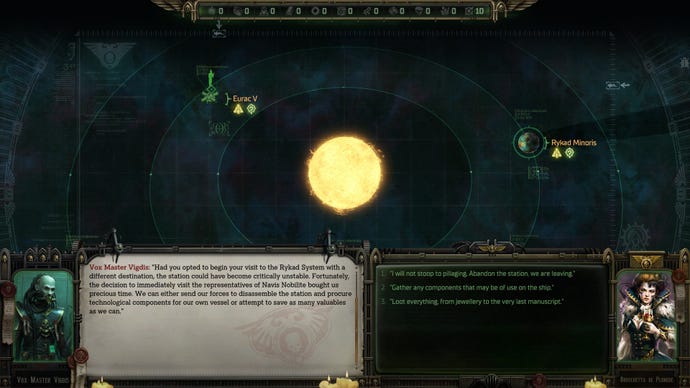
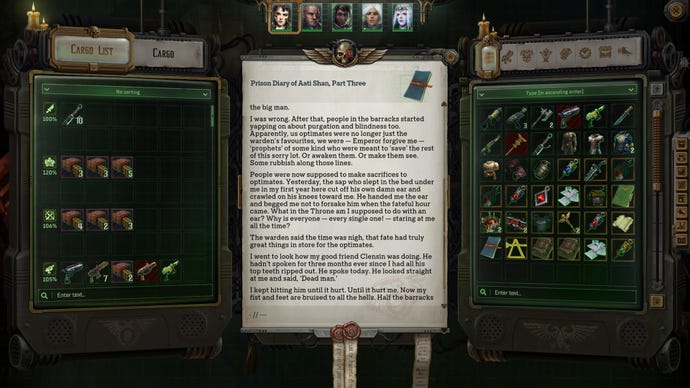
The game does recommend certain abilities with thumbs-up icons, but this is akin to a nudge towards the approximate end of a corridor crowded with people bellowing phrases like “+2 temporary wounds per Archetype taken”. If you’re going to play Rogue Trader, be prepared to spend a fair few of those estimated 100 hours with your eyes closed, straining to picture scenarios before choosing an unlock. I’m enjoying the process, but a bit more guidance would have been appreciated. People who get excessive FOMO about choosing the wrong progression path should probably steer clear.
But anybody who’s in the mood for another massive RPG should definitely take an interest, pending my full review. There’s still time for things to go south, mind you. The writing has so far struck a good balance between committing to the worldbuilding, and poking fun at it, but there’s the risk of it becoming over-serious as the stakes are raised. The battle system’s complexities could prove to be inelegant and gratuitous in hindsight. The big thing, for me, is how much choice of alignment changes the story, and how much Owlcat will have to rein in the possibilities as the decisions multiply and evolve. I hope they’re fully committed to unpacking the consequences of Heresy, in particular. I’d hate for daft old Bruschetta to make it to the finishing line unscathed.
