HomeReviewsRatropolis
Ratropolis reviewWith foes at your door, well it’s time to make war, rat’s amore!
With foes at your door, well it’s time to make war, rat’s amore!
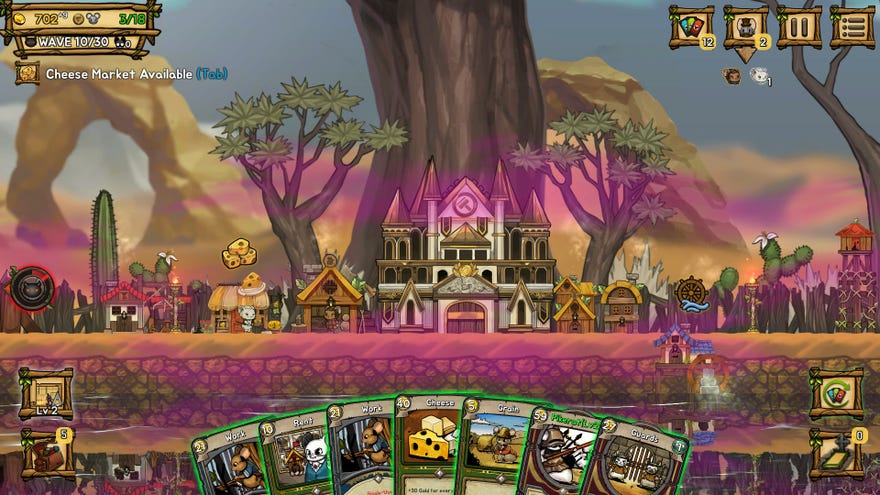
It’s all about time. As you’re building defensive walls and placing troops, the clock never stops. Want to visit the market? An icon will sometimes appear in your base and linger for 30 seconds or so; if you miss it you just have to wait for it to come around again. At its most frenetic moments, Ratropolis becomes closer to a clicker game. You’re clicking on to order guard rats around, you’re clicking on chests enemies have dropped, and you’re also clicking on cards, because Ratropolis is a deckbuilder too. Oh,andit’s a base-builder, and a tactical attritional survival game like Plants Vs. Zombies. Is there anything these rats can’t do?
Ratropolis Launch TrailerWatch on YouTube
Ratropolis Launch Trailer

When the game starts you draw a hand from a deck of cards, and can draw more on a cooldown timer. Efficient, quick use of these cards is essential, because they let you deploy forces to your left and right fronts, unleash special attacks, construct new buildings, upgrade your settlement - which is spread across a 2D plane - and build new defensive walls farther from your town. Your cards are also the basis of your economy at the start of a run.
You quickly learn that playing efficiently means playing the right cards in the right order, and sometimes not playing certain cards at all. Cheese cards give you 30 gold for every one in your hand, and you always draw a few - but the developers Cassel Games have also set a mousetrap, because if you’re too hasty when you’re clicking around you might accidentally play the final Cheese card for a goldloss. But before any of that you want to play the Pottery card you drew, because that gives you 10 gold for any card of any sort in your hand…
It all takes place under that constant, mutant-driven time pressure, and for me the game is just stressful enough to be fun. I feel busy, but have enough time to start building my deck towards a particular style of play. Ratizen colonists are needed to support any plans, though, and they need houses. These are the simplest buildings you can buy, and essentially convert gold into Ratizen resource at the expense of space in your base.
Some buildings take up more space but come with powerful abilities - I like the Scrapyard, which you can use to ditch unplayable Scrap cards from your hand - and naturally the confined space in your territory forces you to pick buildings with the functionality to support your deck. Ideally, you want your best buildings close to your hub, because that puts them behind more defensive walls. This raises dilemmas a dozen or so waves in, though, when space there is low or non-existant. You can knock down buildings and replay them using certain building cards, but it’s time consuming, expensive, and takes those buildings offline - rarely a worthwhile sacrifice.
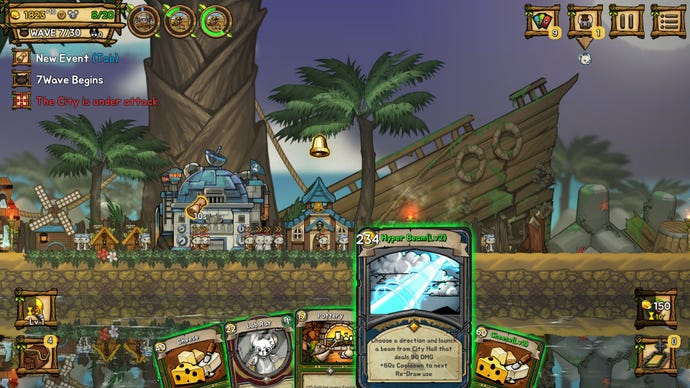
I have tried to get around this monstrous onslaught of fatal rammening many times, and thankfully there are a lot of ways to experiment. Before any run you appoint a leader to your clan, who comes with a passive bonus and an ability you can activate on a cooldown. There are six to choose from (the first couple are sort of tutorial rats that make it easy to make money, and easy to fight respectively) but I like the Builder Leader, who can play a house on a house to make it a bigger house, without requiring any specialist building upgrade cards. More advanced rats let you build robots and buff them during a session.
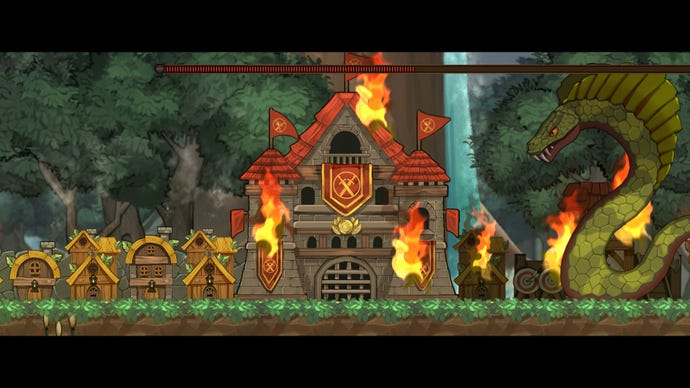
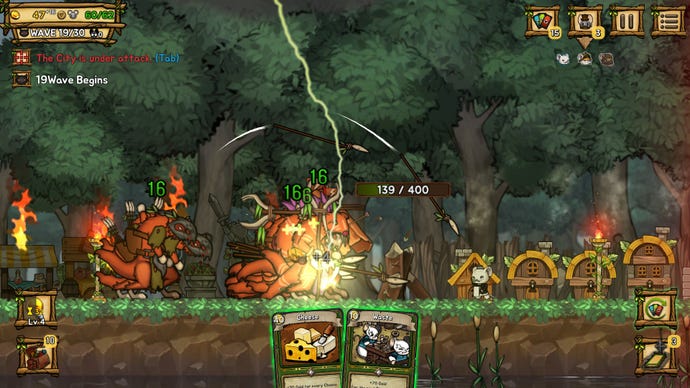
It’s telling that whenever I’ve hopped back into the game while writing this, I’ve ended up being sucked into an entire run. But past the euphoria of the first few hours, the difficulty curve feels uneven. When the waves escalate and I crash out, I find it hard to identify where I went wrong, in part because you receive new cards in a haphazard and unpredictable manner.
Enemy chest drops, events, and some leader abilities let you pick or delete cards - always a necessary option when you’re trying to build an elegant deck. Events seem to occur quite randomly, offering some flavour text and a resource choice. I enjoy these choices, but I they don’t offer cards reliably, and in a game all about time I’d prefer a more predictable cadence of deck choices so it feels like I’m building into a strategy.
That sense of satisfaction competes with genre expectations too. Ratropolis is a citybuilder in part, a type of game I tend to approach as a gentle gardening experience with a flat layer of challenge throughout. Tower defence wave-games have a similar slow-paced appeal. Conceptually, throwing vital, high-pressure deckbuilding decisions into that context is a bit like drinking orange juice after you’ve just brushed your teeth.
Given that, I’m amazed that Ratropolis works so well. I’m amazed it worksat all. I extracted many hours of satisfaction from it before I hit the wall, and it’s a game I will return to with every patch, because there’s something excellent here. It’s time for my humble rats to become gaming heroes.
