HomeFeaturesQuake
Quake Renaissance: a short history of 25 years of Quake moddingHow fans have kept the classic shooter alive in good times and bad
How fans have kept the classic shooter alive in good times and bad
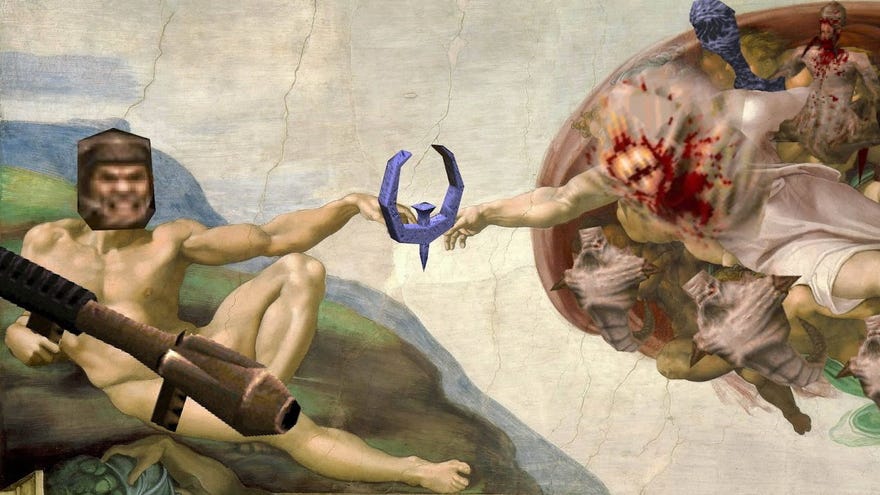
Imagine an ancient monastery hidden away in the mountains, where aging monks and nuns carve these kitschy little demonic sandcastles that no one cares about. Every year their numbers dwindle. The world has forgotten them. Is this how the old ways die?
Quake 1modding seemed destined for the same death too. Then a few years ago, a Quake nun started ripping and tearing through the walls. Today, the newly remodeled Quake monastery has thousands of new members keeping the faith alive. This is a short history of the Quake Renaissance, the surprising rebirth of a 25 year old retro game mod community.
Quake - Official Trailer (2021)Watch on YouTube
Quake - Official Trailer (2021)

Early Quake (1996-2000)
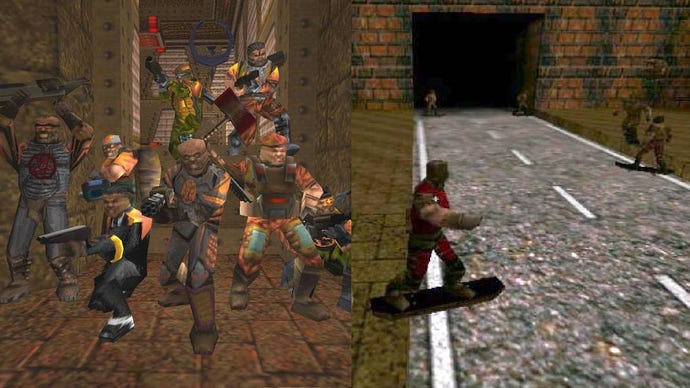
Upon its 1996 release, Quake mapping and modding focused on multiplayer. Sites likeMultiplayer Quake (MPQ)andRamshacklecurated hundreds of custom arenas for deathmatch-hungry Quakeworld players. Popular multiplayer mods set standards across the industry:Team Fortresspopularized character classes,Threewave CTFpopularized capture the flag, and there’s aRocket Arenagame mode in every shooter. Some mods retrofitted other genres onto Quake, like RPG modFuture vs. Fantasy, racing modQuake Rally, aerial combat modAirquake, and even a skateboard mod calledKickflip Quake.
Team Fortress (left), Kickflip Quake (right).
Clockwise from top-left: Zerstörer, Beyond Belief, Shadow Over Innsmouth, Nehahra.
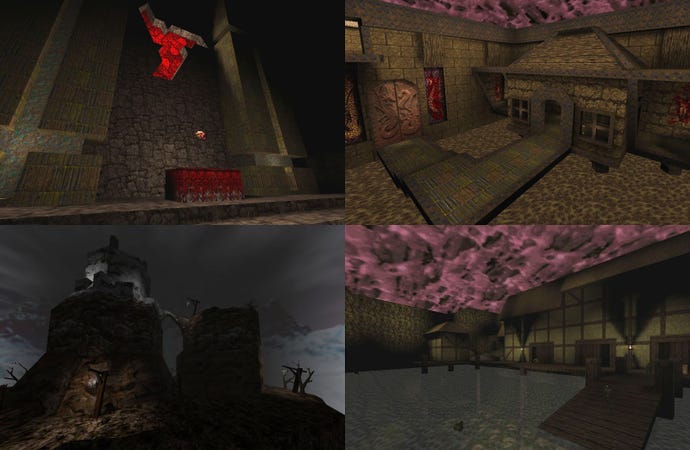
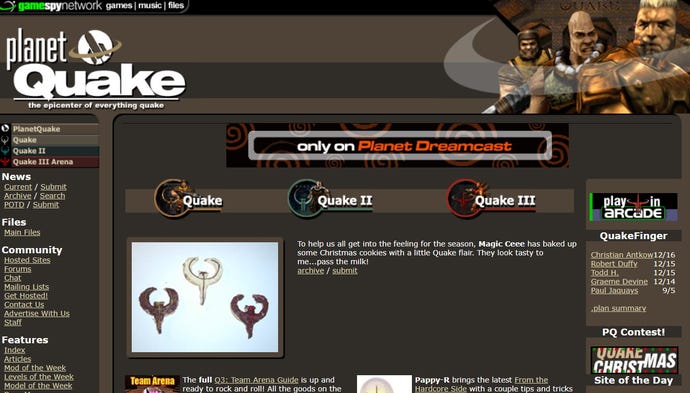
Nehahra was a spectacle, and required many factors to align. First, a team of online volunteers need shared trust and norms from socializing at early mapper hangout sites likeQBoard,QMap, and#terrafusion. Second, “all-star” reputations and critical consensus come from review sites likeProminenceandTEAMShambler. Third, no one can / will even download it without hub sites likePlanetQuakeandFilePlanet. Every creative community has at least one Nehahra-like project - even if it’s not that good, the hype means the community ecosystem is strong.
The homepage of PlanetQuake from December 2020.
Modern Quake (2000-2010)
In late 1999, id Softwareopen-sourced the Quake 1 engineand new Quake engines multiplied. Congregating onInside3D(nowInsideQC), many coders sought to update Quake’s aging graphics. LadyHavoc’s 2002 graphic enhancing engineDarkPlacesbecame the most popular, paired often with remastered textures from theQuake Revitalization Project.
And with every year, Quake looked more modern… with much less multiplayer. “It’s incredibly difficult to get hardcore players to adopt new multiplayer maps,” says Bal. “They are usually a lot more comfortable playing what they are used to.”
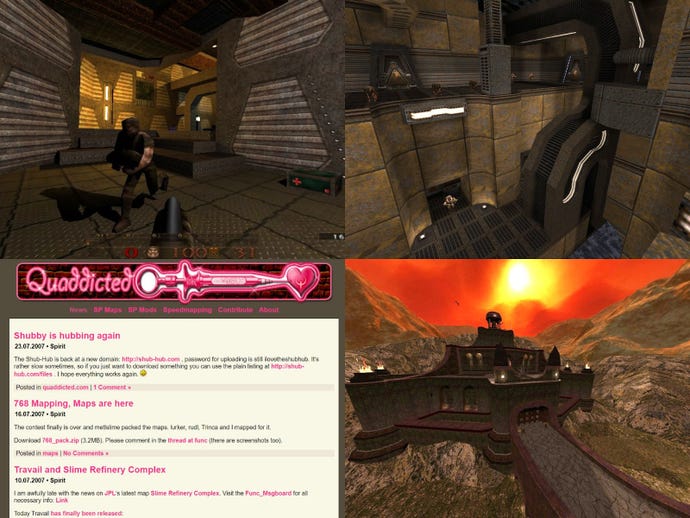
Gathering at new hubfunc_msgboard, mapper culture turned away from multiplayer and toward modernizing single player:Insomnia(2000) incorporated Quake 3’s huge sweeping curve, while the landmarkMarcher Fortress(2005) mixed a huge Halo-like valley with an epic Quake 3 neo-gothic citadel. This trend later culminated inAltar of Storms' (2011) audacious recreation of an Elder Scrolls IV: Oblivion dungeon.
If you keep trying to make Quake something else, is it still Quake? How “faithful” should we be, and who are the faithful anyway? In 2005,Quaddictedwas founded as a new modern community site to try to rebuild and centralize this player audience, eventually evolving into the indispensable map archive it is today. “[I] felt there was no real active hub,” says Spirit, who operates the site along with Negke. “Even back then it was hard to find some of the files when author homepages or file hosts vanished.”
Clockwise from top-left: DarkPlaces in 2004 with QE1 textures (Quake Revitalization Project), Insomnia, Marcher Fortress, Quaddicted front page in 2007.
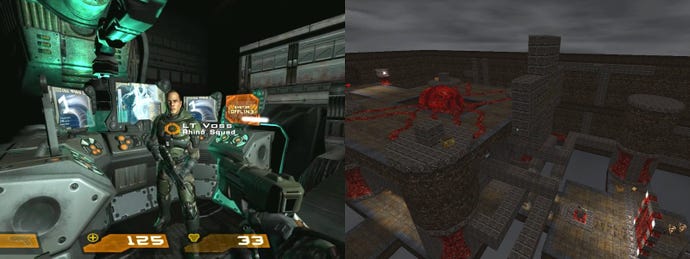
Quake 4 (left), Warp Spasm (right).
Months later, mapper Dustin “Tronyn” Geeraert wrote the first Quake community history,“The Lingering Legacy of id Software’s Quake: A Glimpse Into Thirteen Years Of Darkness”. He was pessimistic too: “[Most] of us who are here seem to have started in the late 90s, and sort of stagnated in the early 00’s,” Tronyn said in a2009 interview. “I doubt there will be new Q1SP maps being shared and people discussing them online in ten years.”
Quake Renaissance (2010-now)
Quakespasmdebuted in 2010, eventually becoming the most common Quake engine today. Modern yet “faithful”, it ignores DarkPlaces' graphics updates and re-commits to retro-style unfiltered pixels. This revised nostalgia defines the Quake Renaissance.
In his book"Handmade Pixels: Independent Video Games and the Quest for Authenticity", Jesper Juul analyzes the stereotypical indie pixel art platformer from an art history lens. Juul notes that back in the late 1800s, theArts and Crafts movementargued that industrialization had led to soulless inhuman art. Similarly, indies rejected AAA industrial photorealism and instead tied their crispy handmade pixels to homemade authenticity - even though old CRT monitors actually softened and blurred pixels. Our nostalgia for crisp pixels is a modern invention to suit the present, as with any other renaissance.
But revision isn’t bad. Ben “Makkon” Hale’s 2020 Quake textures perfectly fuse past and present, using modern tools like Substance Designer to generate obscenely detailed high-res floor and wall textures - all designed for Quake’s 256 color palette as unfiltered pixel art.
Alkaline (2021) using Makkon3.wad textures… and yes, this is Quake
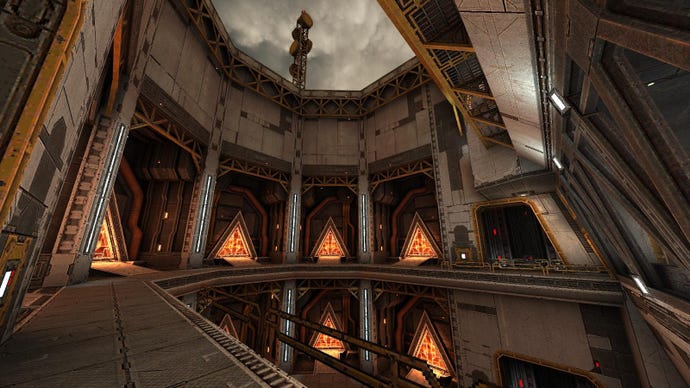
“His textures are unlike anything that could have been made at the time of Quake’s release,” Bal says. “I saw his texture work on Twitter and instantlytold himhow great they would be in Quake maps.”
Makkon remembers: “He showed me how it looked [and] seeingthat screenshotgot me so excited,” he says. “I hadn’t realized just how far Quake had come. I picked up TrenchBroom…”
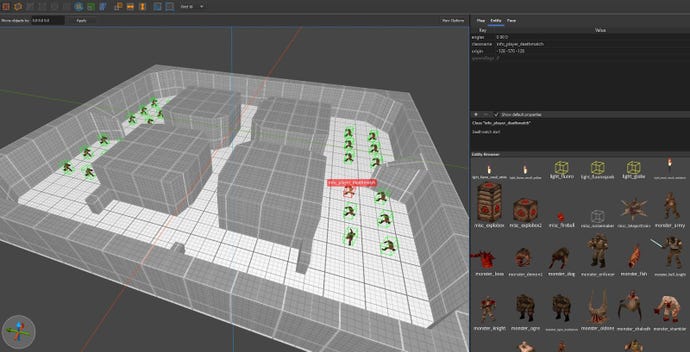
Since its v2.0 release in 2017,TrenchBroomhas become the most widely used level editor for Quake. It’s so good that some designers even use itoutside of Quaketo make commercial Unreal Engine games.
“One of the unique things among Quake editors is you can do everything in the 3D view,” says Eric “ericw” Wasylishen, co-maintainer of TrenchBroom. He also credits good documentation and community support for its widespread adoption.
The Trenchboom level editor.
To learn TrenchBroom in the 1990s, you would’ve crawled through some articles on PlanetQuake. But today, for better or worse, learning starts on YouTube. And since 2018, modder David “dumptruck_ds” Spell has made dozens of slickly-produced video tutorials for Quake modding. His"Mapping for Quake: TrenchBroom 2 Quickstart"video has over 50,000 views.
Yet a video tutorial can’t replace a patient mentor willing to answer questions. As with many online communities, some of the more hardened parts of the Quake community can be quite crusty, unpleasant, and downright abusive, often pushing away newcomers and even many regulars. Fortunately, the community also realized the need for better inclusion and created a new social hub: theQuake Mapping Discord, a highly moderated “safe for school” public space where cursing isn’t allowed but beginner questions are welcome. Since 2018, it has unexpectedly grown to thousands of members interested in making custom content for a 25 year old game. It’s now basically the center of the Quake single player mod community today.
“There’s still ways to go, but I feel it’s a lot less toxic than it was 10 years ago,” says SleepwalkR. “The community has diversified into different pockets that have different cultures — there is something for everyone now.”
Some modshew to 1996-era memory limits, otherstoy with stealthor evenignore combat entirely, and then there are those whogenerate poetryorquote the Black activist Audre Lorde. Quake is no longer just one thing, there are now many Quakes.
Clockwise from top-left: Xmas Jam 2018, Tears of the False God, Underdark Overbright, Slayer’s Testaments.
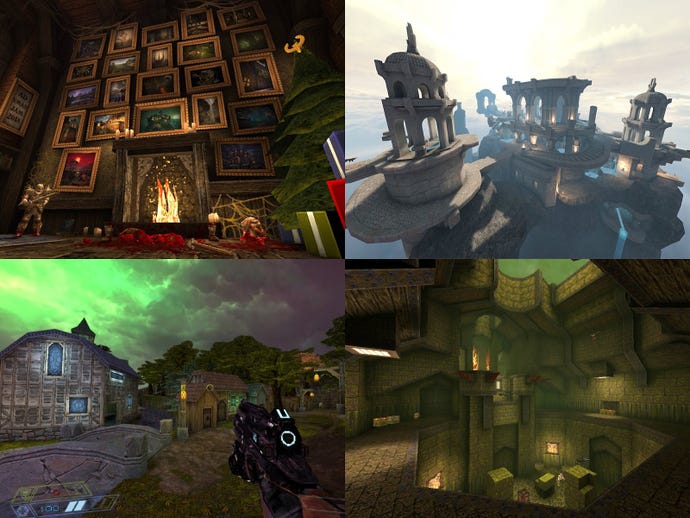
This focus on a more inclusive community owes a lot to indie game jam culture. Starting in 2014, casual online events likefunc_mapjam,Retro Jam,Xmas Jam, and newly revivedSpeedmapjams, lowered a decade of expectations while also breathing new life into the community. Everyone participates together, from beginners to masters.
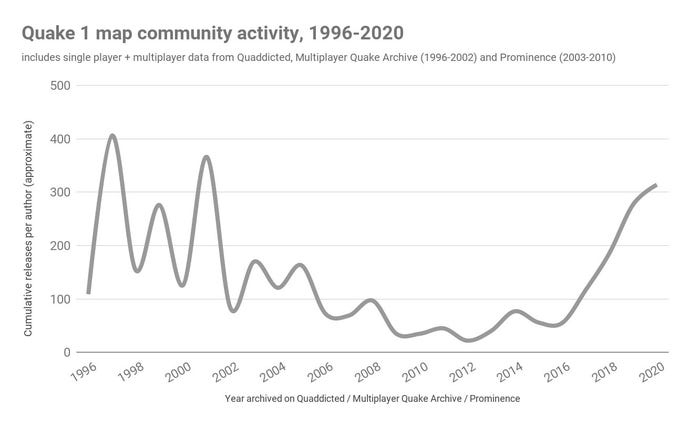
Quaddicted’s self-described “archival zealot” Spirit isn’t impressed. “If you build it they will come - maybe, maybe not,” he says. “Public interest can come and go.” And he’s not wrong; Quake exists in its own dimension, disconnected from the larger industry.Previously I wroteabout how modding leads many to work in games, yet these older retro modders often have no industry aspirations, or even already work in the industry.
“It’s comfortable as a leisure activity, frankly,” says modder Matthew “Lunaran” Breit, who also worked on Quake 4 multiplayer and The Beginner’s Guide. “Levels and assets don’t take forever - unless you make them take forever.”
“It’s very different from my day job, where we’ll nitpick on details all day, and work on multi-year projects,” says Bal, who also works as a AAA character artist. “One of the things I love with modding and Quake is that we can really experiment, and we’re allowed to fail.”
Quake modding symbolizes the opposite of work - it is life. And ultimately this is what the Quake Renaissance is about: when our communities control our own games - from the source code and tools, to the social hubs and archives - we can reinvent it as necessary, and through it, reinvent ourselves too.
NEXT TIME:Part 3, a guide - how to join the Quake Renaissance today.
