HomeReviewsPersona 4 Golden
Persona 4 Golden reviewJung people these days
Jung people these days
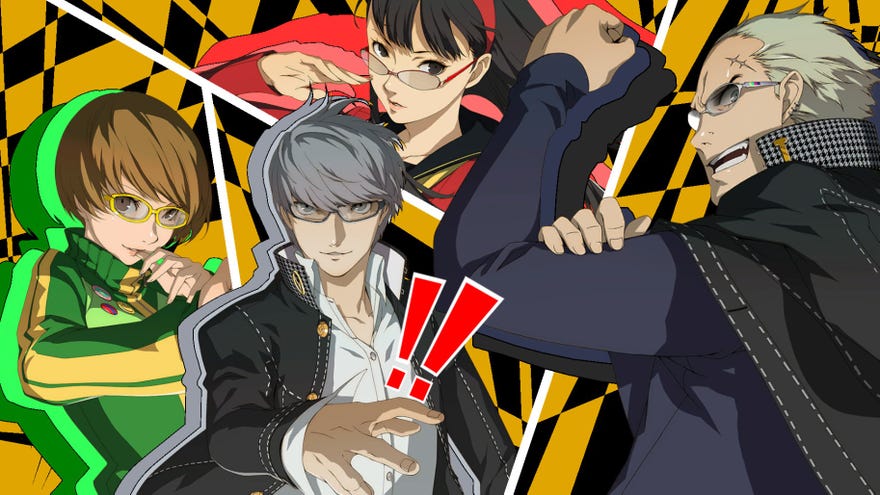
Most roleplaying games span continents, planets, even galaxies.Persona 4 Golden– the first of Atlus’s celebrated RPGs to make a belated landfall on PC - is set almost entirely inside a single town. It’s not even a very memorable town: neither a wistful Chosen One Village nor a bustling world hub, but a wilting suburb done up in Google Map shades of tarmac and drizzle, full of collapsing businesses, bitter old people and bored children.
Watch on YouTube
Watch on YouTube


Time management is the key to Persona 4’s 70 hour+ story, with a range of endings dangling in the balance. Days are divided into morning, afternoon and evening, and most activities advance the clock, the crucial exceptions being shopping and fine-tuning your Personas. It gives rise to some entertaining indecision. Should you while away your Sunday with a book on studying methods, doubling the bump to your hero’s Knowledge stat when you hit the library? There are midterm exams in the offing, and everybody will like you more if you earn top grades.
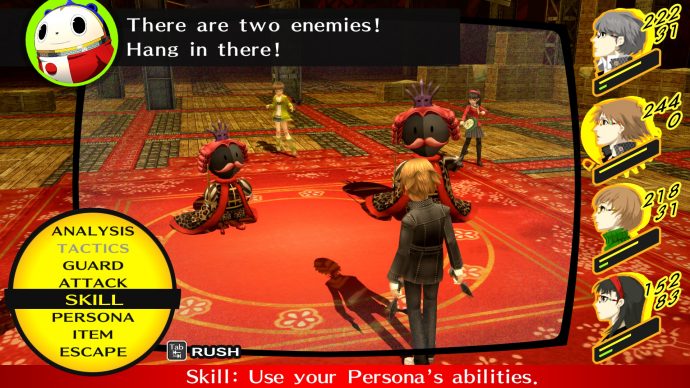
There’s a lot more predictability to the battles, which hinge on targeting elemental weakness so as to knock enemies flat, robbing them of their turn and earning your character a bonus move. Bowl every opponent down, and you can have your whole party pile on simultaneously in a billowing cloud of onomatopoeia. While the hero can switch Personas freely, party members only wield a single Persona, which evolves and shapeshifts as the story trundles on. These Personas correspond loosely to RPG classes like mage and cleric, which gives you some solid ground to fall back on while experimenting with different ability sets as the lead.
There’s a lot of whimsy to Persona 4’s brawling, for all the quiet malice of touches like attacks that expend health rather than stamina. Battles often conclude with a nifty minigame where you pick from Persona, item and bonus cards in a limited number of moves. The game is also pretty considerate of your time, for all the emphasis on grinding between the major plot beats. Enemies are visible in the field and can be avoided. If you need the XP but you’re weary of the fray, you can turn on party member AI and hit “Rush” to fast-forward each battle.

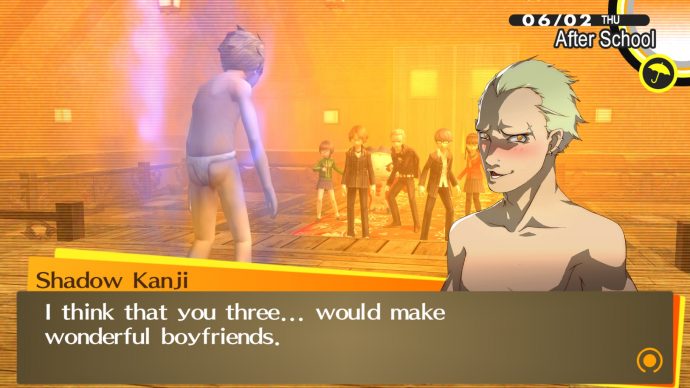
At least, that is, before you run into Persona 4’s extremely dubious, are-they-or-aren’t-they renditions of gay and transgender people.Beware of major spoilers from this point on. Another of your companions is Kanji, a macho outcast in punk leathers. His TV world dungeon is an erotic bathhouse, and his Shadow self is a cavorting, blushing figure in a loincloth. The very obvious suggestion is that Kanji is gay and struggling to deal with this, but later, he tells you that he identifies as heterosexual - his deepest fear is actually of rejection because he enjoys feminine-coded pursuits like sewing.
Framing Naoto as a woman navigating a man’s world feels akin to gaslighting.
There’s a lot of discussion of this scene, with some arguing that the game’s representation of gayness is beside the point – Kanji’s tale is purely about gender expectations. For me, it’s a bait-and-switch that allows the game to avoid reckoning with the implications of the bathhouse dungeon, where being queer is flamboyantly associated with “unmanly weakness”. There’s a definite homophobic undertow to Persona 4’s writing. Dialogue with Kanji often goes beyond recreating the prejudices of teenagers into treating bigotry as a source of comedy. At one point, the game’s class clown Yosuke asks Kanji whether he and the hero are “safe alone with you”, clearly evoking the stereotype of the gay man as a predator.
The portrayal of Naoto, a youthful genius detective who wears male-coded attire and accepts male pronouns, is equally questionable. Naoto’s appearance and manner are eventually positioned as an attempt to fit into a profession where women are belittled: it’s a strategic gesture, in other words, not a statement of identity. But Persona 4 is hazy on this distinction, often representing Naoto as deeply uncomfortable with being perceived as female, which makes framing him as a woman navigating a man’s world feel akin to gaslighting.
As Carol Wrighthas written, the character’s TV world dungeon - a military base housing a patchwork Naoto puppet - is a thin allegory for the act of persuading somebody not to undergo gender reassignment surgery. Later, in the course of completing his S-Link story arc, you’re able to congratulate Naoto on being “born a girl” and even correct the pitch of his voice to sound more feminine, after which he’ll come to an event in a schoolgirl uniform rather than his usual attire. It feels like you’re playing out the convictions of social conservatives who would rather tell trans kids they’re “confused” than love and support them. For more on this front I recommendVrai Kaiser’s lengthy article from 2015, which also digs into how Kanji and Naoto reflect perceptions of queer and trans people in Japanese society.
These failings are depressing because Persona is rare among blockbuster videogame series for giving space to queer and trans characters, and the developers are often quite deft at telling stories about adolescents navigating a broken society that preys upon their youth and naivete. Even Kanji and Naoto are well-rounded, sympathetic personalities, if you close your eyes to what they suggest about the prejudices of their creators. That likeableness only makes the nastier elements of their framing more insidious.
Persona 4 is a twisting tale of dreams gone rogue in a town sapped of purpose. It brings personal demons to life in gaudy but plausible ways, and uses this to rejuvenate the dog-eared framework of a town-and-dungeon fantasy RPG. Unceremonious as it is, the PC port leaves all of that peculiar magic intact. It’s just a shame that the insight and empathy on show here doesn’t extend to everybody.
