HomeReviewsPentiment
Pentiment review: a captivating murder mystery spanning 25 years of rich medieval historyA real page-turner
A real page-turner
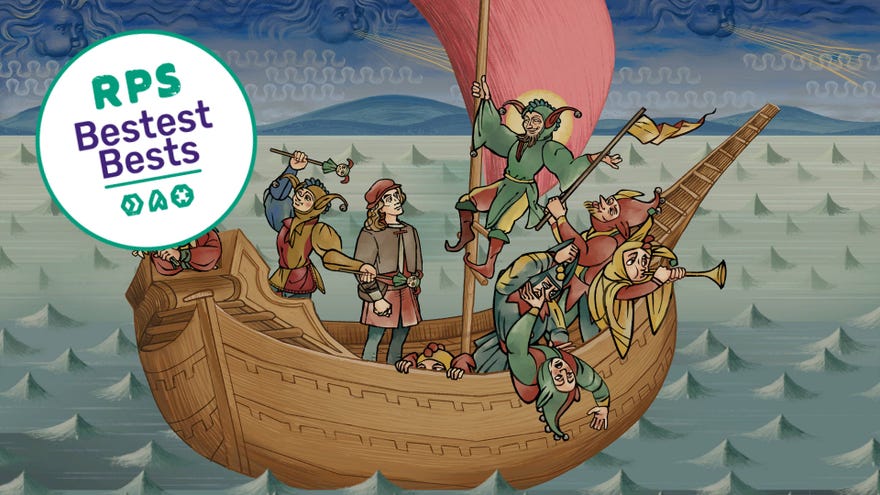
Just when I thought I had my top 10 games of 2022 sorted, Obsidian releasePentiment, forcing me to shred my former list and grab my quill and ink for a rewrite. It’s an odd pairing on paper - a detective thriller about a string of grisly murders set in the quaint countryside of 16th-century Bavaria - but, surprisingly, this coupling is a match made in heaven.
Pentiment announcement trailerWatch on YouTube
Pentiment announcement trailer

The dreaded ‘This will be remembered’ message that makes you question every decision you’ve ever made. I’m getting flashbacks to Life Is Strange. |Image credit:Xbox Game Studios
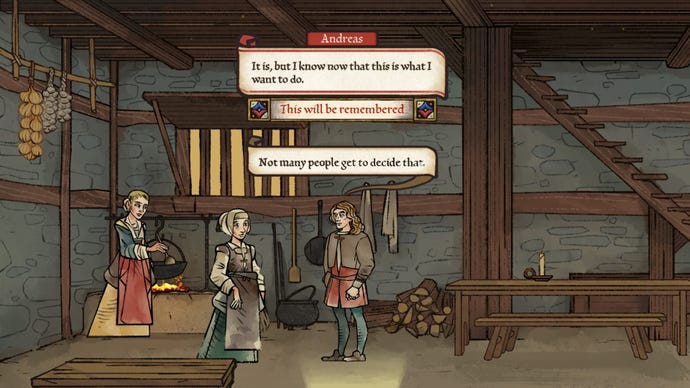
Near the beginning of your investigation, you get to define Andreas’ backstory, like where and what he studied, and these will trigger littleDisco Elysium-esque pop-up prompts in conversation. A passion for occult magic might help you decipher ancient symbols, or a background in theology might give Andreas an edge when debating the church’s pushy monks. Your background choices also come into play when trying to pry out juicy bits of information from characters or asking them for favours. These character-building choices, together with your actions and dialogue picks, can help or hinder you with the mystery, like how I royally fluffed up my chances at getting an important clue from a nun because earlier in the day I’d run my mouth off about how shit the church is. Oops. On the flip-side, my anti-church ramblings had gained the favour of some of the local peasants who then let me in on all the hot goss from around town.
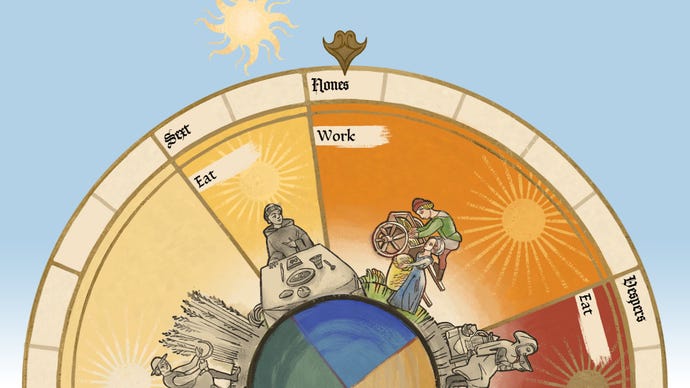
Time fliesYour day is structured into segments and talking to people takes up time. Pentiment is one of the few mystery games that I really want to play again so I can follow other possible leads I missed on my first playthrough.
This tension between the townsfolk and the church is another aspect that you’ll have to carefully navigate, and it’s a big theme throughout the whole game. I think the focus on your relationships on this hierarchical ladder is much better placed than if it were solely on detective work. No Sherlock mind maps, clumsy LA Noire item inspections, no combining tat to make more tat, or obsessive Obra Dinn notetaking.
Sure, the game has plenty of detective game favourites - ciphers to decode, secret passageways to discover, notes soaked with blood, and the like - but there’s much more of a focus on world-building as Pentiment’s story is just as important as its mystery. There’s more than one suspect and you’re more or less free to pursue who you think dunnit, but whoever you eventually point the finger at has a direct impact on this community in what quickly unravels into a 25-year-long conspiracy. It’s difficult to explain exactly how your finger-pointing has impact without spoiling anything, but I’ll just say that I’m desperate for another playthrough to see how else I can twist the course of history for this little European town.
Pentiment is firmly set in medieval history and events, but there are also wonderful sequences of dreams, visions, and folk tales brought to life. |Image credit:Rock Paper Shotgun/Xbox Game Studios
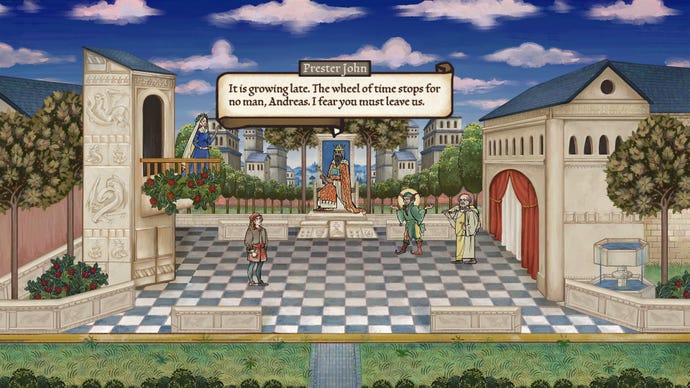
While multiple playthroughs aren’t needed, it almost feels like a must from the sheer volume of historical information Pentiment holds. The love and passion that has gone into researching this period is honestly incredible. It’s all a bit overwhelming at first - what the times of days are called (Terce, Sext, Nones, Vespers??), who the hell Saint Luke is, what wanderjahre means, the various chambers of a medieval monastery, how well you know the writings of Martin Luther and Thomas Aquinas, on and on and on. Thankfully, you don’t need to be a medieval scholar to unravel Pentiment’s mystery (although it would certainly help), and a lot of it went straight over my head, but I love how Obsidian shoved it all in there anyway, together with the art style, the inclusion of so much information further helps the world-building.
I haven’t even talked about the art style yet! I mean just look at it. It’s like you’ve tumbled straight into the pages of an illustrated medieval manuscript. It’s gorgeous, no doubt, but what you can’t tell from the static screenshots is that there are also so many exciting little flourishes that, yet again, show how much love went into this game. A couple of examples: peasants, townsfolk, and church members all have their own style of font depending on their education and status. Ink in dialogue bubbles begin to splatter when the person speaking gets angry. When a character starts to grow old, their artwork will start to show signs of fading at the edges. It’s all beautifully crafted and nicely brings everything else in the game together.
If you’re having issues reading Pentiment’s lavish text, there’s an option that turns it off. Thou hast mine thanks.
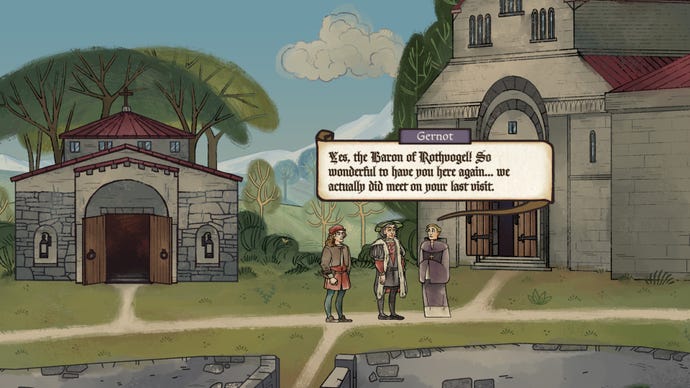
I can’t recommend Pentiment enough. It’s an enthralling murder mystery (with a satisfying conclusion, I might add) and its use of Europe’s rich history during the 16th century as a backdrop is incredibly astute for a detective tale focused on faith and truth. Pentiment can sit nicely next to the likes ofParadise Killer,Disco Elysium, andReturn Of The Obra Dinnas some of the best mystery games on PC. This is definitely one for the history books.
