HomeFeaturesPacific Drive
Pacific Drive is shaping up to be an electric mix of roguelike and driving survivalThere’s a lot going on under the hood here
There’s a lot going on under the hood here
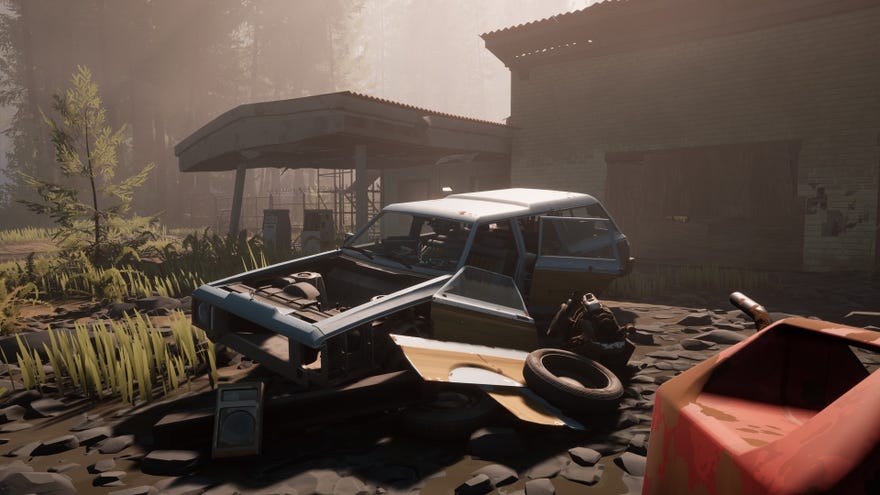
WhenPacific Drivewasfirst announcedduring one of Sony’s State Of Play streams a couple of months ago, my initial thoughts were, ‘Hey, that spooky first-person driving game has some cool sci-fi vibes about it that makes it look like Control on wheels,’ and, ‘Man, I want to find out more immediately.’ Well, thanks to a recent press presentation, I have found out more about Ironwood Studio’s survival roadtrip game, and it’s a lot more roguelike-y than I was expecting. Here’s everything I learned.
Coming to Steam and the Epic Games Store later this year, Pacific Drive is all about exploring the strange landscape of an area known as the Olympic Exclusion Zone in the Pacific Northwest from behind the wheel of your trusty old station wagon. You have a garage that acts as your base of operations, and during each run you’ll be plotting your route, collecting special energy cores along the way, and then using those cores to create a portal to beam yourself back to the safety of your body shop to collect your spoils and prepare for the next drive.
Pacific Drive | 2023 Gameplay TrailerWatch on YouTube
Pacific Drive | 2023 Gameplay Trailer
The hands off demo I was shown was set a little way into the game, just after you get stranded inside this mysterious exclusion zone. Here, you discover your car, “but not everything with it is quite as it seems,” Ironwood founder and creative director Alex Dracott tells me. “You get caught up in this mystery of where did this car come from, what makes it special, and that’s going to lead you further and further into the zone.”
He hands the reins (or should that be keys?) over to lead game designer Seth Rosen, who performs a couple of important checks before heading out on a supply run to show us the ropes. He tops up the car’s petrol, charges the battery, repairs some damage on the doors, and generally makes sure the car’s in tip top shape to be taken out. Then it’s over to the back wall where a large map hangs in the corner.
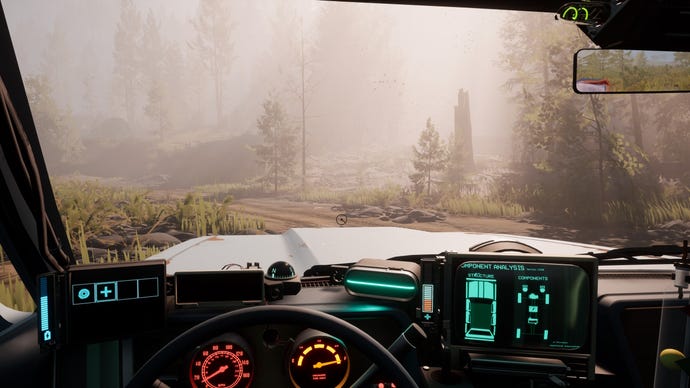
Your car’s dashboard gives a wonderfully analogue overview of your car’s current health.
“When you start the game, the only icon that’s going to be there is the home base of your garage,” says Rosen. “As you progress through the game you’re going on these journeys out in the Zone, and each time you make a successful run and return to the garage, you discover a new junction and it reveals the adjacent roads from that junction, allowing you to explore deeper and deeper into the Zone.”
For the purposes of our demo, the devs note that they’ve scripted a lot of what we’re about to see, but in the final game, each run will be heavily randomised to offer fresh experiences each time you head out. This includes the weather and types of hazards you’ll face, the radiation density, the stability of the portal gates you create, how volatile the zone is in general, and the size of the area you’ll be driving through. Most places are at least 1km squared in size, says Dracott, and many of them will require you to go off-road to track down what you’re looking for. At first you’ll be going in blind to a lot of these places, but over time you’ll be able to use a scanning device to find out more about a particular junction point, arming you with more knowledge to make better decisions about what kind of equipment to take with you as you pack your boot and roof rack.
When you’re in the car itself, you also have a wonderfully diegetic contour map screen mounted in front of the passenger seat, showing you roughly where those all-important energy cores are, as well as other main roads, buildings and points of interest in the area. In the midst of all this, you’ll also be looking for other resources - perhaps to upgrade your car with later when you get back, or to build a new machine in your garage to craft new items - while also contending with the local wildlife.
Pickpocket run off with your door? Scavenage a new one from the many abandoned cars you’ll find on the roadside.
These aren’t your run of the mill forest animals, though. As Rosen starts driving, two “bunnies” immediately jump onto the roof of the car as an abnormally powerful wind picks up. These black, glowing tumbleweed-esque creatures don’t look anything like their namesakes - more “dust bunny” than anything else - but the name does feel strangely appropriate somehow - as do the “abductors” we meet later (big floating turret-like things that shoot out big, long suckers onto your car and other belongings), and the wonderfully chaotic flying octopus-like “pickpockets”, who literally made off with an entire door at one point that Rosen had to go and retrieve - lest he open to the elements the rest of the run. This is still asurvival game, after all, and both you and your car have their own separate health bars you’ll need to take care of during your journey.
“We wanted to design all of our anomalies and gameplay events you’re seeing with this wind squall to be relatively simple in their behaviour, but to have a capacity to combine in interesting ways and create lots of emergent, interesting scenarios,” says Rosen. “And along with that, it’s important to us that, though a lot of the anomalies are pretty dangerous and are more likely to create trouble for you than to help, we wanted to make sure that there is space for creative problem solving and making sure the player has ways to use some of the anomalies to their advantage, or be a little bit inventive with how they’re working around the threats that they present.”
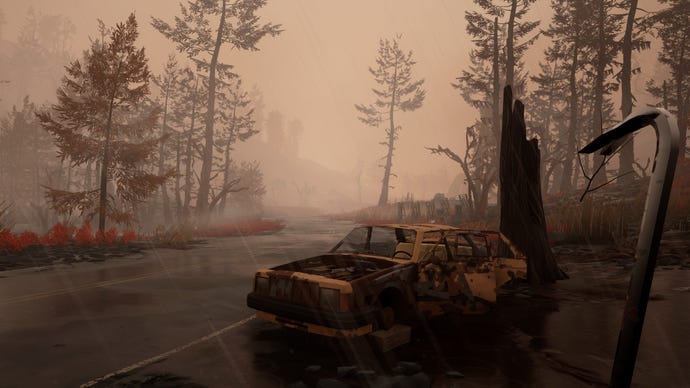
Of course, this being the Pacific Northwest, the weather alone is going to be a constant adversary for the player, with rain and fog (and more powerful, anomalised versions of those systems) featuring prominently in its 24-hour day and night. These weather effects aren’t just extra bits of atmospheric scene setting, though.
Pacific Drive has a full 24-hour day and night cycle you’ll need to content with, as well as its own independent weather systems.
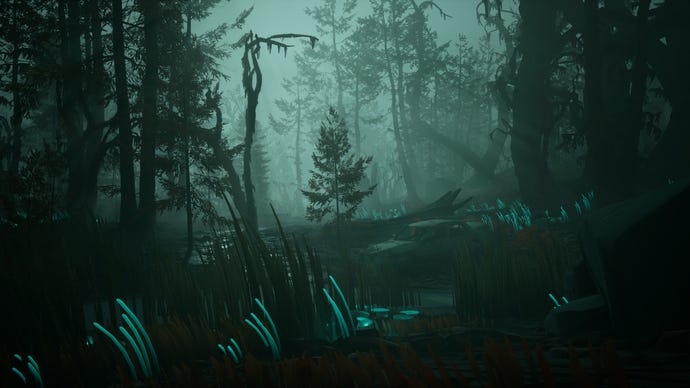
“[The weather] actually does affect the way your car handles,” Dracott explains. “When it comes to car handling, we are aiming to find a balance between [what’s] representative and [what’s] accessible that works and lets you feel the difference between driving off-road or driving in the rain or driving on mud, but isn’t to the point where it’s so realistic and accurate that it’s actually going to annoy you while you play.”
As someone who infinitely prefers the arcade-style racing ofForza Horizonthan the much more serious sim-like approach ofForza Motorsport, say, this is excellent news. Of course, this being a hands off demo, it’s impossible to tell if Dracott and his team have actually found that balance just yet, but I’m hopeful that, between all the windscreen wiper flipping, handbreak pulling and automatic gearstick switching, Pacific Drive will lean into those friendlier Horizon-style driving lines than other, more demanding racers out there.
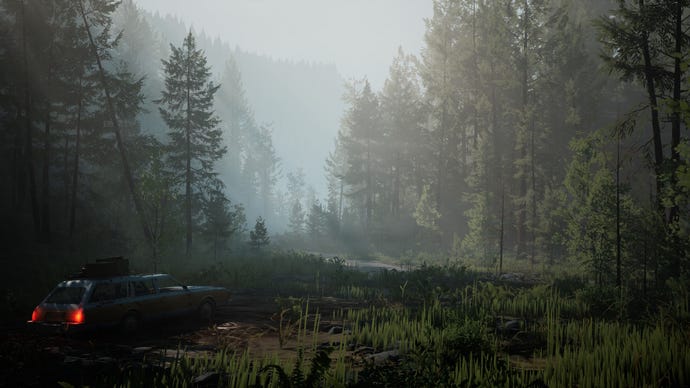
“We want the relationship that you develop with your car to be a primary factor of what this game experience is,” says Rosen. “So to help accomplish that, we’re putting most of the crucial information about the state of your run in the car itself. The car’s health is generally a better indicator of how a run is going than your own health. As long as the car is repaired enough and in good enough shape, it will protect you from all the different elemental hazards and dangers that the Zone offers.”
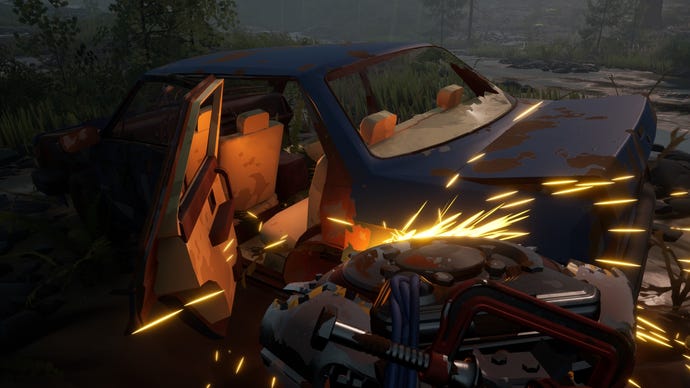
“You do not want to be on the outside of that circle,” says Rosen. “It will melt your car pretty quickly and that’s a good way to not make it back in one piece!”
As the wall of fire approached, the entire screen turned into a hellish nightmarescape. Debris was flying everywhere, the entire world was a deep, dark red, and the trees were shaking like nobody’s business as smoke and mist poured across the road, making it very difficult to see where you were going. Thankfully, the gateway remains visible at all times - a blinding pillar of light stretching up into the sky - but yeah, not a situation you want to find yourself in often, that’s for sure.
Junk in your trunkIn addition to those energy cores you’ll be on the lookout for, there will also be side stories to follow, logbooks from previous Zone travellers to find that add a bit of colour to the world, cassette tapes of (fully licenced) music to play on your radio, and different types of car cosmetics to personalise your wagon with, such as steering wheels, bobbleheads and new paints.
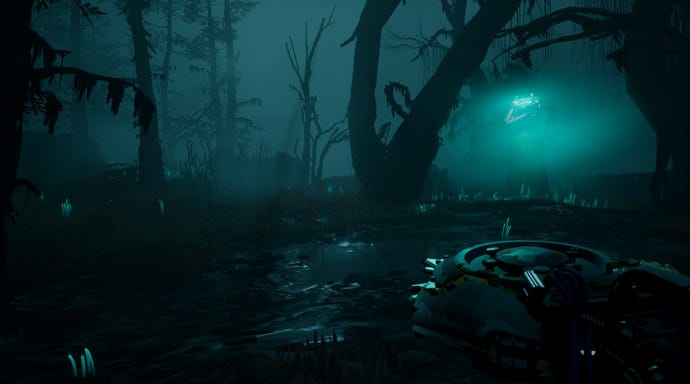
Luckily, the devs still managed to make it back to the garage in one piece, where they promptly went about fixing up their car again after its hellstorm beating. “We want this moment to be a respite, a moment of zen, and a chance to exhale and unload your trunk and maybe use some of the paint your just found while out on your run or change some of the cosmetics or just repair your car to get it back up and running,” says Rosen.
You can also use the energy you collected from the cores to unlock crafting recipes at your Inventing Station, allowing you to make new tools to harvest resources or entirely new machines to place in your garage. The devs chose aDissemblermachine in our demo, which lets you break down resources more efficiently with a higher yield, but I also spotted a “Route Re-analyzer” for finding new routes, a “Fast Gas Pump” to fuel up quicker, and a “Destabilizer” to actively make a Zone more volatile if you’re finding it “too docile”.
Then, once you’re satisfied with the state of your car, it’s back out on the road again and cruising down that familiar, roguelike node map. I couldn’t tell you what lies at the end of it all just yet, but even from that small supply run, Pacific Drive has turned out to be quite a different beast from what I was expecting - and I’m absolutely taken with it. Its friendly blend of survival,managementand base-building elements, along with its arcadey approach to driving, looks like just the right kind of onramp for my particular appetite of these genres, and the Exclusion Zone feels like a weird sci-fi playground just begging to be explored. Its full release can’t come soon enough.
