HomeHardwareNews
Only Nvidia’s RTX 30 Founders Edition GPUs will have dual axial fans and 12-pin power cablesOfficial pictures of Asus' RTX 30 cards are in.
Official pictures of Asus' RTX 30 cards are in.
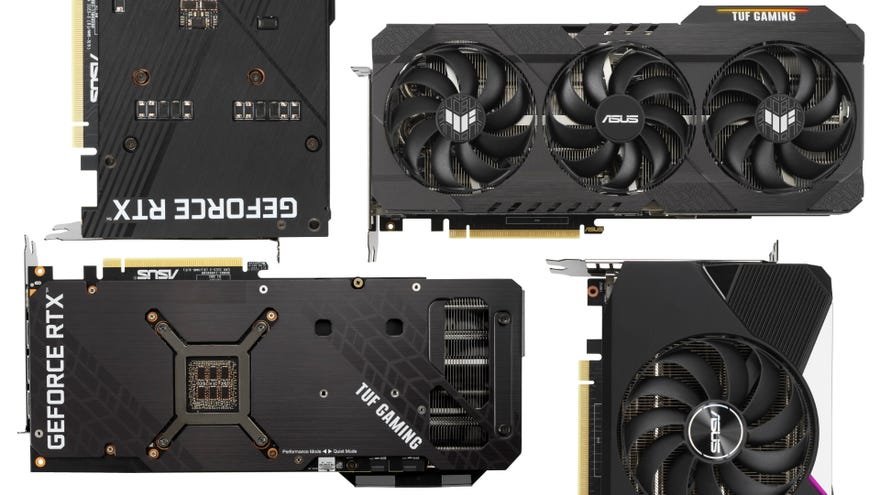
Official images of third party Nvidia RTX 3000 cards show that the unusual dual axial fan and 12-pin power connector design shown off during last night’sNvidia Amperereveal will only be found on the Nvidia Founders Editions of each card. The double-sided fans of theRTX 3070,RTX 3080andRTX 3090are arguably one of the most striking features of Nvidia’s next-gen graphics cards, but anyone buying a card from one of Nvidia’s traditional third party partners will likely get one that looks very similar to their old one. The good news, though, is that you won’t have to throw out your old power supply just yet, as these third party cards also seem to use the same 8-pin power connectors as their RTX 20-series predecessors.
Third party RTX 30 cards are still in the process of being announced, so it’s possible we may yet see some more third party cards adopt a similar design to Nvidia’s three Founders Editions. However, as you can see from the images below, Asus' upcoming line-up of Dual, TUF Gaming and ROG Strix RTX 30 cards all have their fans in the usual, downward facing position, with a bare backplate facing up toward your CPU. You can still see a smidgen of one of the fans coming through on the back in a couple of Asus' RTX 30 designs, namely their RTX 3080 and RTX 3090 cards, but it’s still not quite the same as having a full-blown fan on both sides like Nvidia’s Founders Editions.
This is the Asus GeForce RTX 3070 Dual, which just has two fans on one side of the graphics card like normal.

This is the Asus TUF Gaming GeForce RTX 3080, which has three fans on one side of the graphics card, and a small sliver of one peaking out the back.

Asus' ROG Strix GeForce RTX 3090 also has three fans on one side of the graphics card, and like the RTX 3080 you can see a small section of one visible on the back of it.

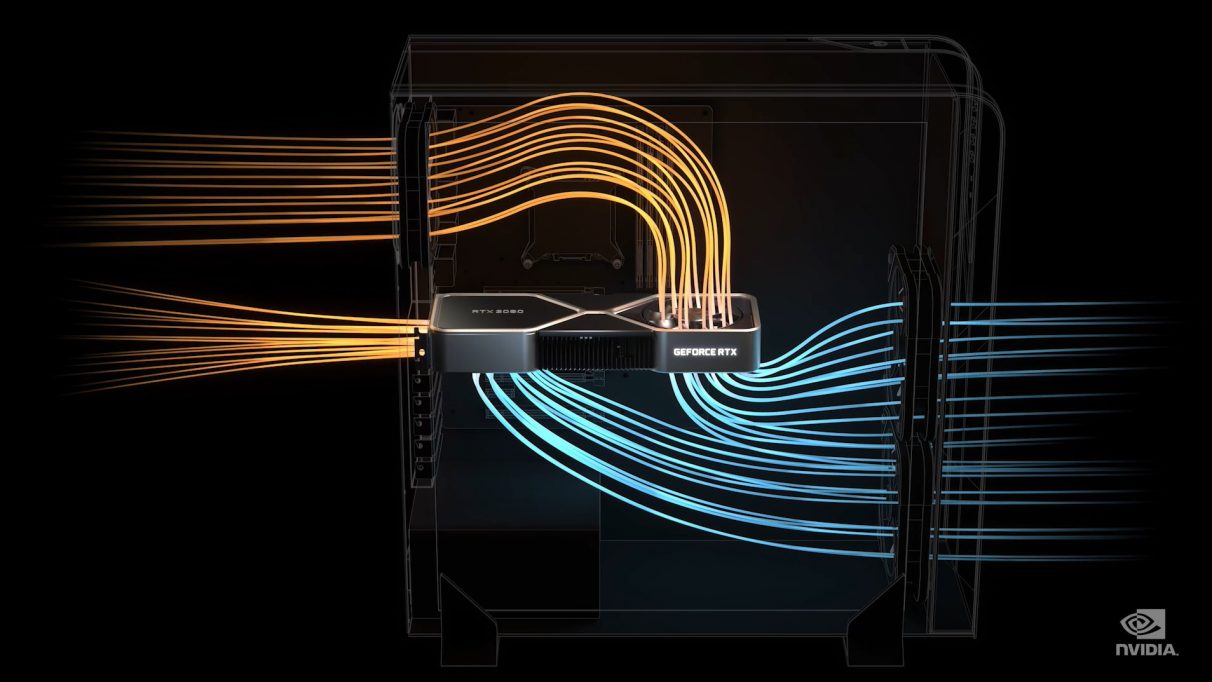
The loss of the dual axial fans is a bit of a bummer in my eyes, especially after Nvidia made such a big deal of it in both last night’s reveal and theirRTX 3000 teaser videoat the end of last week. In the latter, Nvidia made it sound like the dual axial fans played a pretty big role in helping their Ampere cards hit the lofty performance goals they have for this generation of next-gen graphics cards, and that it was critical to achieving their “breakthrough thermal technology”.
It may all be a load of cobblers, of course, as I’ve yet to test any kind of RTX 30 card to see if the fans actually make a difference to their overall performance. Still, if the dual axial design is meant to allow up to 55% more airflow compared to their previous RTX 20 Founders Editions like Nvidia said last night (not to mention being up to 30% more efficient and 3x quieter than the previous generation), I can’t help but feel like having a regular fan design will end up hampering performance in some way.
On the Founders Editions of Nvidia’s RTX 3000 cards, air can be expelled much more efficiently than before.
Still, I’m pleased to see that Asus' RTX 30 cards all have normal 8-pin power connectors like normal, as the initial rumours aboutNvidia’s special 12-pin power connectormade me think I’d also have to buy a whole new power supply to make use of Nvidia’s new graphics cards. It’s since been confirmed that the Founders Editions of Nvidia’s RTX 30 cards will all come with adapters in the box, thankfully, but part of me is relieved I won’t have to deal with them either way.
Asus' RTX 30 cards will have regular 8-pin power connectors just like the previous generation.

Again, I’ll have to wait until review samples are available before I can say for sure whether this will also have an impact on third party card performance compared to Nvidia’s Founders Edition cards, but for now I’m just glad that I won’t have to budget for a new PSU on top of everything else. It also gives me hope that the next-genBig Navicards due out before the end of the year will also use the same 8-pin connectors, too, as I’ve yet to hear any kind of rumour to imply they’ll follow in Nvidia’s 12-pin footsteps at the moment.
