HomeHardwareFeatures
Nvidia GeForce RTX 3070 Ti reviewFar from super
Far from super

Now, we have theRTX 3070 Ti, slotting in between the RTX 3070 andRTX 3080with its alleged starting price of £529 / $599. I say alleged, because in all likelihood you’re going to be paying a lot more than that when it goes on sale tomorrow (June 10th) due to the ongoing graphics card shortage. It’s a bad time to be buying a new graphics card, and if you can at all help it, I’d strongly urge you to just keep what you’ve currently got right now - especially since this whole situation isn’t likely to resolve itself until next year, according to AMD and Nvidia.
If you’ve currently got one of Nvidia’s RTX 20 cards, for example, you’re good. There’s no need to upgrade to an RTX 30 card - not when you’ve still got things like Nvidia’s DLSS tech to help bump up those frame rates in pretty much all of today’s bigray tracing games, and you still get all of the same Nvidia Broadcast gubbins with them as well. And heck, if you don’t already have an RTX card of some description, please, please just hang in there. Turn the resolution down on your monitor, turn the quality settings down,anythingto prolong that upgrade - because it’s just not worth it right now.
Cyberpunk 2077 | Official 4K RTX Launch TrailerWatch on YouTube
Cyberpunk 2077 | Official 4K RTX Launch Trailer
Equally, if you’re already got an RTX 3070 on pre-order from earlier in the year, either as a standalone graphics card or as part of a pre-built desktop (the latter of which is probably the only decent way of upgrading your PC right now that isn’t going to cost you a relative fortune), keep it. There’s no need to upgrade or cancel it to get an RTX 3070 Ti, because according to my benchmark figures at least, you’re looking at pretty much identical performance across the board between these two cards. It’s nowhere near the RTX 3080 as you might traditionally expect from one of Nvidia’s Ti GPUs, and in a lot of cases only offers a handle of more frames per second than its vanilla sibling.
In fairness, the RTX 3070 Ti has received a much more modest spec bump over the RTX 3070 than what we saw with the RTX 3080 and 3080 Ti last week. For instance, we’ve still got 8GB of VRAM here, only now it’s the faster GDDR6X type rather than plain old GDDR6. It’s also only got a fraction more CUDA cores, rising to 6144 from 5888 - an increase of just 4% compared to the 17% CUDA core increase we saw between the RTX 3080 and 3080 Ti. The 3070 Ti has slightly faster clock speeds than its vanilla sibling, but the downside is that it’s a lot more power hungry, with a GPU power of 290W, up from 220W. This increase has also forced Nvidia to raise their recommended PSU power for the 3070 Ti as well, with it now joining the same 750W PSU ranks as the rest of Nvidia’s higher-end RTX 30 family, as opposed to ‘just’ 650W for the regular 3070.
Unfortunately, all that extra power has resulted in an embarrassingly small boost to the RTX 3070 Ti’s overall performance. At 4K, you’re still looking at 50-60fps speeds on High settings in pretty much all of today’s biggest games, and at 1440p you can expect anywhere between 60-100fps on max settings depending on the game’s vintage - just like the original RTX 3070. Seriously, if you want to know what the RTX 3070 offers over its old GTX 1070 predecessor, go and read my originalRTX 3070 review. It’s all covered in there. In this review, I’m going to focus on what the 3070 Ti offers over its vanilla sibling, which as we’ll soon see, is not a lot.
Like Nvidia’s other RTX 30 Founders Edition cards, the RTX 3070 Ti FE comes with a special 12-pin power connector (don’t worry, though, an adapter is included in the box). Third party cards, on the other hand, will use a regular 2x 8-pin power connector.

Nvidia RTX 3070 Ti: 4K benchmarks
To test the RTX 3070 Ti, I was sent theNvidia GeForce RTX 3070 Ti Founders Edition, which will be available alongside other third-party cards when it goes on sale tomorrow. It borrows a very similar design to the vanilla RTX 3070 FE, utilising the same front and rear fan design and two-slot size dimensions. It was a little loud under load, but nothing like the deafening levels of air hangar jet engine fans I saw on the third partyRTX 3080 Ticard I tested last week.
As per usual, I paired the RTX 3070 Ti with myIntel Core i5-10600Kprocessor and 16GB of RAM with a 750W power supply. Sure, my choice of CPU might not be quite as ‘premium’ as the card itself, but the aim, as always, is to give an accurate representation of what you can achieve with these cards on an ordinary mid-range gaming PC. After all, you’re still GPU bound when playing games at 4K (and 1440p, to a large extent), and I’ve tested enough CPUs over the years to know that a faster processor isn’t going to make a tangible difference to your overall frame rate at these higher resolutions. You might squeeze a few extra frames out at 1080p with a faster CPU, but let’s be honest, you shouldn’t be buying an RTX 3070 or 3070 Ti for playing games at 1080p. There are much better and (usually) cheaper options for playing games at this resolution, such as Nvidia’s ownRTX 3060, which can easily deliver 70-80fps on max settings at 1080p, if not higher once you knock the settings down a bit. Really, you should only be considering an RTX 3070 or 3070 Ti if you have a 1440p, 4K or ultrawide gaming monitor. Anything else is overkill.
And frankly, I’m struggling to see the point of the RTX 3070 Ti at all right now, especially at 4K. InTotal War: Three Kingdoms, for example, while the RTX 3070 Ti managed a respectable average of 52fps on High in the game’s built-in Battle benchmark, this is only a 2fps increase over what I saw on the vanilla 3070 at the end of last year. Dropping down to Medium, the Ti came in with an average of 80fps, which to my eyes is pretty much the same as the regular 3070’s average of 78fps.
Also like Nvidia’s other RTX 30 FE cards, the RTX 3070 Ti has a fan on the front and back of the GPU to supposedly aid air flow inside your case.

It was a similar situation inMonster Hunter: World, too. While the 3070 Ti’s average of 47fps was perhaps a touch smoother on Highest than the vanilla 3070’s 45fps average, stick on DLSS and both cards are capable of hitting a smooth 60fps or above - a 65fps average in the case of the regular RTX 3070, and 68fps on the Ti. That’s not the kind of difference my eyes are able to appreciate on a high refresh rate monitor, and certainly not the kind of difference I’d expect given the Ti’s higher starting price.

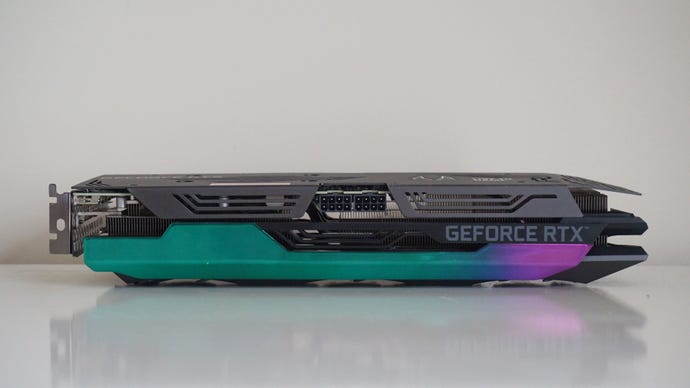
To get a sense of whether customised third party cards might offer slightly more performance than Nvidia’s RTX 3070 Ti Founders Edition, we’ve also been benchmarking Zotac’s GeForce RTX 3070 Ti AMP Holo edition this week. LikeZotac’s RTX 3080 Ti version of their AMP Holo, this is a large GPU that would have required us to remove some of our case’s HDD bays if they hadn’t been taken out already. Thankfully, it’s much quieter than the 3080 Ti model we tested, although its fans still kick up more of a fuss than Nvidia’s FE version under load. It’s also got a plentiful supply of RGB lighting, and a top boost clock speed of 1.83GHz - that’s up from the FE’s max speed of 1.77GHz.
In practice, the Zotac AMP Holo was, in fact, a teensy bit faster than Nvidia’s Founders Edition card, but on average I only saw an increase of around 1-2fps, both 4K and 1440p, which still doesn’t put it anywhere near the RTX 3080. Its 1080p speeds, meanwhile, were much of a muchness.
So yes, it’s likely that the Nvidia FE version of the RTX 3070 Ti isn’t the best one out there, but when third party cards tend to cost a lot more than Nvidia’s FE card (which is usually always available at the proper starting price), any increase you’re getting isn’t going to be proportionate to how much you’re actually paying.
Metro Exodussaw both cards within a hair’s breadth of each other as well, with or without ray tracing and DLSS thrown into the mix. Both cards were most comfortable on High at 4K, with the 3070 finishing its tough internal benchmarking tool with an average of 59fps compared to the Ti’s 62fps average. Add Ultra ray tracing and DLSS into the equation, though, and you’re looking at an average of 50fps on the vanilla 3070 and 52fps on the Ti, which to me felt nigh-on identical in practice.
It’s still not massive in the grand scheme of things, though, and the only other game I saw a similar 7fps-sized bump in wasShadow Of The Tomb Raider. On Highest with its regular SMAA anti-aliasing setting enabled, for example, the Ti managed an average of 69fps in Tomb Raider’s internal benchmarking tool, which on paper looks like a semi-decent bump from the vanilla 3070’s 62fps average considering the paltry gains we’ve seen elsewhere so far. However, when the RTX 3080 can do a whopping 93fps average on those same settings, it still feels intensely underwhelming. Even worse, add its Ultra ray traced shadows and DLSS into the mix and the Ti actuallyfell behindthe regular 3070 in my tests, managing an average of just 49fps versus the vanilla 3070’s 52fps.
InHorizon Zero Dawn, it was the vanilla model out in front again, too, coming in with an average of 66fps on its Favour Quality setting over the Ti’s 65fps average, and 80fps on Original over the Ti’s result of 78fps. Indeed, inAssassin’s Creed Valhalla, the 3070 Ti showed no improvement over the regular 3070 whatsoever, coming in with an identical average of 60fps on Medium, and 50fps on High.
Even older games such asThe Witcher 3didn’t show much of a boost with the Ti. Both cards can easily hit 60fps on Ultra settings here, but to me, the vanilla 3070’s average of 63fps felt just as smooth as the Ti’s result of 67fps. The same goes forFinal Fantasy XV, too. While the RTX 3070 Ti feels a little more agreeable on Highest, averaging 59fps versus 54fps on the normal 3070, all of this is made null and void once you enable DLSS, with both cards hovering around the 70fps mark.
A close-up of the RTX 3070 Ti’s 12-pin power connector adapter.

Nvidia RTX 3070 Ti: 1440p benchmarks
If you were hoping for a little more good news in the 1440p department, I’m sorry to say the Ti disappoints here as well. As I said earlier, you can still expect speeds of around 70-90fps on max settings at this resolution, but in terms of what the Ti offers over the regular 3070, you’re only looking at a similar 2-5fps boost as what we saw at 4K.
InShadow Of The Tomb Raider, for example, the Ti’s average of 88fps on Highest with its top SMAA x4 anti-aliasing setting looks and feels lovely and smooth, as does its 83fps average with Ultra ray traced shadows and DLSS switched on. Is it noticeably better than the vanilla 3070’s respective speeds of 83fps and 81fps, though? Not really.
Heck, the gap was even narrower inTotal War: Three Kingdoms, with the Ti’s average of 72fps on Ultra settings barely scraping ahead of the vanilla 3070’s 71fps average.Assassin’s Creed Valhallapushed that gap to a whole 2fps, with the Ti averaging 65fps on Ultra High, but both cards scored an identical average of 72fps on High here.
Final Fantasy XVfelt much the same, too, with the Ti’s average of 96fps on Highest barely registering against the regular 3070’s 92fps average. There was another 4fps gap inMonster Hunter: WorldandHorizon Zero Dawnas well, with the Ti coming out on top in both instances with an average of 87fps in MonHan and 100fps in Horizon, but my eyes aren’t nearly sensitive enough (nor are anyone else’s, I suspect) to distinguish that from the regular 3070’s respective averages of 83fps and 96fps.
The RTX 3070 Ti proved no more adept at handlingMetro Exodus' demanding ray tracing presets either at 1440p. Both cards scored an identical average of 81fps on Ultra settings in its tough internal benchmark, and both returned equally smooth scores of 68fps with Ultra ray tracing and DLSS thrown in.

Should I buy an RTX 3070 Ti?
Ultimately, the RTX 3070 Ti is probably one of the most disappointing Ti cards in recent memory. Much like theRTX 3080 Ti, it’s still a stonkingly powerful GPU, but it offers so little over its vanilla sibling that it’s barely worth bothering with. It might be a different story if this was a ‘Super’ card coming in at the same price as the regular 3070, like Nvidia did with theirRTX 2070 and 2070 Supercards a couple of years ago, but when Ti cards have traditionally been about getting that high-end performance for a little bit less than the card above it, the 3070 Ti just doesn’t cut the mustard.
If we weren’t suffering from a massive graphics card shortage right now, I’d recommend the regularRTX 3070in a heartbeat, as this still offers more than enough power for 4K, 1440p and ultrawide gaming alike, and would normally be much better value for money than shelling out an extra £100 / $100 for the Ti. I’d also recommend the regular RTX 3070 over its closest AMD rivals, too, because until AMD’s DLSS-alike FidelityFX Super Resolution technology gets off the ground (and has a good number of supported games), there’s simply no competition when it comes to those high res gaming speeds - with or without ray tracing. Meanwhile, those after even more power for high-end 4K gaming should look for theRTX 3080, which offers substantially faster speeds than the 3070 and 3070 Ti for $649 / $699 - just £100 / $100 more than what the 3070 Ti should normally cost.
Of course, these are far from ordinary circumstances. If you’re after a standalone GPU, you’re likely looking at very similar prices for the RTX 3070 and RTX 3070 Ti at the moment, in which case, sure - if you absolutely must upgrade your GPU right this second and you can’t find an RTX 3070 for less, then you might as well go for the Ti. If you can afford to wait, though, then please, please do so. The 3070 Ti just simply isn’t worth paying through the roof for, especially if none of the current or futureray tracing gamestake your fancy right now.
