HomeFeaturesYedoma Globula
My journey to the bottom of a bottomless worldA load of balls
A load of balls
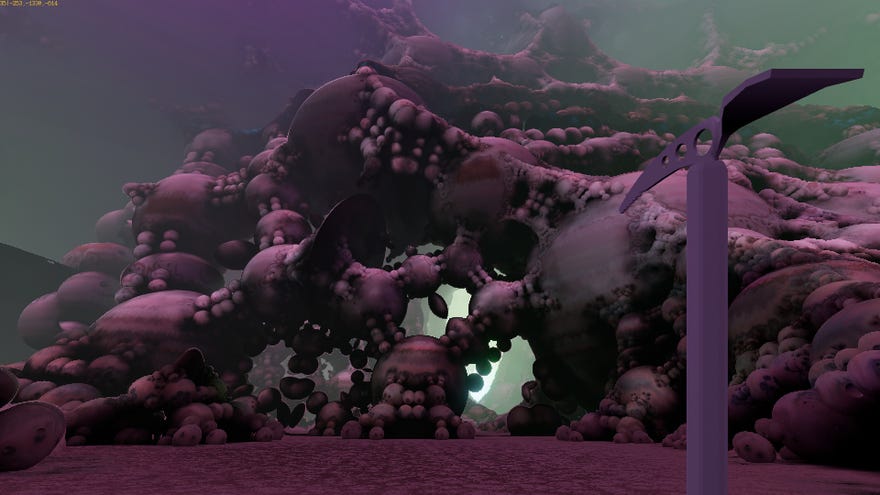
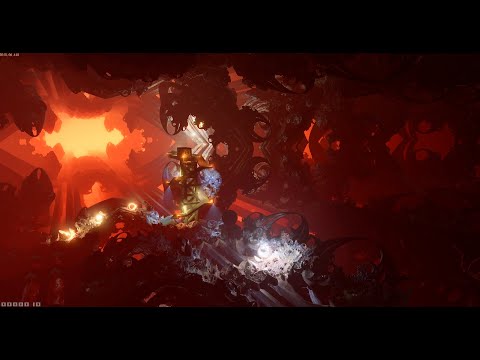
I remember the first time I thought I’d gotten to the bottom of Yedoma Globula. I was descending through a chasm in my airship - a beautifully ramshackle steampunk vessel, the only homely object in the game’s fathomless procgen world, with a charming, leather-bound steering wheel and, as it turns out, seriously inadequate handrails. Disengaging from the wheel, I fired a flare over the side and accidentally threw myself after it.
Yedoma Globula introduction.Watch on YouTube
Yedoma Globula introduction.
Dusting myself off, I found myself on a vast plane. Far away, the floor sloped up into fog. A little nearer lay angular drifts of symmetrical orbs, some big enough to stand on, others glinting flecks like drops of ocean spray. Checking my map, a 3D wireframe apparatus redolent of the Homeworld series, I saw that I’d fallen beneath the cluster of so-called “biomes” the game’s Russian creator, Bananaft, has mapped out for visitors.
Perhaps this is it, I thought to myself - the bedrock of this strange, imponderable universe. But then something occurred to me. Among Yedoma Globula’s handful of spelunking tools is an energy ball launcher that leaves short-lived craters, the edges sucking back together after a couple of seconds. I’d used it like a machete to widen gaps and slice through fussier bits of free-floating geometry. But what if I used it like a drill?
I experimented with blowing holes directly underfoot and found that, with reasonably careful timing, I could burrow deeper and deeper before the ground filled in. The surface sealed itself overhead as I gouged and blasted. I swallowed my claustrophobia and kept digging. Each flash of detonation revealed a screenful of warping texture. Then, without warning, I burst through and found myself falling once again, into a world both different and the same.
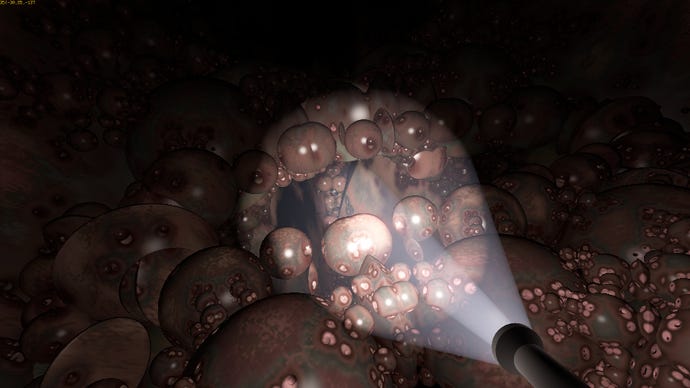
Part of Yedoma Globula’s thrill is that it’s unfinished. Devoid of objectives, NPCs or utilities beyond a handful of airship jetties and some horrifying devices that call themselves teleporters, it’s a testament to how engrossing virtual landscapes can be when you resist the urge to fill them with routes and handholds. It’s a universe of chance gaps and unfriendly surfaces - porous floors that drop you into caverns so large there is no hope of return. But what makes it truly eerie is that it consists of 3D fractals.
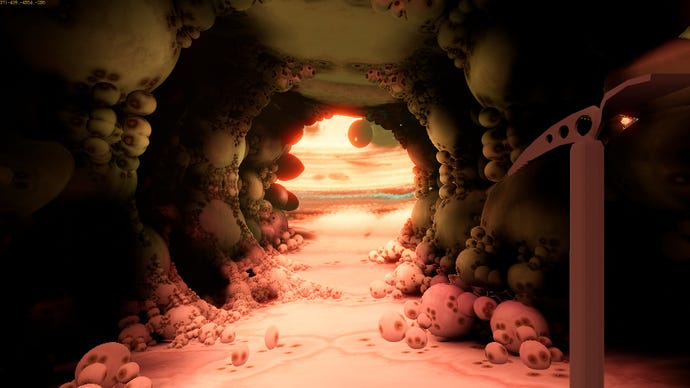
These structures, indissociable from the rise of computer graphics, are mesmerising aesthetic objects. But fractals aren’t just ephemeral trinkets: they occur in everyday reality as well. Coastlines, for example, look similar whether you’re gazing from orbit or inspecting the beach between your toes. Pineapples grow according to fractal principles. The human lung branches like a tree, repeating itself at smaller and smaller magnifications.
In Yedoma Globula, the repeated shapes are orbs, some planetary in scale, others tiny beyond sight. Often the results are beautiful, thanks not least to an eldritch play of lighting conditions I’m still trying to decipher. (There is apparently a day-night cycle - I have yet to locate the sun.) Sometimes, the surfaces call to mind intricate lacework, or snowflakes - another example of fractals in the wild.
Other times, it’s like staring through a kaleidoscope into the eyes of a spider. The textures in themselves are worryingly organic, like flesh smoothed and polished into marble. But the idea that this is all one shape on endless repeat is a far more dreadful prospect than any passing resemblance to the art of H.R. Giger. In Mandelbrot’s view, the entire universe may amount to grander or smaller iterations of the same, played out indefinitely. Where does that leave you and I, creatures whose ability to comprehend the world seems to require distinctions and a degree of finitude - each individual thing taken this far and no further?
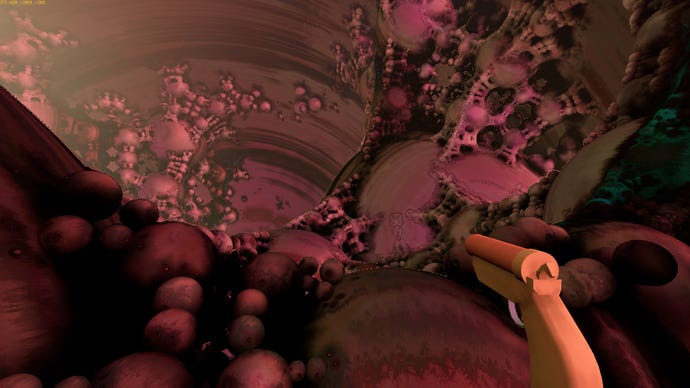
It was with such questions in mind that I began an afternoon-length excavation of Yedoma Globula’s underside. I was hell-bent on uncovering either a hard barrier or a part of the world not comprised of self-replicating spheres. (I haven’t asked Bananaft to talk me through the game’s innards – he’s already writtenan essay about programming a fractal engine, which I understand approximately one tenth of, and besides, that would be spoiling the fun.) Like Samus Aran wielding a noclip cannon, I crept between the rinds of nested spheres, using flares not just for illumination but to work out which direction was down. I bounced through catacombs of overlapping interiors, and stumbled along bridges of pearls. I broke the skin of the world again and again.
I developed a particular appreciation for the game’s scanners. One of them, I belatedly realised, is an X-ray mapper, piercing walls and floors to reveal navigable surfaces beyond. With this latter discovery, I became more scientific in my descent, tunnelling toward the bigger, hollow spheres where I could let good old gravity take over.
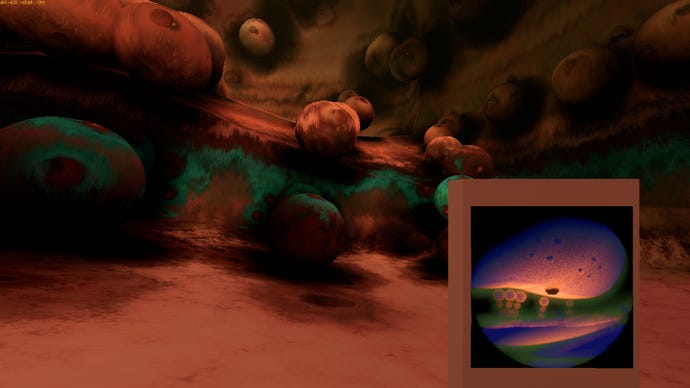
Over time, I gleaned a little of the artistic intent alternately guiding and meddling with the procedural generation. Yedoma Globula is far from a work of sheer abstraction: there’s a curated air to the central “biomes”, where lightpoles lead you toward apertures, and a sense of hidden, even sinister consequence to the tools. Take the teleporters, which are the only structures marked on your map screen. I’m still trying to work out what they’re for, but suffice to say they don’t always teleport you. The one on your airship is safe enough, whisking you back to the starting area, a small outpost of reassuringly non-fractal metal ramps and pipes. The ones you find further afield are… messier.
And then there’s the name. “Globula” means globe-shaped. “Yedoma” is apparently a kind of permafrost dating back to the Pleistocene, the thawing of which is a major source of atmospheric methane. There are shots of permafrost landscapes in Chukotka on Bananaft’s Twitter feed. I don’t know what this bodes, but it suggests that the game is about more than numbers talking to themselves. I also don’t know why some of the spheres emit noise: a gentle, cushioning roar, like the engine of a passenger plane.
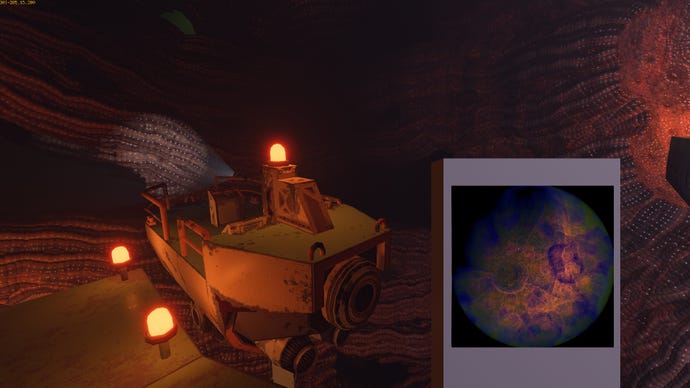
It’s to be hoped that later versions of the game - Bananaft’s plans include multiplayer, fauna and bigger airships - leave some of these mysteries intact. The last thing I want this terrifying, neurotic cave system to be is fully explicable. The developer’s efforts to organise it into a game already feel like an intrusion, crude edifices and implements shoved into a realm that doesn’t really exist for human consumption.
I could definitely do with a universal save function, though. After four hours of heroic tunnelling I had to break off my descent to make tea, whereupon I discovered that I had no means of preserving progress. How would I mark this colossal enterprise? I mooched around a bit, then, in a fit of hubris, stencilled my name on a cave floor using the game’s rudimentary base-builder (right now, all it’s good for is metal platforms). Put that in your pipe and smoke it, Tenzing Norgay.
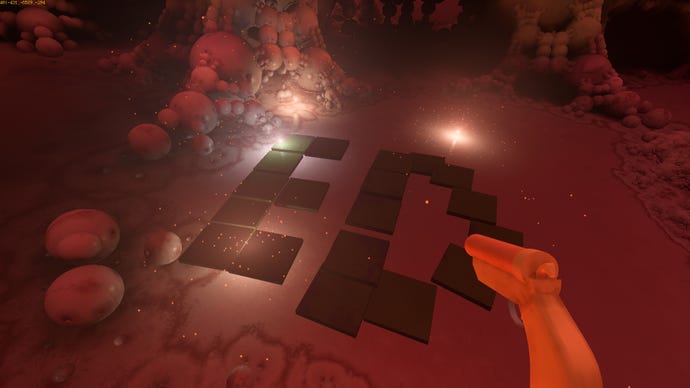
The end? Not quite. It occurred to me that while I’d spent plenty of time drilling down, I had yet to do much horizontal pioneering. Starting a fresh save and jumping aboard my airship, I plotted a route between the larger spheres and outward into the seeping expanse of the skybox.
Everything solid slowly vanished behind me. I could see nothing ahead save nebula-like formations that seemed, at times, like distant cavern walls. Would I reach a final, all-encompassing sphere, like the realm of the divine in medieval cosmologies, or just chug along until my laptop battery gave out? I held a steady course for about 10 minutes, pausing now and then to ponder the lonely green triangle surfing the blackness of the map screen.
My finger began to ache from holding down the W key. Perhaps all there was to see out here was sky. But even skyboxes are finite, right - why else would they call them boxes? And what of the terrain beneath? Flexing my cramped hand, I peered over the side to launch some flares and fell out of my airship once again.
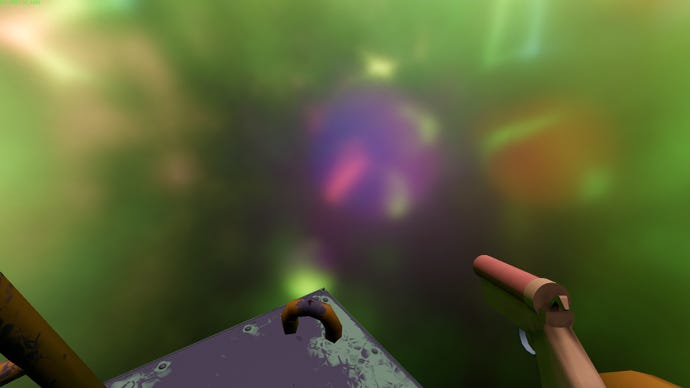
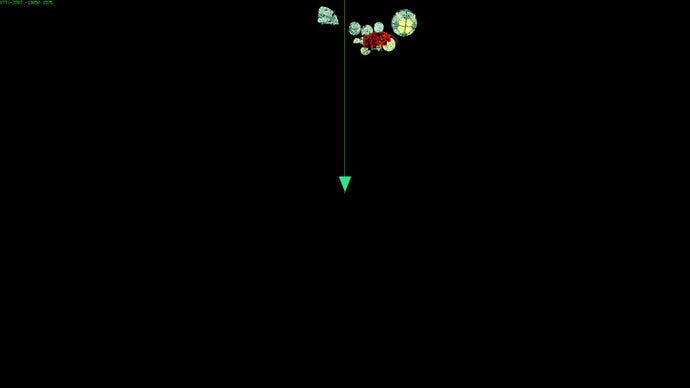
15 minutes of freefall. I fired my jetpack a few times to alleviate the boredom. 20 minutes. The sky darkened. I got up from the computer, made myself a coffee and started writing this article.
Suddenly I heard it again, that faint roar of a passenger jet engine. I jumped up from the table and went back to the computer. I looked around but everything appeared the same. Then I opened my parallel world visor and saw something miraculous - a shaft of gauzy, orange light, like a planet’s ring when seen through its edge, petering away to nothing at its base.
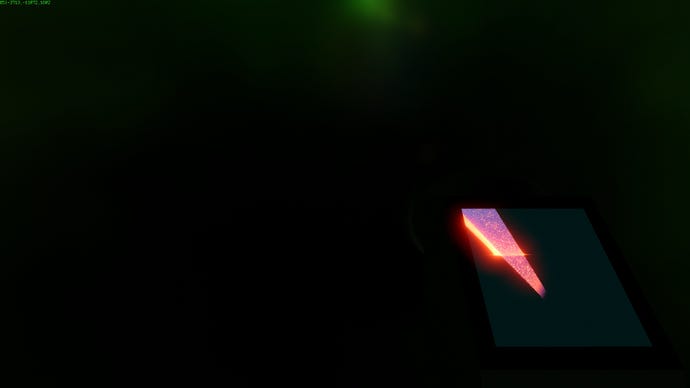
I waited for another 10 minutes, monitoring this bizarre, and as far as I could tell, non-spherical phenomenon, chucking energy grenades at it, trying to jetpack over to it. No further developments.
I’m still falling.
