HomeHardwareFeatures
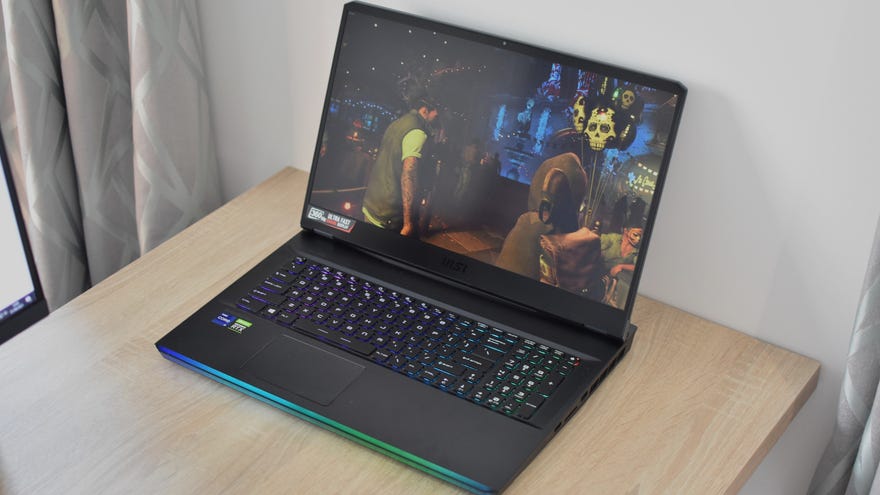
Intel have chosen an interesting time to launch theCore i9-11980HK, their latest top-of-the-line CPU for gaming laptops. Their 12th-gen Alder Lake chips, after all, are launching in what’s likely a matter of weeks. Why, then, should you drop£4098/$3400on a laptop like the MSI GE76 Raider, even if its 11th-gen chip is primo for the time being?
The answer lies in a combination between what the Core i9-11980HK has to offer, even compared to earlier 11th-gen chips, and the sheer luxury of the GE76 Raider as a whole. This is a mad machine for the madly monied, from its 360Hz screen to its RTX 3080 GPU and PCIe 4.0 SSD storage.
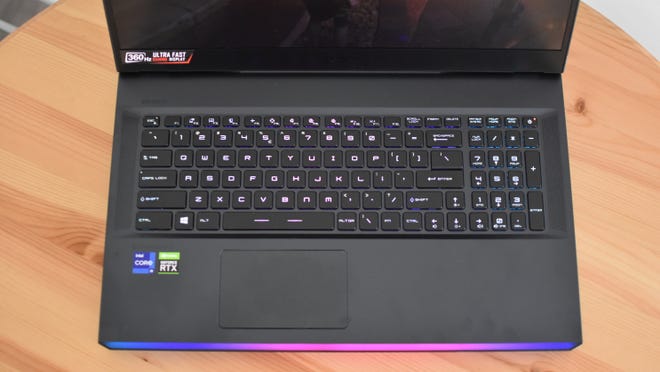
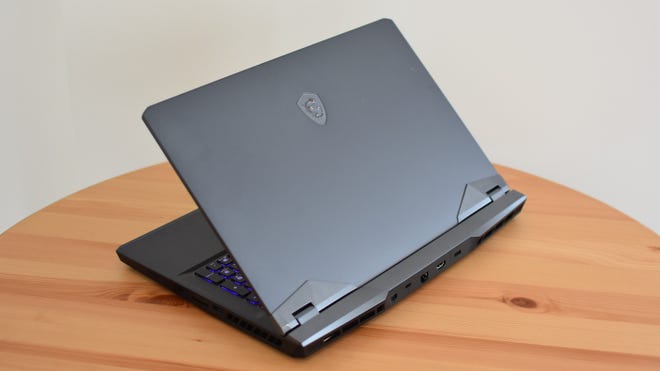
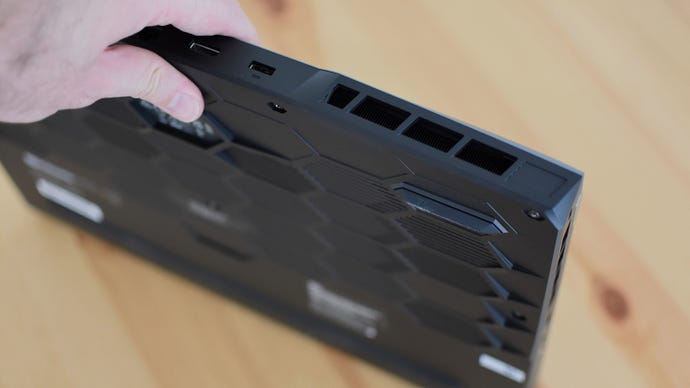
Other than a teeny touch of flex to the screen, the GE76 Raider is finely crafted throughout. Although the 17.3in screen, top-end components and comprehensive cooling system preclude a thin and light frame, it’s not unreasonably chunky, and the only real gamerish facets of the design are the RGB keyboard and light bar across the front edge. You can customise these to be less showy, if you like.
Top 10 New PC Games For September 2021Watch on YouTube
Top 10 New PC Games For September 2021

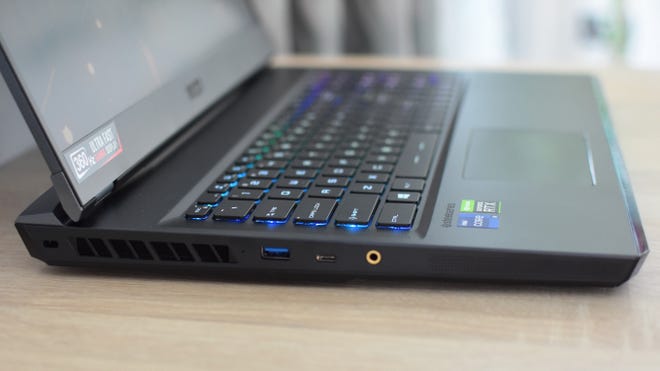
There’s a good mix of ports as well, including that Thunderbolt 4-ready USB-C port at the rear. Another perk of the Core i9-11980HK is that support for Wi-Fi 6E, though you’ll need to pair the GE76 Raider with a 6E-compatible router to get the most of its added speed. For what it’s worth, downloads were still as fast as I’ve seen from my older, built-for-Wi-Fi-5 router.
Back on the subject of cooling, the keyboard – a non-mechanical but firm, responsive and well-spaced design from SteelSeries – only gets slightly warm under load. According to my infrared thermometer, it doesn’t surpass a tolerable 38°c around WASD. It’s mainly the ribbon of aluminium just above that gets toasty to the touch, hitting 45°c under sustained strain.
The drawback is fan noise, which the GE76 Raider is all too happy to share. While running games, you can expect to deal with about 48dBA of whirring; so says the RPS decibel-o-meter. Still, even a laptop as fancy as the GE76 Raider can’t defy physics, and I’d rather just slap on a headset than risk the alternative of slower fans and worse cooling. It’s also worth noting that while there are exhaust vents on both sides, it never felt like my mouse-operating hand was being air-fried.
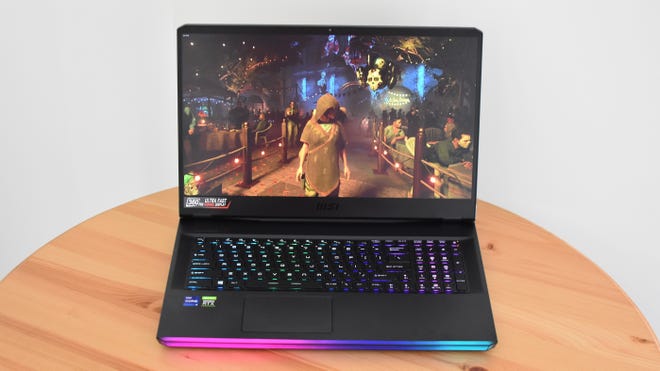
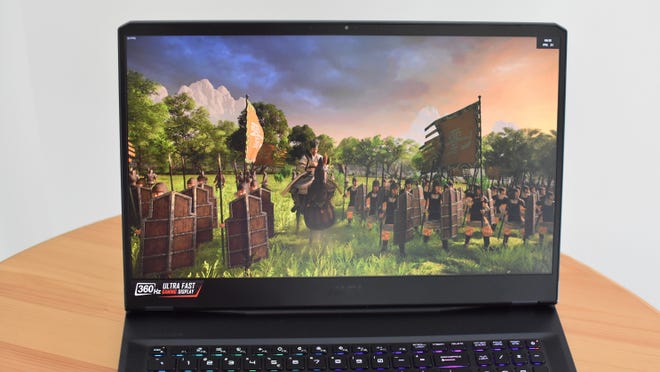
Also specced out at 1080p is the display. This sounds like disappointinglystandarddisplay res for a four grand laptop, but it makes more sense in conjunction with the 360Hz refresh rate: it’s much easier to actually produce enough frames to take advantage of the latter when you don’t have the added GPU stress that 1440p or 4K brings.
Admittedly, outside of the speed-freak refresh rate, this could stand to be a more vivid screen. Contrast ratio only measures in at 772:1, short of the ideal 1,000:1, and together with the so-so peak brightness of 184cd/m2 you’ll be left squinting at darker scenes.
It’s colourful enough, though, being able to cover a respectable 90.4% of the sRGB gamut. And while I’ll admit to scoffing at 360Hz panels in the past, the GE76 Raider does make faster-running games look utterly lush in motion. Even if there are diminishing returns over 240Hz and 144Hz,Team Fortress 2running at close to 300fps looks very swish indeed. There’s noG-Sync, but it isn’t really missed when the refresh rate naturally prevents screen tearing.
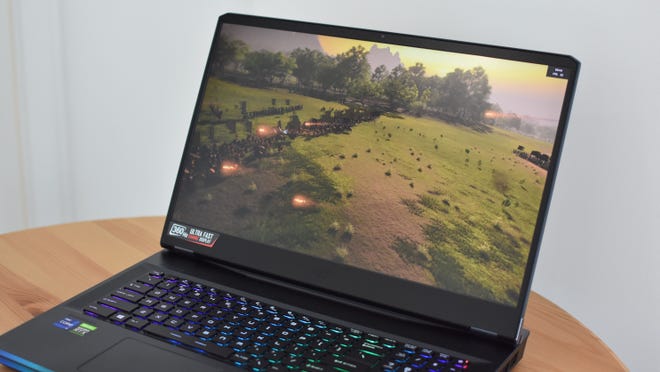
Unlike with cheaper TN or VA screens, you’re also getting wide viewing angles from the IPS panel, and the matte finish MSI that have applied to this screen is effective enough to see off reflections without adding a nasty, grainy look.
Or, at least, it can in certain games, and with certain settings combinations. With the Highest preset but all of its TurfEffects and HairWorks tricks disabled,Final Fantasy XVagain ran best on the GE76 Raider: moseying around the verdant Alstor Slough area produced a low of 83fps and a high of 120fps. The ROG Strix Scar 15 also bottomed out at 83fps, but could only reach as high as 104fps. Turn on TurfEffects and Hairworks, though, and the gap closes, with the GE76 Raider peaking at 80fps and the ROG Strix Scar 15 at 73fps.
The MSI laptop’s advantage was even smaller inMetro Exodus, where a blend of Ultra quality, Ultra ray-tracing and DLSS produced a 65fps average. That’s only a single frame faster than the ROG Strix Scar 15, though keen eyes could see the difference between this performance and the Aorus 15G’s 54fps.
Monster Hunter: Worldalso gave the GE76 Raider a better opportunity to flex, planting itself in the 94-122fps range while out in the field. While this averaged out to about 110fps, according to some very rough notepad arithmetic, you’re still looking at meaningful gains on the ROG Strix Scar 15 and Aorus 15G, neither of which peaked higher than 100fps.
It’s fair to say, then, that the i9-11980HK does a better job of unlocking the RTX 3080 than the Ryzen 9 5900HX. It’s also a slightly better octa-core chip in general, if Cinebench R20 is any indication: the GE76 Raider’s single-core score of 619 and multicore score of 5052 both beat out the ROG Strix Scar 15’s respective scores of 570 and 4935.
I also ran CrossMark, a relatively new system-wide benchmark that tests how well a PC handles productivity and creative tasks. The GE76 Raider scored 1446 overall, and while I don’t currently have any of its rival laptops to compare, I did try Crossmark on my own desktop rig, which has a Core i9-10900K and anRTX 3090. My PC scored 1471 overall, so considering GE76 Raider has to make do with lower-power parts and cramped notebook cooling, I’d say it put in an extremely strong showing.
Yet is it strong enough for – yes, this is going to keep coming up – over £4000? If you’re solely concerned with in-game performance, it probably remains tempting to eat the 1-20fps loss and get the closest equivalent ROG Strix Scar 15 model for £2,400. That’s a towering investment in its own right, but loose change compared to the GE76 Raider.
You can at least add faster storage to the latter’s list of strengths. The GE76 Raider model I received for testing has 1TB of PCIe 4.0 storage space, though it looks like the only available model in the UK bumps this up this up to 2TB – that makes the price a little more palatable. Whatever the capacity, it’s bloomin’ quick, managing random read and write speeds of 57MB/s and 169MB/s. That’s another win over the ROG Strix Scar 15, which posted 48MB/s and 151MB/s respectively.
Ultimately, the only outright weak point to the GE76 Raider’s hardware setup is the battery. This apparently has the biggest capacity a lithium oon battery can offer before it gets you kicked off commercial airliners, but all those high-end components are awfully thirsty. The result? I could only run Shadow of the Tomb Raider for an hour and 10 minutes before the battery called time. I get that this is intended as more of a space-saving desktop alternative than something truly portable, but still, that is not a lot of uptime.
Even so, and definitely in spite of the vast riches required to own one, I very much like the GE76 Raider. It’s the kind of gaming laptop that aims for (and largely achieves) superlative performance, but is sensible enough to avoid the ludicrous excesses of notebooks like theAcer Predator Triton 900.
Of course there are other, better-value alternatives if you simply covet the RTX 3080, and it’s arguably worth waiting to see if Alder Lake includes any laptop chips that can similarly unshackle Nvidia’s speediest mobile GPU. If, however, you want and can afford to have it all, the GE76 Raider will give it to you right now.
