HomeReviewsJett: The Far Shore
Life’s a beach, and then you fly
Image credit:Superbrothers
Image credit:Superbrothers
JETT : The Far Shore - Gameplay Trailer (PS5 | PS4 | PC)Watch on YouTube
JETT : The Far Shore - Gameplay Trailer (PS5 | PS4 | PC)
It’s a backdrop that makes for a winning short science fiction story - one that resists the clichés of its genre and establishes a unique tone, in firm yet gentle fashion. But the conflict, sadly, isn’t limited to plot and themes. The game, too, is at war with itself. One part of Jett wants to be a tightly controlled, linear gallery of gorgeous vignettes. Another is interested, first and foremost, in becoming an experimental pool for playing with an alien ecosystem. Despite several years of development, the two haven’t settled their differences, and that tension is a near-constant source of discomfort throughout Jett’s 12-hour adventure.

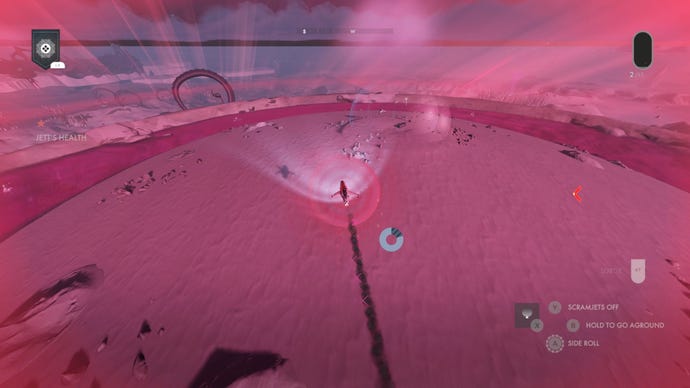
It’s here, in the periphery of your rocket-rambles, that the Shore’s ecosystem shines. Whenever you pass a giant plant, brightly coloured animal or unusual rock formation, you can scan it with a tap of a button and learn something. A bubbling ionic pool could restore your shields when approached, or stabilise a volatile substance. An electric snake might be attracted to your scramjets, causing you to turn them off. Or, rather, leave them on: tempting the serpent into a conductive bramble, which creates an explosion of flowers. In isolation, these qualities are mere curiosities. But you soon realise that they’re all catalysts, designed to change the rules or swap the palette of the surrounding world in delightful ways.
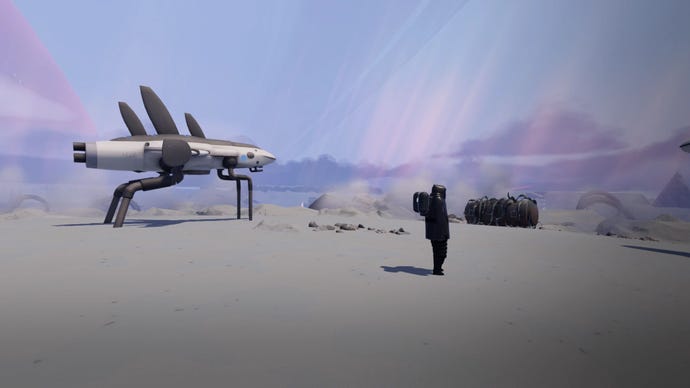
It starts with the shuttle launch that first takes you to the Far Shore, a moving montage of interlocking images that successfully serves a sharp cocktail of emotions - hope for the future, guilt for the “remnants” left behind, the giddy thrill of a long journey somewhere new. As the year counter ticks up, you’re acutely aware that the parents, village and planet you’ve left behind are crumbling to dust. “Those of us who remain will soon recover our sense of the unforgiving,” says dad. “Remember our love,” says mum.
Even in scenes where you’re granted a semblance of direct control, you’re bumping up against walls - some visible, some not. It’s frustrating. But the trade-off for this tight choreography is some of the most extraordinary first-person imagery I’ve ever seen: industrial age chimneys turning the sky sepia; balloon animal grass swaying in an unbreathable wind; a colossal air-whale drifting past a porthole, indifferent to your awe. AsSword and Sworceryplayers will know, few can do symmetry, silhouette, and framing quite like Superbrothers.
Over time, I came to resent the fact that the rituals of Jett’s crew, however charming, took precedence over those I might create for myself. I never set up a shelter that felt like my own, for instance, since my colleagues were always telling me exactly where to park my ship.

But alas, bugs only exacerbate the sense of freedom curtailed. One prevented essential resin from spawning that made a sequence unfinishable until I rebooted the game; another saw Isao pause in uncharacteristic, eternal silence during a mandatory conversation. It’s testament to Jett’s great strengths that, in the language of the scouts, I adapted and persevered through its severe lows.
Once the story finished, I hoped an endgame would open up and allow me to play freely in its world. That I’d have more opportunities to watch great Ghoke, the red sun, rise in real time, and to ponder the Far Shore’s fascinating mysteries at length. Instead, I could only replay previous chapters. If only Jett had embraced a rhythm as organic as its inspired ecosystem.
