HomeReviewsIxion
Ixion review: an intricate management sim wrapped in a stirring space operaHomeworld Bound
Homeworld Bound
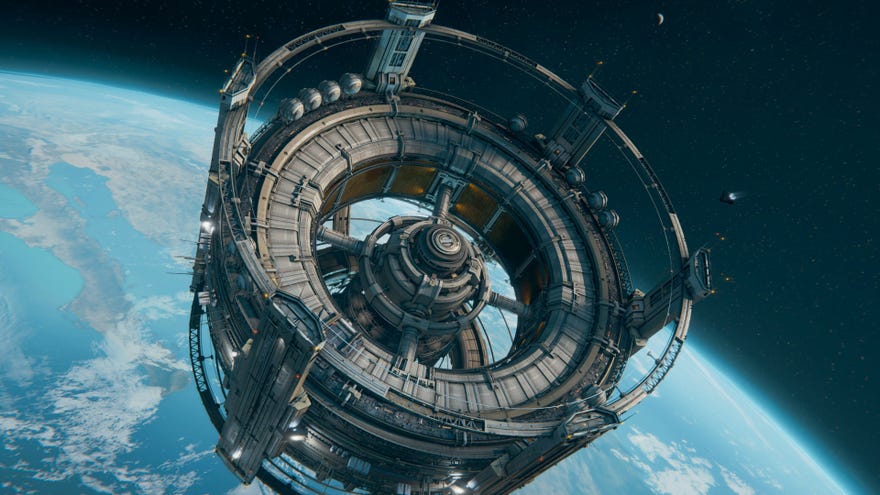
Also like Homeworld, it’s a darned stylish thing. The game commences with a spectacular intro cutscene wherein a futuristic space-shuttle launches from Earth, breaking through the atmosphere to dock with a gigantic, revolving space-station like a chromed hubcap off some petrolhead’s pride & joy. The cutscene neatly transitions into the play-perspective, where you see that same shuttle slide into the docking bay from the cold void outside. Welcome to the Tiqqun, Administrator. Your long journey starts here.
IXION | Epic Gameplay Trailer!Watch on YouTube
IXION | Epic Gameplay Trailer!

The Tiqqun (pronounced “Tycoon”) is an Ark for humanity, or alternatively, a colossal Muskian folly built on the belief that finding a new planet to call home is a better idea than not shitting-up the atmosphere of the one we’ve spent millions of years evolving to thrive on (not that I have strong opinions on the subject). Anyway, the Tiqqun has everything humanity needs, namely tenements, insect-burgers, and a massive engine called the “VOHLE” drive, which allows the station to travel between stars in a way that I won’t pretend to understand. Naturally, when you turn the key in the ignition, something goes wrong. I won’t spoil what, but the net result is the Tiqqun is left broken and alone in the great expanse. From here, you have two basic goals. Keep your crew alive, and find yourself a nice watery goldilocks planet on which you can reboot civilisation.
In play, Ixion is split into three separate, yet interconnected layers. The first of these, and the one you’ll spend the most time in, is the interior of the Tiqqun. This is where Ixion most closely resembles a standard management sim. To keep your crew alive and happy, you need to build them homes, ensure a steady supply of food, and maintain “stability” through constructing specific buildings and enacting certain policies. Doing all of these will require you to establish production chains for various resources, like alloys, electronics, and polymers.

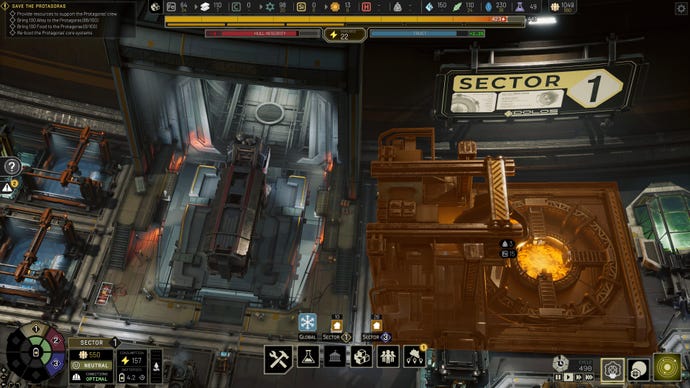
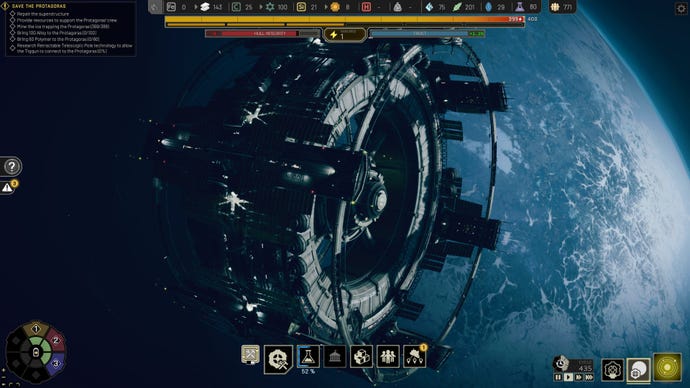
All familiar stuff. But Ixion’s settings adds a couple of wrinkles. The Tiqqun may be huge, but its interior is still finite. Before you know it, you’ll have completely filled the first of its six sectors, and will be cracking open the bulkhead to Sector Two to expand your construction space. Each sector is operationally independent, but most will rely on other sectors to provide them with specific resources. This means you need to manage the import and export of resources between different sectors, establishing a complex web of logistics pipelines that run like arteries through the entire station. The emphasis on spatial management works well with the game’s theme, although it is slightly annoying that you can’t relocate a structure once it has been built, instead having to dismantle it and rebuild it entirely.
The other notable wrinkle is the crew itself. Since you’re stranded in space, your workforce is initially limited. Although you can acquire more workers in ways that I’ll get to, you can’t just create more of them whenever you want, as it would take about eighteen years too long. Hence, you must be careful about how you distribute your workforce, migrating workers between sectors, and ensuring you don’t overload individual sectors with work, as this can lead to accidents and discontent.
At this layer alone, Ixion is a perfectly decent management sim. Balancing the needs of your population with the space and resources available to you makes for some engaging plat-spinning, while setting up a new logistics route and watching all your automated robots pour out of the relieving stockpile is always satisfying. The portrayal of life aboard the Tiqqun is a little sterile, however. Buildings bear a reasonable amount of detail, but your human workers wander aimlessly along pathways. It’s a far cry from the intricate, characterful animation of the Two Point series. This isn’t too much of a problem, though, because most of Ixion’s personality lies elsewhere.
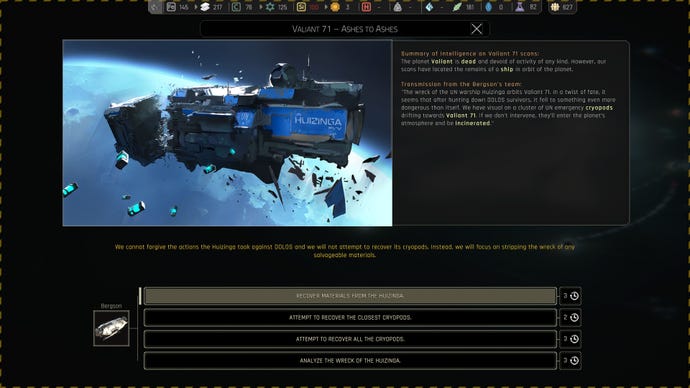
“Ships, you say?” Well, fellow traveller, let me introduce you to the third layer of Ixion – the planetary layer! Here, your perspective zooms out toMass Effect-style overview of the star system you’re currently in, and lets you direct the Tiqqun’s exploration of the system. You’ll launch probes to investigate signals that reveal new resources and anomalies, then dispatch mining and cargo ships to acquire the resources, and science ships to investigate the anomalies. These will reveal nuggets of narrative that, depending on your choices, could result in new resources, a horrible death for your science team, or the discovery of cryopods which you can retrieve and defrost aboard the Tiqqun to gain new workers.
The three layers are all interesting in their own way, but it’s in how they interrelate that Ixion really starts to impress. If a cargo ship brings back a resource to the wrong loading dock, you’ll need to establish a whole new logistics pipeline to get it where it needs to be. Meanwhile, external events, like the loss of a science ship, can have a dramatic effect on crew morale, leading to unrest and even worker strikes. Moving the Tiqqun itself is always a huge event, as the station can only run on battery power while moving, and travelling substantially increases the strain on the hull. Hence, you need to plan and prepare for Tiqqun manoeuvres very carefully, ensuring you have enough stored power to manage the trip, and possibly doing it in stages, hopping from one planet to another.


This aside, however, Ixion is a properly great blend of management sim and sci-fi storytelling. There are a lot of games clamouring for my attention right now,Darktide,The Callisto Protocol, that new God of War over on the devil’s PC to name a few. But throughout my time with Ixion, I was never tempted to sack it off for those bigger, flashier games, which is a testament to its meticulous design, and its engrossing tale of humanity’s search for a new celestial roof to sleep under.
