HomeFeatures
In Frostpunk 2, it’s not the cold that’s your enemy, but human natureAn early look at 11 bit Studio’s ambitious survival sequel
An early look at 11 bit Studio’s ambitious survival sequel
Image credit:11 bit Studios
Image credit:11 bit Studios
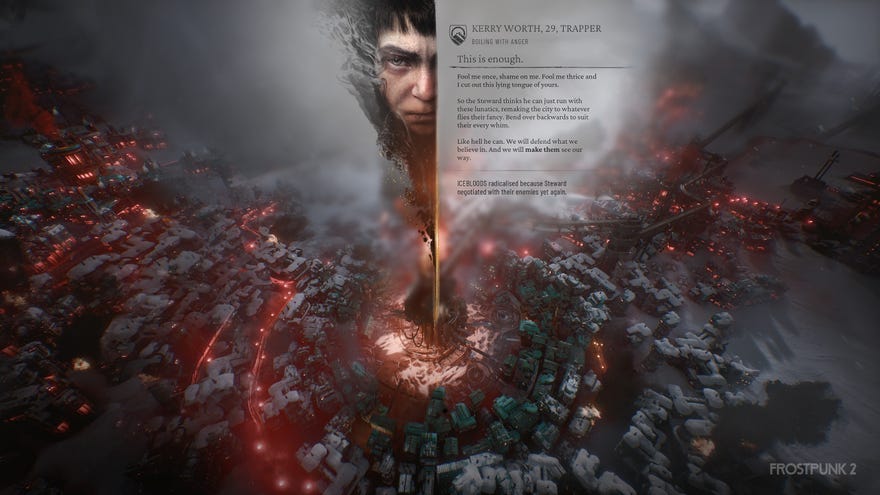
In the frozen hellscape ofFrostpunk, you eked out your existence in hours and days, clinging to your heat- and life-giving generator at the centre of your fledgling city like there wasliterally no tomorrow. In 11 bit Studio’s forthcoming sequel,Frostpunk 2, the apocalypse is yesterday’s news. Now you’re dealing with “what happens when you survive the un-survivable,” as the game’s co-director and design director Jakub Stokalski neatly puts it when I sit down for a hands off presentation at this year’s Gamescom. And to do this, Frostpunk 2 is going big, measuring its time not in days, but weeks, months and even years.
“If we want to show the evolution of societies and different utopias/dystopias, we need breathing room,” says Stokalski. “And this breathing room really is in the scale, both in the physical sense but also in the sense of time. It’s difficult to show meaningful social change in the space of a month, so the time ticks now in weeks and months, and in a long playthrough you’ll get up into years, so you can see the consequences of your choices.”
Image credit:11 bit Studios
Part of the reason why 11 bit Studios are choosing to reveal the Utopia Builder mode first is because the original Frostpunk didn’t have an endless mode at launch, Stokalski explains. Despite this, it quickly became the number one feature players wanted next, and so “if we released [Frostpunk 2] without it,” he says, “we knew what the highest requested feature would be immediately after [launch]. So we might as well get on with it,” he laughs.
But the Utopia Builder mode is about much more than just satisfying the demands of their community, Stokalski says. Since Frostpunk’s original campaign was designed to play out over a very set period of time, “we ended up simply running out of content” when players tried stretching that out over the course of an endless run. “It wasn’t a natural fit for the game,” his fellow co-director and art director Łukasz Juszczyk says, and they “wanted to do better” for Frostpunk 2.
“That’s not to say there’s an endless amount of content in Frostpunk 2,” Stokalski adds. “I wouldn’t dare to say that it’s an endlessly replayable game, but I would say there should be significantly more fun exploring different strategies, different setups, different builds, and different content as well because of how the game has been made,” revealing there will be different starting communities and factions to pick from, so “even just exploring what are the social landscapes you can build will hopefully lead players to try lots of different strategies and different ways to play”.
What I’m actually looking at is Frostpunk 2’s Utopia Builder mode, which is essentially their version of an endless sandbox experience where you just keep trying to survive for as long as possible. When itlaunches next year, it will, of course, have its own story-driven scenario mode much like the first Frostpunk game, which picks up 30 years after the events of the first game, Stokalski tells me, and explores what happened to the city of New London after they made it through the world-ending mega storm at the end of Frostpunk 1. Alas, Stokalski isn’t ready to reveal much more about the story mode just yet, so we’ll have to wait until a later date to hear more. However, there’s still plenty of things to glean from its Utopia Builder mode, and I reckon it gives us a pretty clear picture of what we can expect from its story mode at launch.
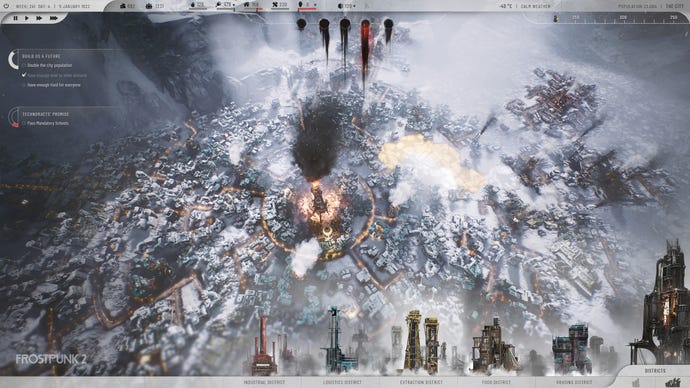
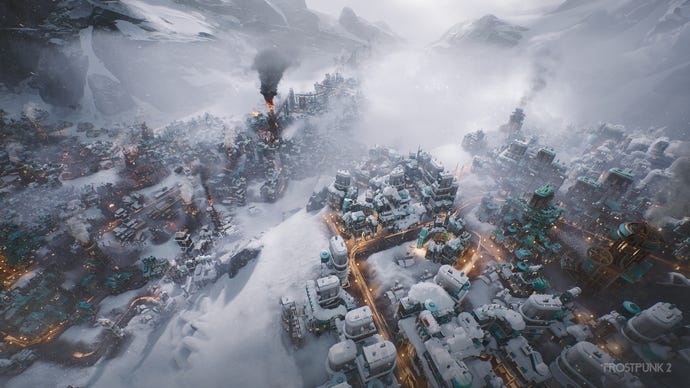
As hinted at above, this is a game of vast scale, where construction now takes place across districts instead of plonking down individual buildings, and where its ant-like citizens now whizz through the streets at lightning speed, their handheld lamps and torches streaking through the city’s frosty warrens like a sped-up timelapse of nighttime car headlights. Indeed, with time now running across weeks and months in Frostpunk 2, Stokalski says it would be strange to issue objectives such as ‘go and gather 100 wood’ to construct an individual building. Hence the move to building these larger regions of the city, which will be split into different types such as housing, food, logistics and extraction districts.
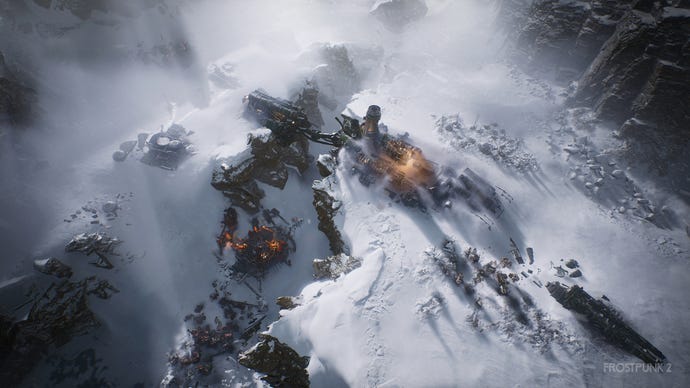
In fact, the central district I can see onscreen during my demo session is more or less what you might end up with at the end of a successful run in Frostpunk 1. The difference here, however, is that this central district is just one of many on display, with the city stretching out into the snowy wilderness like long, metal tentacles. Some of this scale, naturally, comes from the fact we’re looking at its ‘endless’ Utopia Builder', but I do get the sense that the main campaign will be similarly expansive.
Image credit:11 bit Studios
“We really changed the whole economy system, so it’s now based around supply and demand,” Stokalski explains. “When you build something, you get something out of it. If you build a housing district, our people have more shelter, but the same housing district requires people to maintain it and more importantly, a constant supply of resources to run, fend off the cold and the decay and all of that. This balancing act is really what construction and expansion is all about.”
It’s a similar rhythm to old Frostpunk, then, just from a larger, more macro perspective. The placement of your districts “matters”, too, he says, as there will be a proximity system at play that rewards efficiency, such as placing housing next to the generator, but penalises you if you, say, put housing next to a more industrial zone.
Image credit:11 bit Studios
To illustrate, he starts to tell me about two of the core factions that have emerged since the events of Frostpunk 1: the Foragers and the Engineers. As their names might suggest, the Engineers are descendants of the people who built the generator in Frostpunk 1. Technology is king for this lot, while the Foragers believe that relying on anything other than ourselves will only lead to disaster. “Exploring what happens to these communities and how these can spiral out of control a bit is at the heart of the game,” Stokalski says, alluding to the game’s tag line: “The city must not fall.”
“If we ask the question of ‘how do we produce more food in our city?’, depending on who you ask, you might get a slightly different answer,” he says. “If you ask the Engineers, they’ll be like, ‘You should totally come up with some ingenious process, for example, chemical fertiliser, that will enable us to scale up production.’ But if you ask the Foragers, they’re like, ‘Well, we can’t grow dependant on any one particular process, let’s use something that’s always available, time-proven and it works, so let’s use human waste.'”
At first glance, this will all feel very familiar to those difficult Book Of Law decisions we made before, and Stokalski chooses to pursue the Foragers’ idea of a Hothouse building rather than listen to the more technologically minded Engineers. “What’s important is that there are not bad and good answers,” he says. “All of these have their pros and their cons, and it’s up to you how you want to shape the technological landscape you’re building.”
Image credit:11 bit Studios
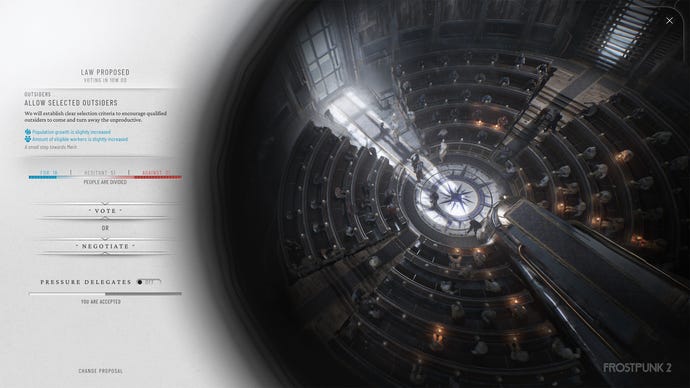
What’s new is that it’s not just you calling the shots anymore. To pass laws relating to broader issues and tensions relating to the city’s overall equality, such as ‘what to do with the city’s children’ (as some have been roped into working in these Hothouses while others are out playing and studying, we find out from clicking on one of the citizens and hearing their thoughts on the matter), we must pay a visit to the new Council Hall. Stokalski calls this “the most important special building that we have in the game” - even more so, perhaps, than the generator itself. Indeed, the days of being able to justify anything to ensure your people’s survival “are long gone”, he says, and the people now “expect to be heard in how the city is run, what the rules in the city are, and how it’s going to be shaped.”
Image credit:11 bit Studios
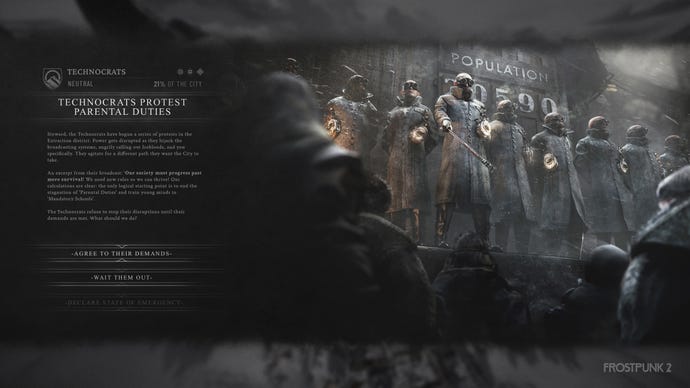
Again, there are still hints and echoes of Frostpunk 1 here, ensuring its spirit is still intact, even on this kind of larger scale. Similarly, as time progresses, zeitgeists can emerge in your city as well, leading to the birth of newer factions who have even more radical views than the Foragers and Engineers. After a quick time skip of two years, for example, Stokalski gives me a quick glimpse of the Ice Bloods (ultra Foragers) and the Technocrats (mega Engineers) who will each have different views again on the issues you’ve previously debated. They’ll come forward with their own ideas and interpretations, continuing the debate long after that initial council vote.
Unfortunately, that was where my demo presentation ended, and so I’ve yet to see exactly what kind of nuisances these radical groups might become further down the line. But I left my demo presentation excited for what’s to come, as the size and scale of Frostpunk 2 not only looks more ambitious than its predecessor, but the evolution of its sociological problems also feels a lot greyer and more nuanced than the binary choices we faced before. “This time around the storm is internal,” Stokalski concludes, and on this point at least, I’m definitely inclined to agree.
For more of the latest news and previews from Gamescom 2023, head to ourGamescom 2023 hub. You can also findeverything announced at Opening Night Liveright here.
