HomeHardwareNews
If your PC says it can’t upgrade to Windows 11, check your BIOSA lack of TPM chip could also be the undoing of many a potential upgrade
A lack of TPM chip could also be the undoing of many a potential upgrade
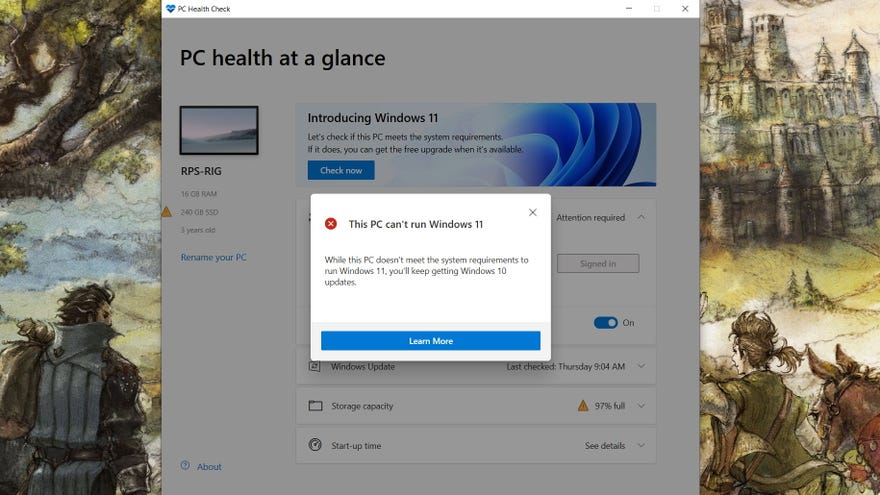
Microsoft unveiledWindows 11this evening, and people can already download their PC Health Check up to see if their PC meets the new OS' minimum hardware requirements to qualify for itsfree ugprade. However, a lot of users with relatively new PCs (myself incldued) are coming up with big angry red crosses when running the app, saying, “Nope, sorry pal, your 10th Gen Intel CPU, Z590 motherboard and RTX 3070 Ti just aren’t good enough.” Which is bonkers, obviously.
Turns out, it’s probably not a problem with your hardware at all. It’s because of your motherboard’s BIOS settings.
Introducing Windows 11Watch on YouTube
Introducing Windows 11

According toThe Verge’s Tom Warren, you’ll need to have Secure Boot enabled in your motherboard BIOS, and have one with a TPM 2.0 chip (that’s Trusted Platform Module, in case you’re unfamiliar).
Indeed, a TPM 2.0 chip is part ofWindows 11’s minimum hardware requirements, and it’s related to lots of different security functions. However, its minimum spec also only says ‘Secure Boot capable’ rather than ‘it definitely has to be switched on, you dolt’.
In fairness, there’s also a strong chance your PC simply doesn’t have a TPM 2.0 chip if you built it yourself. While I’ve turned on Secure Boot, I can’t find hide nor hair of a TPM chip on my own PC, and yes, having consulted my motherboard’s instruction manual, my Asus ROG Maximus XIII Hero Z590 board has a header for one, but the actual module is ‘sold separately’. Well I’ll be damned. Turns out they’re not actually that common on consumer motherboards, which is a right pain in the ass if you ask me.
It is possible to install TPM chips on your motherboard, but it’s a bit fiddly and you’ll likely need to consult your motherboard’s manual to see where the right header is. It’s just a lot of needless faff, and a real bummer for us PC folk. I’ll be keeping an eye on this situation as we get closer to Windows 11’s upgrade rollout later in the year, but here’s hoping Microsoft drop the requirement so us PC builders don’t get unnecessarily penalised.
