HomeReviewsHumankind
Humankind review: a heavyweight alternative to CivilizationGiant leap
Giant leap

So, then. No point drawing this out: is Humankind as good as Civ?
HUMANKIND™ Victor OpenDev - Official Trailer [PEGI]Watch on YouTube
HUMANKIND™ Victor OpenDev - Official Trailer [PEGI]

Yes. I think. But honestly, I can’t think of anything less fun for me, less fair to either game, or less useful to you, than a long set of oblique feature comparisons, ramping up to an arguably worthless “better than/worse than” verdict.
What I can tell you is that whenever I open up Steam, my brain starts moving towards the prospect of playing Humankind like a tray of nails sliding towards a giant cartoon magnet. It is, indeed, the precise sort of magnetism I have felt from Civ games in the past. As far as I’m concerned, Humankind lives up to a giant slice of the hype which has preceded it, and it should rightly be considered as state-of-the-art for the 4X genre.
Every time I see this image, from Humankind’s loading screen, I cannot get over just how intensely ready to fuck someone up that astronaut looks.

But honestly, I still need to playwaymore of Humankind to know for sure whether it’s a classic. I’m still at a stage where every session is revealing a whole new seam of potential play experiences to me, and since 4X playthroughs are such glacial things, it’s a pile of thinkbiscuits that will take me a very long time indeed to eat. It’s easy to become infatuated with a game when you’re still exploring what it can do. But the real test will be whether I’m still playing it months after that process is done, and the illusion of infinite possibility is dispelled. On that front, I really don’t know what to expect.
Last time I previewed Humankind, I talked about how the game’s mix-n-match civilisation-building system left it open to the emergence of bonus combos too powerful not to be used, seriously throttling the effective breadth of pathways through the ages. Having played a few more games, my outlook is brighter on that front. It feels like bonuses are offset in such subtle ways that you can’t see them being balanced out, leading you to feel like you’re a genius exploiting loopholes in the rules.
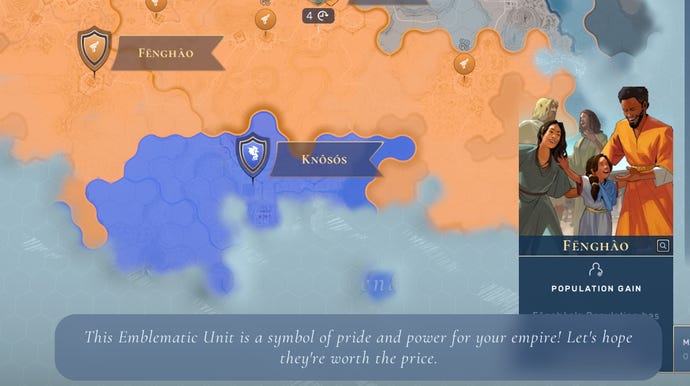
One thing I couldn’t leave out of this review is a round of applause for Humankind’s narrator. This smooth-voiced fellow has something to say most turns, and he’s both charming and genuinely funny.
In another game, the combo of Phoenicians into Carthaginians on a coastal map gave me a swarm of hyper-harbours that basically allowed me to force-feed every citizen four tons of herring a day, exploding my population and making me sickeningly rich. But then, since I hadn’t yet built up the infrastructure or technology to keep that population content, my growth smashed into a hard ceiling quickly, and my cities were too depressed to build much for a few dozen turns. Going all-in on the harbours had seemed an unbeatable choice at the time, but it really binned off my flexibility, and set me back hard enough that I actually lost my lead to an AI on the way to the endgame.
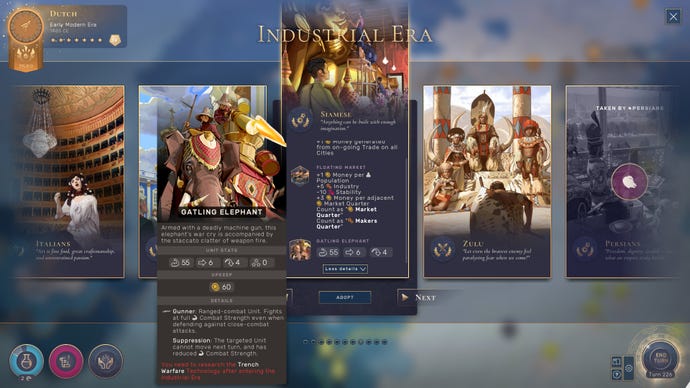
I’m an idiot for breezing past the military game, to be honest, because that means I’m missing out ongatling ‘phants.
I’ve also found this fixation on the strength of dependable bonuses - generally research, food, money and production - has limited my appetite for civ picks. There’s a woeful number of civs in each of the eras that I simply haven’t tried yet, since their advantages are in areas of the game which feel less… winny to me. Of course, this might all be an issue which goes on to tidy itself up, once I’ve had more time to play and experiment, so I’m hesitant to criticise too hard.
I was about to say that I’d get a better feel for the relative strength of different approaches once I’d tried a military-focused game or two - but that needn’t be the case, and the reason for that is possibly Humankind’s greatest strength. When you switch civs at the end of an era, you can change the entire working of your empire at the drop of a hat. A money-making dynamo can become a diplomatic powerhouse or a research colossus in just a few smart turns, retaining a tasty remnant of its financial acumen for good measure. Knowing just when to accomplish such a 180 degree turn is a hugely important skill, and represents an exquisitely juicy bit of decision-making.
In my harbourgeddon scenario above, for example, a smart switch into a civ focused on stability could have seen me beast my way to the top of the world in no time. Instead, I made the “obvious” synergy picks - Norse into Dutch, for yet more harbour synergies - and ended up with all the food and gold in the world, but a population too miserable to care. I had skipped leg day on a civilisational scale.
This on-the-fly redefinition of your entire gameplan, and the fact that it’s a necessity rather than an option, is a masterstroke. The more I play, the more fundamentally brilliant a mechanic I realise it is, and on this front at least, I don’t feel like a dick in saying Humankind blows Civ out of the water. Every Civilization game comes to the table with a set of innovations on its predecessor’s ruleset, but I can’t think of a development in that series that was half so neatly transformational as this. So, you know: good on yers, Amplitude.
Humankind isn’t perfect, even discounting my personal feelings about the relative efficacy and fun potential of different playstyles. There were a lot of small but weird bugs in the review build: notifications informing me that the Olmecs had advanced to the Ancient Era no less than five times; the narrator expressing his shock at my building five, fifteen, and then thirty farming quarters on consecutive turns, when I had done no such thing; a boat panicking when set to auto-explore.
There was nothing game-breaking in there, but there were a few too many noodles out of the soup for a game so highly polished in other regards. It did lead me to wonder how many other cracks were hidden below the waterline of this weird, mixed metaphor noodle boat.
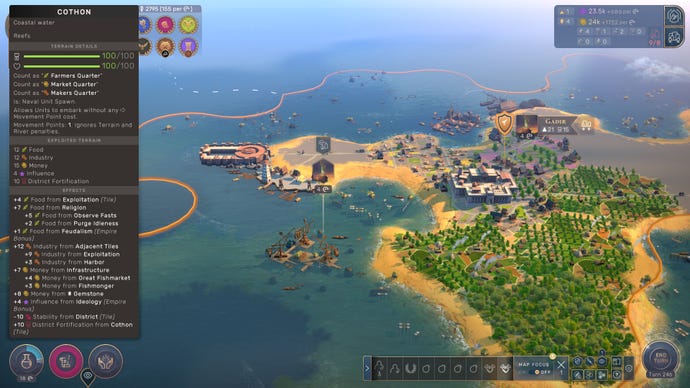
I actually grabbed this screen to illustrate my excess of Harbours in that one game, but I’ve just noticed several of my city quarters rendering as eerie grey voids, so it rather neatly illustrates the point on bugginess, too.
Indeed, and especially in the later stages of a game, Humankind can feel more like a puzzle game than a 4X, with the business of hexes and multipliers abstracting it from its central theme of humanity. Still, if the worst things I can find to say about Humankind are that it sometimes makes me think too much, and that I need to play it more, it’s hardly a bloody disaster, is it? Go make yourself some harbours, and tell the Olmecs I said hello. If they ever make it out of their Ancient Era time loop and invent writing, that is.
