HomeFeaturesWarhammer 40,000: Chaos Gate - Daemonhunters
We sit down with creative director Noah Decter-Jackson to talk about the origins of their upcoming turn-based tactics game
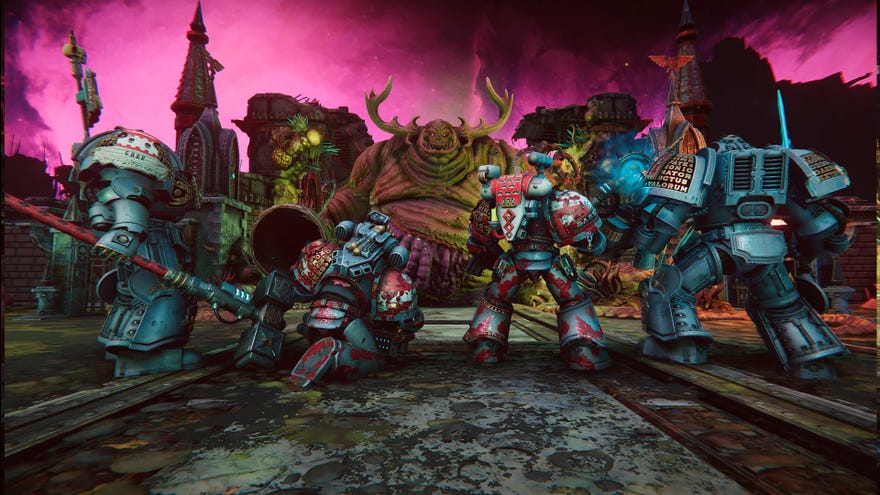
You may not have heard much about developer Complex Games, but the Canadian studio has a surprisingly storied history. Despite spending the last two decades building mobile and browser games for the likes of Disney, Nickelodeon and Zynga, their heart has always resided with the PC. “There wasn’t a lot of game development in Winnipeg, so we tried to figure it out ourselves and spent a few years trying to build a PC game,” says creative director Noah Decter-Jackson. Fresh out of college, Complex’s first project was a third-person hand-to-hand action prototype that they pitched to publishers at E3 2003, an endeavour that Decter-Jackson describes as “phenomenally unsuccessful”.
This led to Complex remodelling as a work-for-hire outfit, and their long track-record making mobile games. But in 2015, Complex launchedThe Horus Heresy: Drop Assault, a fast-paced tactics game in conjunction with Games Workshop. In the wake of Drop Assault’s success, the studio saw an opportunity. “We had been wanting for a long time to return to our PC roots,” he says. “So we pitched a core idea for a game to Games Workshop, because Drop Assault had been quite successful… and that’s essentially howChaos Gate: Daemonhunterscame to be.”
Warhammer 40K: Chaos Gate - Daemonhunters | Developer Diary 3Watch on YouTube
Warhammer 40K: Chaos Gate - Daemonhunters | Developer Diary 3

If this sounds to youlike XCOM in space(well,morein space, like it did for Matt in our earlier preview) that is true to an extent. Daemonhunters adopts both the base combat mechanics and the broad campaign structure of Firaxis' tactical masterpieces. However, the fact that Daemonhunters is also 40K game necessitates some key differences. Whereas in XCOM your starting units were little better than cannon fodder, the Grey Knights begin the campaign as psychic supersoldiers and work their way up from there. Consequently, one of the primary goals of Daemonhunters was to ensure your units felt powerful from the start.
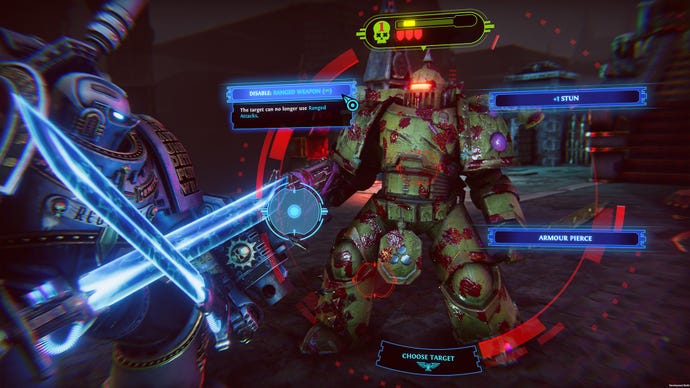
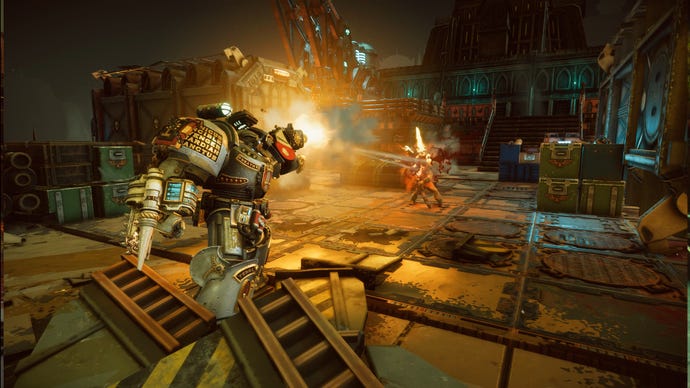
This is where Daemonhunters' most novel mechanic – its melee combat system – comes in. Known as “Precision Targeting”, if one of your Knights successfully performs a critical attack on an enemy, they create an opportunity to rush in and attack a specific part of that opponent’s body. You could choose to sever a limb, for example, hindering that enemy’s ability to move or fight. Or you could target their weapon, instantly disabling one of that unit’s more dangerous abilities.
The mechanic is designed to encourage you to play aggressively, rather than “creeping around” as Decter-Jackson puts it. “There’s a system in place, effectively called the ‘execution system’, where if you’re able to stun an enemy effectively and perform an instant kill in melee combat, then you get momentum bonuses in terms of additional action points,” he says. Moreover, killing daemons helps generate the Knights' psychic energy, making them even more powerful. Hence, there’s a cascade effect to combat, where playing boldly rewards you with the ability to push forward harder.
Placing such a strong emphasis on melee attacks is unusual in a tactics game, and Decter-Jackson notes that balancing the system to be flexible without overcomplicating the game was one of the biggest challenges during development. “It went through many iterations of whether or not enemies would have specific damage and armour values on their body parts,” he says. “You don’t want to get too bogged down in ‘analysis paralysis’ trying to make every fine decision.”
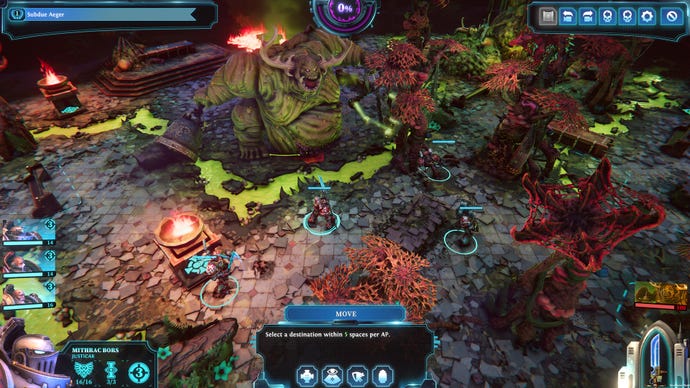
The tactics of precision targeting instead lies in manipulating your likelihood to do critical damage, for which Decter-Jackson notes there are “a variety of different things you can do”. The options that open-up in precision targeting are as much a reward for pulling off that crit as they are an extension of your tactical options. It’s also worth noting that, while your Knights are proficient in close range combat, that’s far from their only skill. Some classes of Knight are geared more toward ranged combat or support abilities, while all the standard abilities you’d expect in turn-based-tactics, likeOverwatchand Suppression, make an appearance as well.
Indeed, part of the challenge of developing Daemonhunters was ensuring your Knights feel powerful without that power compromising meaningful tactical choices, and that the scenarios you find yourself in feel tense and dangerous. According to Decter-Jackson, there are several layers to this. Your Knights are always outnumbered in combat, for example, but on top of this comes the risk of ‘warp surge events’. The psychic abilities of the Grey Knights derive from the ‘Warp’, an unstable alternate dimension. When they use their psychic abilities, they increase the chance of an event.
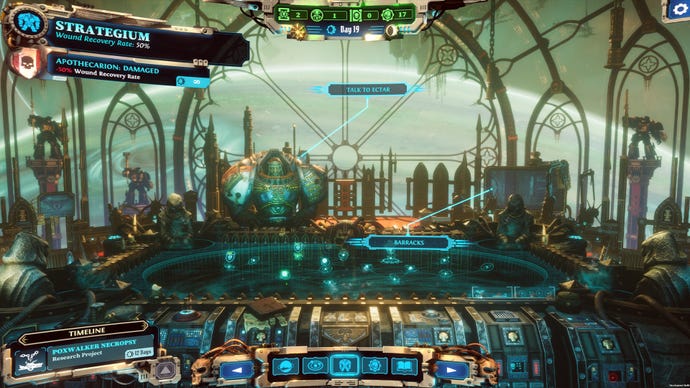
Then there’s the structure of the campaign itself. Like XCOM, it’s an open-ended affair that sees you making targeted strikes against the Bloom’s ever-escalating threat. “The missions that are going to appear on the map will occur organically over time,” Decter-Jackson says. “And based on where you are on the map, you have a certain amount of time to get to each one of those missions where the Bloom spreads, and you’re not going to be able to deal with them all at once.”
Hence, you’ll need to pick and choose your battles based on the potential rewards they offer or the scale of threat level to the galaxy. Indeed, while all missions are important, some are critical. “There are certain types of missions that we have called ‘flowering missions’ where a gate of chaos effectively will open.” Decter-Jackson says. Fail to respond to flowering missions five times, and it’s game over.
Assuming it doesn’t get blown up in battle, the Edict also acts as your base of operations. Here, you can research the Bloom to gain new psychic abilities, recruit more Knights, and upgrade existing units. Unlike XCOM, where character upgrades are mainly a sequence of binary choices, Daemonhunters' upgrade system is grid-based, allowing for greater flexibility in tailoring class roles. “You might want one Knight in the Justicar class to focus on close quarters fighting, and another Knight in the Justicar class to focus more on support abilities [and] disruption abilities that they have,” Decter-Jackson explains.
Daemonhunters sounds like an intriguing prospect. While it may seem like the PC is drowning in tactics games in the wake of XCOM, the truth is it’s been a while since there was a truly great one.Phoenix PointandChimera Squadwere both decent romps, but neither reached the heights ofXCOM 2.Gears Tacticswas arguably the best think ‘em up in the last five years, bearing many similarities to Daemonhunters in terms of its visual spectacle and more aggressive combat. But it lacked the all-important strategic layer to lend it depth. If Daemonhunters can combine the scope of XCOM with the pace and presentation of Gears Tactics, all wrapped in the gloriously gothic excess of the 40K universe, then Complex Games could well be onto the winning PC game they’ve sought for so many years.
