HomeFeatures
How Total War: Warhammer’s players built themselves a World ChampionshipGrassroots warfare
Grassroots warfare
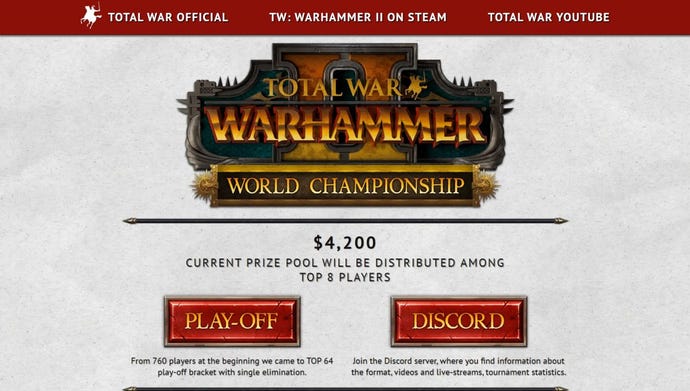
Losing a general is always a morale hit, but for players this practised, it isn’t always a death sentence. In this case it’s a disadvantage Alfredino, despite some excellent cavalry plays, never quite manages to recover from. The finals wrap, and Evenstar takes the lion’s share of the $4,200 prize pool. A relatively humble figure, as far as organised e-sports go, but this isn’t some sponsored, glitzy event.
Total War: WARHAMMER III Global Gameplay Reveal | Full ShowcaseWatch on YouTube
Total War: WARHAMMER III Global Gameplay Reveal | Full Showcase

“The scale is unprecedented,” says “MorS”, long time competitive Total War community member and one of the organisers of the WWC. “All the elements have already been used and tested in previous tournaments, we just collaborated with an unprecedented number of community members and content creators to put it all together this time.”
What is competitive Total War: Warhammer anyway?The Total War series fundamentals are RTS battles based around rock, paper, scissors. At the most basic level, infantry beat cavalry, archers beat infantry, and calvary beat archers. Artillery beats most things, but it’s also slow and fragile. Positioning also plays a huge role. Running your cavalry full speed into the front of a braced unit of spearmen is always a bad idea, but running into their flank or rear whilst they’re occupied in melee? That’s called “hammer and anvil,” and it’s one of the best ways to break a unit’s morale.
But what if your cavalry are also flying pegasusses? What if your infantry are ranks on ranks of reanimated skeletons? Preparing a competitive build means bringing answers for everything your opponent might throw at you. To compensate for some of the asymmetry, many tournaments use a ‘pick and ban’ format, allowing players to avoid some of the more unbalanced faction match-ups.
“The World Championship is really the first major, international, community collaboration, where casters, hosts, players and officials from all across the world came together to work on one major event,” says Turin. “When MorS reached out to me, it almost felt as if we were getting our equivalent of a World Cup. Sign me up!”
The growth of competitive Total War: Warhammer has been, much like the comet that plays such importance in its lore, a twin-tailed journey. On one side there’s a dedicated competitive community, alongside content creators producing an accessible record of the current meta. On the other is Creative Assembly, a developer that has shown eagerness to listen to, and iterate with, their player base. And Total War: Warhammer presents a unique challenge for regular stat tuning. While an RTS like Starcraft has three factions, Warhammer has 15, each with decades of lore to be factored into the design and balancing process.
“A designer’s intent seldom survives contact with the community,” says Oscar Andersson, Senior Designer on the series. Much of the design work, explains Andersson, occurs after the content is already in the wild. The balancing work done in the first few post-content patches is key in ensuring that community and design visions are aligned. Sometimes, this can mean sacrificing flavour for unit diversity.
After the first round of qualifiers, there were 55 groups of seven players each. It took two more stages of round robin matches to get down to the finalists.
“As the game keeps on growing in scale, we’ve also had to adapt our goals and choose our battles,” says Andersson, explaining that early on they were focused on getting each faction an average 50% win rate. Now, it’s more about match-up metrics - and with those 15 asymmetrical factions, this means a near-constant process of iteration. But the original Total War: Warhammer was “very much the wild west in terms of balance and community structure,” Turin explains, but adds that the community rules helped to keep things “reasonably balanced - especially considering it was predominantly developed as a single player game. Thankfully CA has and had several employees who came from a Total War multiplayer background, and shared the community’s passions.”
After Total Warhammer II’s launch, Turin met with then-CA employee James ‘Dogbert’ Given at Twitchcon 2018. Conversations about collaboration between CA and the community led to the first Everchosen tournament. It was done from the apartment of content creator and casterItalianSpartacus; since then, the events have often been in Horsham, at the CA HQ. MorS credits the arrival of the Everchosen as a big factor in competitive TWW’s growth in popularity, saying that the level of promotion and organisation, with professional commentators, official recognition, and a comparatively large prize pool, was a big deal for Total War. “All this brought the competitive multiplayer to new heights, because other tournaments began to try to reach this standard.”
As the biggest official event, the Everchosen is always a great time, but it’s common to see many of the same names competing. For many, the WWC was a great opportunity to take their first steps into the tournament scene. One such player was “Karadok”, who made it through to the third round of qualifiers.
“It was my first Warhammer tournament, and I didn’t expect it to be so well-organised,” says Karadok. With two years experience playing competitive Rainbow Six Siege at a high level, I’m surprised to hear them compare that game’s tournament scene favourably to the WWC’s organisation. Perhaps due to that background in competitive shooters, Karadok is also keen to praise the lack of toxicity they’ve encountered during their time in the tournament, meeting players, chatting with the community, and rising through the ranks. “It helps our fan club to grow.”
I posit my own theory about this to Turin: the lack of multiplayer interface means players have to come together, set their own rules and norms, organise games, and get to know each other in the process. Communication and collaboration are built in.
“I think this is 100% the case, and there are pros and cons,” says Turin. “Over the past year we’ve really seen the community come together, as several major tournament hosts have adopted and begun using the same rules. It brings people together, and creates a passionate community.”
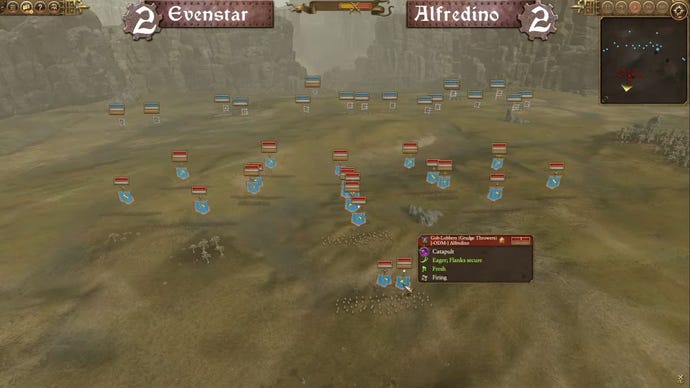
Alfredino’s Dwarves prepare a defensive formation, ready for Evenstar’s Bretonnian forces.
This is highlighted when, towards the later stages of the tournament, a moderator call ends in the decision for a rematch between a player called Crabling and eventual finalist Alfredino. Aerocrastic eventually puts out a statement offering to handle all community queries personally. It’s a rare blip in, what seems from the outside at least, an otherwise smooth process.
But despite, or perhaps because of, all the organisational they put in, the competitive community does have a bit of a wishlist for multiplayer. Turin wants an improved quick battle ladder, the entry point for many new players. “I’d like to see a ladder that resets bi-monthly, has a more efficient matchmaking ratio system, as well as some fun aesthetic rewards for those who rank high.” He also suggests alternative victory conditions to avoid the possibility of players drawing out games - the issue many of the Banner Rules are designed to prevent. “Also,” he adds, “it’s Warhammer. Give us an army painter!”
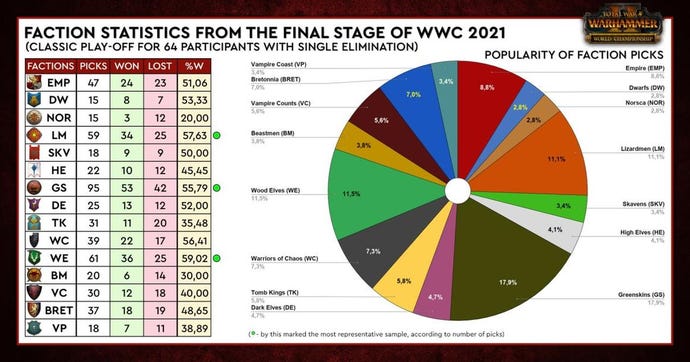
MorS relays a stat that still blows my mind every time I hear it. Every regular tournament player needs to have at least one build for every possible matchup between the 15 factions. Including mirror matches, this means 225 army builds. Unsurprisingly, then, MorS wants a better menu for loading army set-ups. “Top players have special variations of some matchups, which means many more saved setups. Unfortunately for now, we have to scroll through the list when looking for a specific build.”
It can feel strange to throw around words like “grassroots” when we’re talking about multi-million pound entertainment products, but the tight-knit sense of passion and dedication I got from the community means it’s hard to think of a better word. It reminds me of Warhammer tabletop, in this way. It might be a behemoth of a brand name, but most people who play it still have to glue and paint their models, organise their own games, and tell their own stories.
“Total War: Warhammer is not a real e-sport like CS or Dota,” says Mors. “There is not so much hype, prizes and commercialization, so it’s easier to break into the top ranks. Everyone has a chance to try themselves and fight for glory.”
