HomeFeaturesAra: History Untold
How Oxide survived the “nightmare” of making a simultaneous-turn 4X game"I think every single year, for three years straight, we took an additional shot at it."
“I think every single year, for three years straight, we took an additional shot at it.”
Image credit:Xbox Game Studios
Image credit:Xbox Game Studios
“It was to train their generals, it was a legit apparatus of war, it was not for funsies,” says Menard. “And they basically created this massive table that had a modular terrain system. At first they used sand, but that was kind of messy, [and so] they developed a system where they had interchangeable tiles, like hills and valleys and plateaus.
“They would build out this table, literally drop a sheet down the middle, and it’d be like, OK, you guys on each side, you can’t see what the other person’s doing. There was an actual game master, who was the referee who you would report your moves to. He would then re-set up the board and basically call people back into the room and be like, tada! It’s the next turn - let’s see what people did. Was it what you expected?”
You probably didn’t read it here first: the original fog of war was, in fact, asheetof war.
Ara: History Untold Gameplay TrailerWatch on YouTube
Ara: History Untold Gameplay Trailer

“When you play other games that have serial turns, there’s always this bias that comes into play, depending on who gets to go first,” Menard explains. “You get to see what the other person does and readjust your strategy. Whereas if you’re all having to plan and make your choices at the same time, it is forcing you to reevaluate the situation at hand every single time you play.”
“I don’t think we appreciated how difficult it was,” he says. “Because what you have to actually do is build the entire system such that because the orders don’t happen immediately, you’ve got to have an intermediate way of storing them, and effectively almost have the ability to undo things. From an engineering standpoint, it ended up being a huge challenge for us to build the simultaneous turn. And we started to realise when we got really into it, why you don’t see [games like this], because it is such a difficult problem to deal with, just technically.”
Image credit:Xbox Game Studios
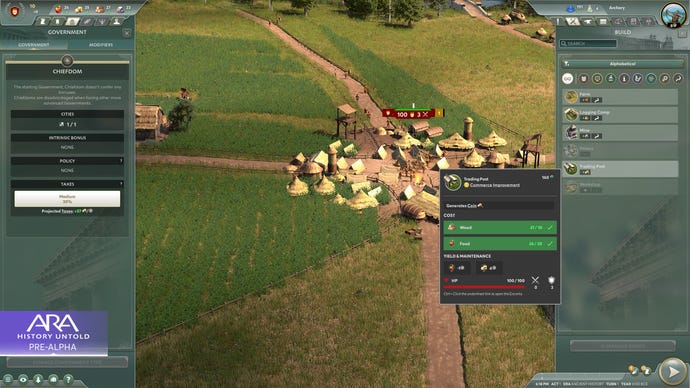
“So some of it was about clarifying that, no, we’re not going to have any interactions like that, if you see that your logging camp has one turn left until it’s built, it does one thing in between turns, and all it does is get built - it will not produce.” Califf has spent many months fiddling with nuances like this. “At some point about this time last year, I just had splattered across the entire floor of my office sheets and sheets of paper, arranging the order and like, defining the groupings and actions that need to take place, and why they need to take place in this order, to adhere to that principle that what you see is what you get.”
It’s important, obviously, that some of these interactions feel genuinely disruptive and startling, while ensuring that they aren’t so chaotic as to make conflict utterly impenetrable. In the current version of Ara, actions such as diplomacy state changes, army movements and land being claimed happen early in the turn resolution process. This theoretically allows players to interfere with each other in a way you can broadly anticipate - if you have a hostile legion on your doorstep, for instance, you’ll know they have the ability to mess with any building operations you have near completion.
Simultaneous turns aren’t Oxide’s only gamble with Ara: History Untold. As Menard explains, the studio have experimented with introducing ideas from “sister or adjacent genres” and roguelikes, though she doesn’t go into detail. “We’re picking out little things here or there that are really good for these kinds of player behaviours and dynamics,” she says. “Are there ways we can incorporate these learnings into a 4X title to make it more engaging, make it feel more modern, make it more accessible for a larger, broader audience? Because that is something we wanted to do, not just make a game for core 4X people, though we definitely want to support them.”
Image credit:Xbox Game Studios
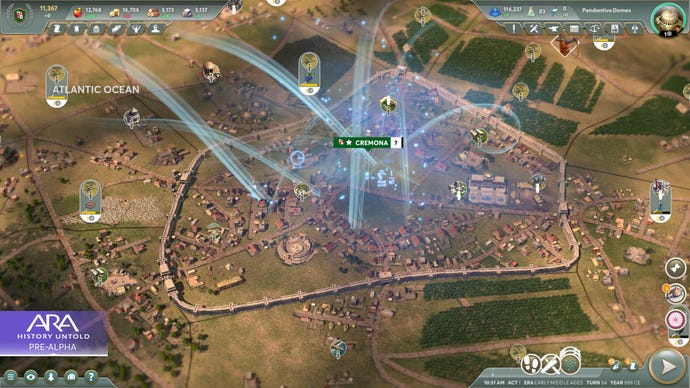
“Just the amount of technology we had to throw at just making that work and you don’t have a regular grid, so the cities have to grow organically, roads have to grow organically,” says Baker. “It was a really, really tough challenge, but it makes a big difference.” Oxide’s hope is that the blend of abstract regions and procgen will make for a more readable, less abstract play environment, with less need to look up terrain tiles in a codex. “We’ll preferably get to a state where you don’t need to see all of the UI that we put into the world,” suggests Califf. Menard estimates that there’s been as many or more “major iterations” upon Ara’s map design as on the simultaneous turn system. “I never want to hear the word about river iteration ever again in my life,” she summarises. “Oh my God, rivers!”
I have yet to lay hands on Ara: History Untold, and I have to say, when I caught the announcement trailer, it struck me as quite familiar - Civilization again, but with a more fluid and bustly approach to units and settlement design that recalls theAge of Empiresseries. Having heard about what’s going on beneath the hood, I’m much more intrigued, though I do struggle to visualise many of the tortuous running-order considerations described above.
One other question I’m left with is whether Oxide might whip away the sheet and open up the workings of simultaneous turns to players. Have the studio considered letting people alter the sequence of actions and interactions per turn in the settings, so as to come up with different flavours of 4X temporality, and different strategic or tactical pressures?
It’s not on the to-do list, apparently, but there’s a foundation here that modders might build on. Oxide have devised a special “mini language” to define the interactions during turn resolution, Baker says, which modders could harness for their own purposes. “There is definitely the potential to mess around with it, to some extent. Be curious what people do - we came up with a very specific way, but yeah, I think players could try interesting things.” You’ll very much tamper at your own risk, however. As Califf concludes: “I couldn’t speak to the results of it, if they chose to mess around.”
