HomeGuidesDiablo Immortal
How much does it cost to play Diablo Immortal?The controversial monetisation model of Diablo Immortal explained
The controversial monetisation model of Diablo Immortal explained

What is the real cost of Diablo Immortal, and is it in fact pay-to-win?Diablo Immortalis already infamous for its microtransaction monetisation model, which many players have pointed out are effectively loot boxes under a not-even-that-different name. You might have seenreportsgoing around that it costs somewhere in the region of £88,000 / $110,000 to fully upgrade a character (and that an F2P player would need to grind for ten years to earn the same upgrade materials for free). This, coupled with the ongoing investigations intoallegations of serious misconductat publisher/developer studio Blizzard Entertainment, has quite understandably been enough to put many players off the game entirely.
Top 10 Best Games Coming To PC In June 2022Watch on YouTube
Top 10 Best Games Coming To PC In June 2022

The issue here, of course, is that Diablo Immortal (like many F2P games) is arguably not really free-to-play. I’m not interested in casting judgement on people who want to play a game that others have legitimate grievances with, but I was curious as to what the real cost of Diablo Immortal is. We already have that shocking £88,000 total figure, which I have no reason to dispute it would be possible to spend on this game. I’ve seen alternative calculations accounting for changes to drop rates in this beta version that now place the sum as “low” as £35,000 / $50,000 (in other words, just as ridiculously high when you think about it).
But what are you actually paying for in each individual microtransaction? The game isn’t going to simply ask you for £88K in one go, after all. And at what point does an F2P player hit a wall in terms of their ability to participate in the game unless they start spending money?
I’m not here to tell you whether you should play Diablo Immortal from a moral standpoint, but I’m interested in informing you whether you even can play without dropping the cost of a nice house in Wales in the process, and what the real running costs would look like from a player’s perspective.
What are you paying for in Diablo Immortal?
The premium currency in Diablo Immortal is called Eternal Orbs. Eternal Orbs are the only thing in the in-game store that comes with a real-world price tag, with the costs as follows:
The odd increases are down to the fact that you theoretically get bonus Eternal Orbs the more money you put in: buying at the second or third level claims to give you an “extra” 5%, 10% at the fourth level, 15% at the fifth, and 20% at the sixth and highest.
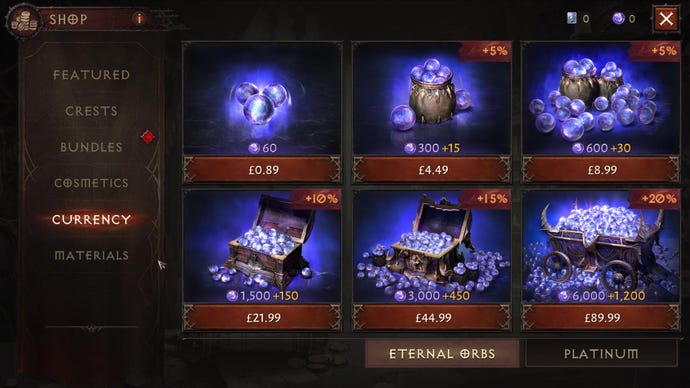
Eternal Orbs can then be spent in other tabs of the in-game store. A browse of the Materials tab shows that entry-level items go for a standard rate of 100 Eternal Orbs each, while on the Cosmetics tab a full costume costs 1,000 for a Standard outfit or 1,500 for a Collector’s outfit. As is often the case in F2P games, then, we can see that paying 89p for the lowest-level currency top-up won’t actually buy you anything from the in-game store on its own, and you’ll be paying somewhere in the region of 20 quid to deck your character out in one of the premium outfits.
I suspect the real draw for many players, though, as well as the real point of contention, is the Crests tab. Here you can purchase Legendary Crests, which are essentially the loot boxes of Diablo Immortal. More on how they actually work below, but for now the thing to keep in mind is that it takes 160 Eternal Orbs to purchase one Legendary Crest, or you can buy 10 in a bundle for the not-at-all discounted price of 1,600 Eternal Orbs.
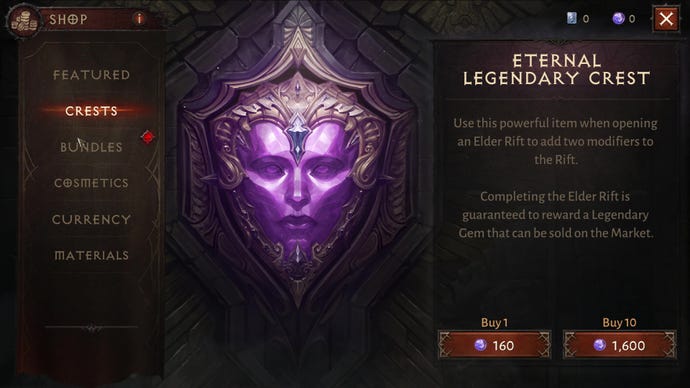
In real money, just to keep it in perspective, that’s a minimum spend of £4.49 to buy not-quite-two Legendary Crests (purchase the second level currency top-up and you’ll come up 5 Eternal Orbs short for the second Crest, which I’m sure is deliberate). Or it’s £21.99 to purchase that 10-pack of Crests and leave you with 50 Eternal Orbs in leftover change (which to reiterate, is half the cost of the cheapest rock in the Materials tab).
Can you get Eternal Orbs for free?
Platinum can’t be spent in the store but has a few in-game uses: primarily, it can be used to forge or trade with other players for Legendary Gems, the game’s best gear which can be viewed as the end goal of purchasing Legendary Crests. It’s in this manner that Diablo Immortal remains technically winnable for an F2P player, albeit at a glacial pace compared to players who are paying for their Crests.
One final currency type of note isHilts, which can be farmed in-game and traded with the Hilts Trader in Westmarch for Rare Crests (at 300 Hilts each) or Legendary Crests (at 1600 Hilts Each). However, there’s a major catch: while you can buy two Rare Crests every day, Legendary Crests are limited to a single purchase per month from the Westmarch trader.
Does the Battle Pass provide a better alternative to buying Eternal Orbs?
Like many games cast in the F2P mould, Diablo Immortal features a Battle Pass with three levels: free, premium, and premium boosted. The “Empowered Pass” costs £5.49 / $4.99 to access, but the boosted version that skips you past the first 14 tiers and allows you to claim their rewards instantly comes in at £16.99 / $14.99. From what I’ve seen so far, each Battle Pass period will last around 35 days, so if you plan to sign up for the Empowered Pass that’s what you’ll be spending on the game more or less every month.
Your mileage may vary as to whether a guaranteed immediate purchase is better or worse than one you have to work for served up with a side of extra materials for your trouble. But financially speaking, there’s scant little difference between what the Empowered Pass and the Eternal Orb top-ups get you in terms of pay-to-win levelling.
How expensive could Diablo Immortal get?
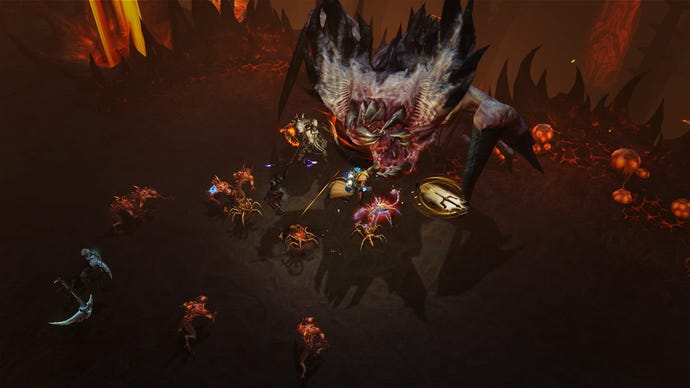
Because you’re ultimately looking to level up your character with the loot you find, what you really want from an Immortal Rift is a Legendary Gem. You can craft and upgrade these in limited amounts or trade them in the player marketplace, but Immortal Rifts are the major source for them. Again, we’ve written a more comprehensive guide towhat Legendary Gems doif you want to understand more about how they work in-game.
The ideal end-goal of Diablo Immortal would be kitting out your character with the maximum number of 10 Legendary Gems, all at 5 Star rarity, and each of which would have a 5/5 Star upgrade in its own right. There are many variations on what this kit would look like because Legendary Gems have a wide variety of effects, but at that point you would probably consider your character fully levelled up.
Each Legendary Crest guarantees a Legendary Gem, which is powerful in itself, and you can apply up to 10 Legendary Crests to every Immortal Rift. However, what’s not guaranteed is the quality of the Legendary Gem you receive for each of your Crests. The drop rates for Legendary Gems in Immortal Rifts with Legendary Crests applied are:
There is a pity system at play, in that every 50 Legendary Crests you plug in to an Immortal Rift will guarantee you an uncapped Legendary Gem with the potential to be upgraded to 5/5-star quality, although its starting quality is not guaranteed and might still be as low as 2/5 Star.
So in that case, what does a 5 Star Legendary Gem with 5/5 Star ranking cost? Honestly, the exact probabilities are still a bit fuzzy, thanks to the lack of clarity around exactly how generous the pity system can be expected to be. Luckily for me, our excellent freelancer Charlie already crunched the numbers and came up with a requirement of 2,300 Legendary Crests to guarantee that perfect Legendary Gem. If you wanted to blitz your way to the highest level on all 10 for 23,000 Legendary Crests, that’d set you back 3,680,000 Eternal Orbs, an amount which would require you to purchase the biggest Eternal Orb top-up 512 times fora grand total of £46,074.88 or $51,194.88. That’s taking advantage of the slightly lower price per unit of Eternal Orbs at that level, mind; if you did your top-ups 89p at a time, it would work out at considerably more.
Can you play Diablo Immortal for free?
If you’re playing Diablo Immortal for free, your only source of Legendary Crests is the Westmarch Hilts Trader, who limits you to one purchase per month. That equates to roughly £2.30 / $2.60 worth of “freebies” during that period (calculated based on the value of a single Legendary Crest when bought with 89p / 99¢ Eternal Orb top-ups).
Of course, it is still possible to receive Legendary Gems from Immortal Rifts using Rare Crests alone, as well as obtain a few via the alternative methods outlined above and upgrade them over time — if it wasn’t, F2P players would potentially need to play for hundreds of years to maximise their loadout, not the mere decade that’s been suggested. But you can’t directly obtain Legendary Gems from Immortal Rifts without applying a Crest, and even then Rare Crest drops are capped at 2 stars and can’t be upgraded beyond that point; so it’s not hard to work out that paying players will have an absolutely massive advantage when it comes to making their characters stronger in the long-run, not to mention getting there much quicker.
Early anecdotal reports suggest that it’s entirely possible to reach Diablo Immortal’s endgame for free if your main interest is in completing the main story and sticking to PvE elements like dungeons. As is so often the case, F2P players will probably have to grind for longer than their paying counterparts to finish the story, but will only really hit difficulties in PvP and ranked competitive modes. It’s there that players who’ve put a lot of money into rapidly upgrading their characters will have a laughably easy time of it, compared to those just starting their long 10-year journey to being fully upgraded for free. Of course, since PvP is the main reason many people play MMOs in the first place, this is arguably going to be as big a problem as if the whole thing was aggressively reliant on paid features.
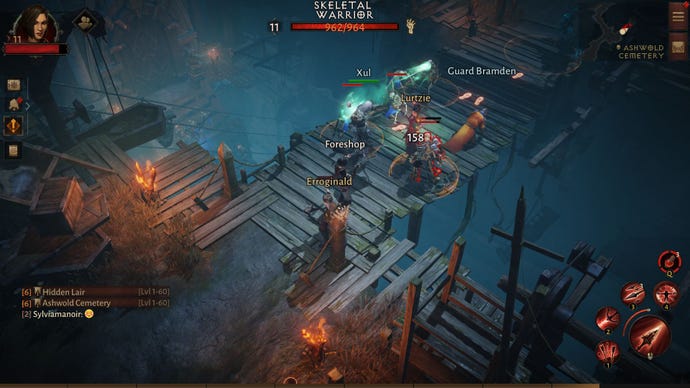
Blizzard get away with describing Diablo Immortal as not being pay-to-win on an extreme technicality, but it does seem as though F2P players interested in engaging in endgame PvP activities will be reliant on the hope that either no-one pays for upgrades (unlikely) or that all the paying players have lost interest well before the F2P crowd have levelled up for free in a decade’s time. Which is, obviously, not great either way, and furthermore really stretches the definition of “win” in that claim of “not pay-to-win” to breaking point.
For what it’s worth, I have seen people who describe themselves as long-time Diablo fans who were satisfied with the story and the PvE dungeons as an experience in themselves, although I’ve yet to see any of them praise the way PvP rankings work or the rate at which loot drops (with or without paying for Legendary Crests).
Should you pay for Diablo Immortal?
Here’s what I’ve learned about Diablo Immortal’s premium purchases over the past few days of research:
The danger with a game like Diablo Immortal is that it’s easy to lose track of how much you’ve spent overall; and, if you do tally it up later on, the sunk cost fallacy kicks in. For many people, it feels like there’s an obligation to keep paying their way to the very top of the leaderboards once they’re invested. And since topping those leaderboards and staying ahead in PvP is arguably the entire endgame goal of Diablo Immortal, it’s hard to imagine a situation in which a dedicated player could walk away before fully levelling up and still feel satisfied with the experience once they’ve begun to plug a lot of their own cash into the system.
It’s not for me to tell you what to spend your own money on, but having looked into the numbers in this level of detail, I can’t honestly recommend putting cash into Eternal Orbs and Legendary Crests in Diablo Immortal. I’m not fundamentally opposed to games that accumulate paid DLC add-ons over the course of long lifespans, and I’ve even found the odd exception to my rule that F2P games are generally no good.
If you’d like to know more about our thoughts on Diablo Immortal here at Rock Paper Shotgun, Alice B has been wonderingwhy it’s even on PC in the first place.
