HomeFeatures
How Arkane’s multiversal Parisian pipedream eventually gave us DeathloopArkane founder Raphaël Colantonio on the game that got away
Arkane founder Raphaël Colantonio on the game that got away
There’s an alternate world where Arkane madeThe Crossing, and it’s not necessarily a better one. BeforeDishonored, the developer was looking down the wrong end of a bad publishing deal which, in the estimation of founder Raphaël Colantonio, would have ended in either The Crossing’s cancellation or a deeply underwhelming end product. In that timeline, there’s no telling whether the studio would even exist today.
For years it was the source of Colantonio’s drive and inspiration, the idea he believed would be the making of his upstart French games company. And for several years afterwards, its abandonment was a painful wound he and the studio carried - one that only the eventual launch of Dishonored could help to heal.
Redfall - Official Story TrailerWatch on YouTube
Redfall - Official Story Trailer

At the time of The Crossing’s conception, Arkane was finishing up work onDark Messiah Of Might And Magic, a swords-and-sorcery romp that forefronted close combat and physics play. For that project, Arkane had adopted Valve’s Source Engine, and identified a crossover in philosophy between its own immersive sims and Half-Life 2’s more focused, but no less detailed, simulation. “We were going a little more into those territories without betraying what we liked,” Colantonio says. “And hopefully we would do things that were a little more mass market.”
With The Crossing, Arkane intended to travel further down that path, building a full-onFPSin Valve’s engine. “Which was so shooter-oriented already,” Colantonio says. “And so that was a natural evolution. The tools dictate so much of what you do.” At the centre of this FPS would be an eight-hour campaign, like the one Call Of Duty had, and gunplay to match. But there the similarities with mainstream noughties shooters would end.
“It really started with a silly conversation,” Colantonio says. “‘Imagine someone was playing Half-Life 2, and you could choose to drop in and randomly incarnate the enemies.’ There was something beautiful about the idea itself. We didn’t know if it would be fun or possible. It became an obsession.”
Image credit:NoClip

Scenes from The Crossing fromNoclip’s documentaryImage credit:NoClip


Thief designer Randy Smithwas tasked with plotting out the narrative - “a mind-bending time travel story that was loaded with a-ha! moments in which you realize you’ve seen this same situation or conflict from a different perspective.” He remembers the protagonist’s journey as a complicated figure-of-eight in which the player was constantly looping back on some prior part of their path.
“Where those overlaps, those crossings, occurred - those were the places where you would enter a battle from a different approach and with a different objective than you had the first time you were there,” he says. “Technically speaking, this is a very economic game design - you can create one narrative quest path that services all players simultaneously, even though they’re at different points of the story, and it conveniently feeds them into battles.”
The solo player, called an Archon, would have access to a grappling hook and boomerang blade from the Templar realm. They had the benefit of mobility and a beefy health bar. But the enemy players, SWAT-esque soldiers dubbed Griefers, had numbers on their side. “They had their own gadgets, but different, and it was four versus one,” Colantonio says. “The beauty of it was that you never had to look for the action, because we would teleport you right before the player arrived.”
Typically, the Archon would get gunned down in their first round. But the Griefers would then repeat their winning strategy, “almost like an AI would do”, and the solo player would learn to counter it. “It would take the single player maybe four to six times to win a challenge, and that was a checkpoint for the next zone,” Colantonio says. “Then we would teleport all the players to the next area, so they would be rolling through the entire level this way. Every time we would show it to publishers it was so fun.”
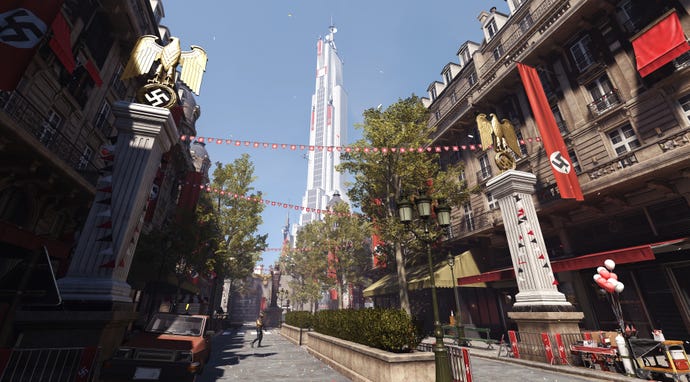
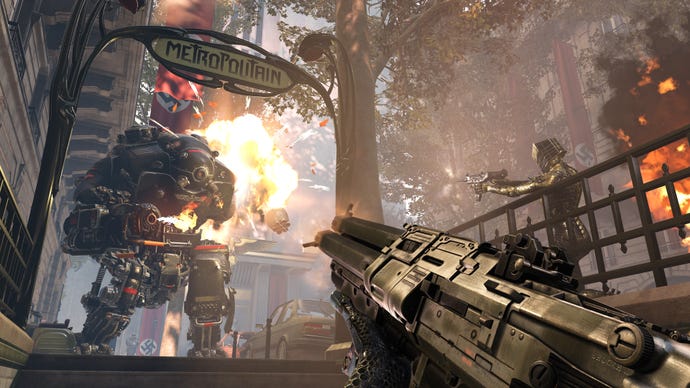
Another alternate Paris in Wolfenstein Youngblood
The director remembers demoing The Crossing for a major publisher. “They were screaming in joy and laughing,” he says. “We had 15 people in that test room, rotating the positions and playing, and it was a super blast.” Once the play session was over, however, the smiles would quickly fade. Publishers would ask: what happens if the players are of different skill levels? “And that’s where the concept would break every time.”
In the end, as recounted in Noclip’sexcellent documentary, Arkane was faced with accepting a bad deal from a publisher to make The Crossing on an inadequate budget, or walking away - and chose the latter. “They tortured us for nearly six months, into a deal that got worse and worse and worse,” Colantonio says. “There were so many constraints. The most enjoyable part of all this process was to tell them, ‘No.’ They really thought they had us. They were kind of evil, frankly, as businessmen.”
Delilah Copperspoon in the Dishonored DLC The Knife Of Dunwall - later the antagonist in Dishonored 2

Arkane spent about a million dollars on the project, money it could ill afford at that time, and suffered a hit to morale. “The team was devastated,” Colantonio says. “I was devastated. I took it so to heart. I took it very personally because you can’t create something that needs so much energy and love half-assed or detached. You can’t be too Buddhist about it. The cost of that is that when it doesn’t work, you’re crushed.” Colantonio reckons it took him seven or eight years to get over the pain. Specifically, it took the release and reception of Arkane’s breakthrough hit. “We needed Dishonored to heal from The Crossing,” he says. “We needed that game and its success to feel good about ourselves again.”
“One could say that, even though in the moment The Crossing felt like a painful failure, in the long run it was just a step towards a big breakthrough for Arkane,” Colantonio says. “Some of it was aesthetic, some of it was the mechanics themselves, and then there’s just the spirit of the team. We had worked together and trained with Viktor and Dishonored was ready to be made.” Later, Arkane co-developed Wolfenstein: Youngblood with MachineGames - Mitton finally lending his distinctive visual style to a dystopian Paris. Swap the Nazis for Templars and you’ll recognise The Crossing. “I remember thinking the same,” Colantonio says. “It’s the same art director, so no surprise.”
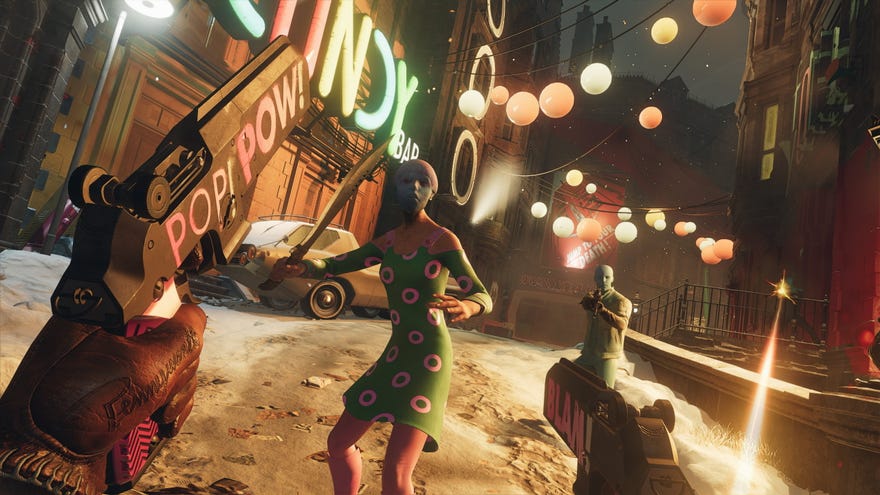
Invading another player’s game in Deathloop

Colantonio was supportive, but a little afraid. Bethesda wanted a little idea to tide Arkane over until its next Dishonored-sized project, and not for the first time, he wondered how the studio would pull off such a big premise with a small budget. In the end, however, Bethesda gave Deathloop its backing as a full-scale release, and it launched to effusive critical acclaim. Though very different to The Crossing - made without Colantonio’s direct involvement and rooted in a very modern form of roguelike thinking - you can see its success as a form of vindication.
For many years, playing The Crossing’s prototype was a rite of passage for new employees joining Arkane. Today, Colantonio would like to see that build released to the public. “It would be cumbersome to make work,” he says. “It was not ready for market. But someone would figure it out. I still hope that Arkane will convince Microsoft to do it, because it was a fun game, it was not vapourware.”
