HomeReviewsHard West 2
Hard West 2 review: rootin' tootin' tactical shootin’West Harder
West Harder
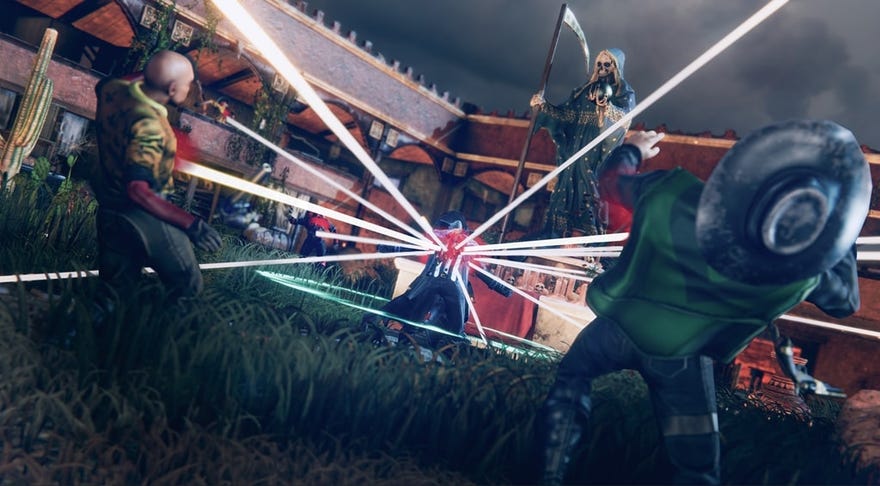
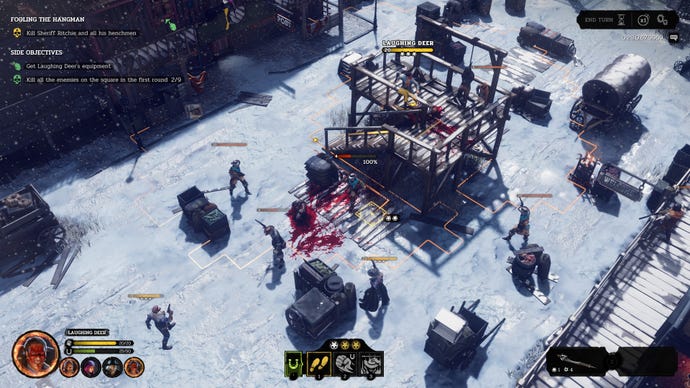
Ice Code Games may have called itHard West 2, but ‘round these parts we refer to it as “The Laughing Deer Show”. New to town, are ya? Let me clue you in. Laughing Deer is a six-foot man of raw muscle and rage, a native American warrior with shoulders like a pair of yoked oxen and a personality best described as “barely contained”. Unlike the rest of his posse, which includes a cowboy without a shadow, a woman with ties to the occult, and one very stubborn corpse, Laughing Deer doesn’t really “do” guns. While his compatriots are all crouched behind crates, ricocheting bullets off buckets and wheelbarrows to hit enemies from behind, Laughing Deer is getting in their faces (shortly before his club gets significantly further into their faces).
Now, bringing a club to a gunfight might not seem like the smartest idea. But while pistols require two of a gunslinger’s action points to shoot, and rifles take all three, it only takes one action point to whack some neckerchief-wearing bandit with a big ol’ stick. And Laughing Deer whacks a whole point of damage harder than normal, meaning he can rush foes and nail them into the ground with a couple of hard swings before they can pull the trigger. Better yet, killing an enemy completely refills a character’s action points inHard West, meaning that, when set up right, Laughing Deer can ping around the battlefield like a weaponised pinball.
Watch on YouTube

Laughing Deer embodies Hard West 2’s aggressive approach to turn-based tactics, which encourages you to take the fight to the enemy with elaborate trickshots and daring chain-kills. It’s hardly a new idea – bothGears Tacticsand the more recentWarhammer 40K: Chaos Gate: Daemonhuntersemphasised the notion that the best defence is a good offence. But Hard West 2 commits even further to this concept, to the point where it ditches what has arguably been the lynchpin mechanic of the last decade of tactics games – overwatch.
The results are bold, distinctive, and ultimately rewarding, although this second journey through the Hard West is not without its frustrations. It takes a while for the game to properly demonstrate its tactical breadth, while a couple of design decisions led to moments where I wanted to bin the game off entirely.
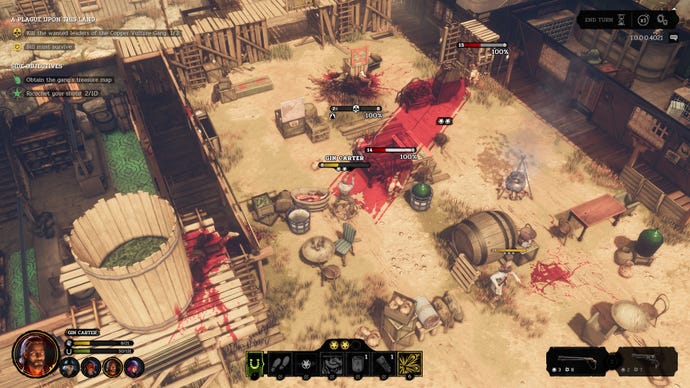
Hard West 2 isn’t an open-ended tactical strategy likeXCOMorPhoenix Point. It’s a much more focused experience, where you guide a handful of bespoke characters through a sequence of meticulously crafted missions. If that sounds limiting to you, fret not. Hard West 2’s tactical scenarios are large, lavish affairs that will comfortably occupy you for an hour or two at a time. They can also be seriously chewy tactical challenges, where you’ll frequently be confronted with seemingly impossible numbers of foes to fight.
It’s an astonishingly powerful system, albeit one that’s less intuitive than similar aggression-facilitating mechanics seen in games like Gears Tactics. Whereas Splash Damage’s game let you share out action points like sweets, giving you lots of little ways to extend a character’s turn, Hard West 2 is more binary. Either a character gets Bravado, giving them another three actions points, or they don’t.
Regarding which is better depends on what you want from a tactics game. Gears Tactics is more immediately gratifying and tolerant of mistakes, whereas Hard West 2’s tactical challenges lean more toward puzzling. I won’t say there’s a right way to approach every mission, but there are plenty of wrong ways. As your characters only get three action points at a time, while some actions such as shooting rifles can eat all those up in one go, you have to carefully deliberate which enemies you’re going to target, whether you should move into a better position before you shoot, how to ensure a character ends a turn without being exposed to enemy gunfire, and a whole host of other considerations.
Luckily, Bravado is not the only tool in your arsenal. All characters can perform trickshots with pistols, ricocheting bullets off metal objects to circumvent enemy cover. In addition, each character has a unique skill that can help even the odds. Gin can fire a barrage of bullets through cover, damaging anyone standing a certain distance in front of him, while Laughing Deer can perform a “Wild Run” that increases damage dealt for every two squares that he moves. Perhaps most unusual is Flynn, whose occult powers let her swap positions with anyone on the map for a small health cost.
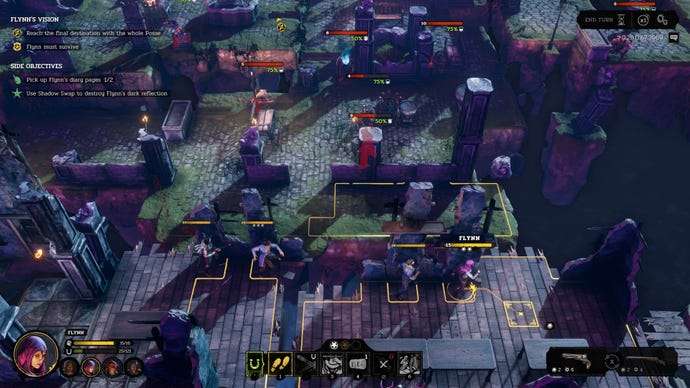
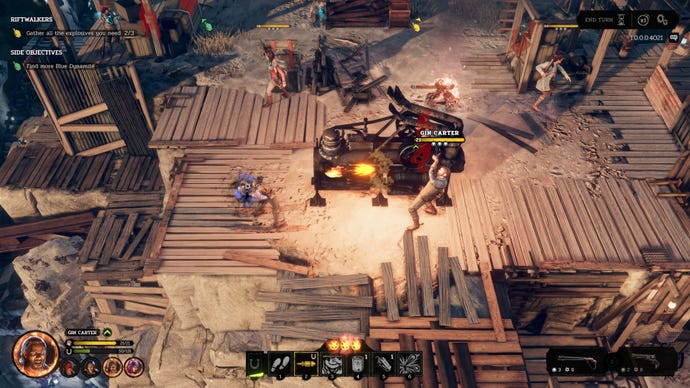
Combined, all this lets you perform some elaborate manoeuvres, such as swapping Flynn with an enemy in such a way that Gin can pepper three foes at once with bullets, before Laughing Deer rolls in to execute them all. But the complexity of the combat system also make battlefields hard to read. For example, certain enemies can trickshot too, which makes it difficult to know when a piece of cover will actually provide protection. Buildings and elevation also affect visibility and shot change in ways that aren’t always clear.
Also, some missions see you fighting enemies on horseback, and the targeting system here can be very sketchy. In one scenario, Gin couldn’t shoot a target riding right alongside him while he was stood in the open freight doors of a train’s cargo carriage, even though he had an open view of the target from where he was positioned. I could have made that shot, and the only time I’ve ever fired a gun, I closed the wrong eye while aiming down the sight.
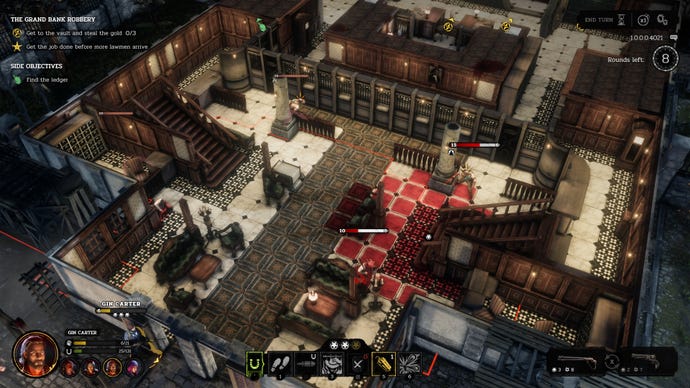
Hard West 2 also has a couple of annoyingly arbitrary smaller features. First, many missions have a timed element where you must complete an objective in a certain number of turns, which given how challenging the game’s tactical conundrums already are, is an unnecessary complication. Worse, though, are the missions that stipulate “all posse members must survive”. Not only is this a completely silly requirement, as the game states at the outset your party members don’t die when they run out of health – they merely faint, but also, given how quickly things can go wrong in Hard West 2, this mandate makes the relevant missions less of a fun tactical challenge and more a painstaking exercise in save-scumming.
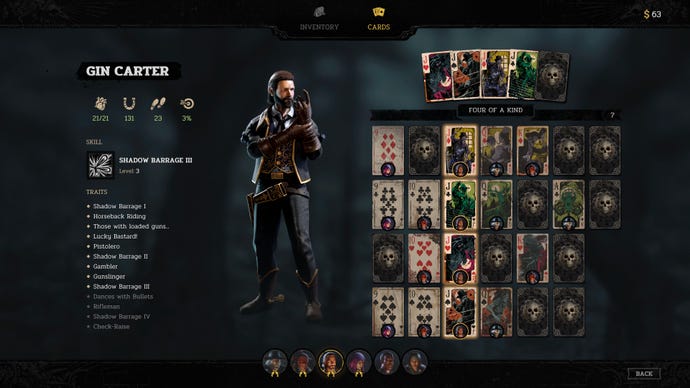
Considering the precision Hard West 2 often demands, such problems can make the game intensely frustrating. But they become less acute as you push deeper into the game, and your characters net a few upgrades that let them trigger Bravado more easily. Speaking of upgrades, Hard West 2’s character progression system is one of the most intriguing I’ve encountered all year. Instead of slotting points into a traditional skill-tree, each character can be equipped with a poker hand of up to five playing cards that are collected in every mission. The strength of this hand denotes the number of bonuses your character unlocks. Not only is this thematically fitting, it also lets you experiment with different builds, swapping cards around depending on who you want to take into a mission with you.
All told, I like Hard West 2. It’s not as easy to get into as Gears Tactics, and it’s obviously a less comprehensive experience than your XCOMs. But its revisions to the familiar tactical formula do ultimately work, giving you the tools to face down some seriously stern opposition in spectacular fashion. Taking a slug of whiskey to heal yourself before bouncing a bullet off the liquor store sign into an enemy’s back is a delightful synthesis of mechanics and theme, and when you combine that with a brain-tangling network of moves that leaves every enemy in sight sprawled in pools of viscous scarlet, boy howdy, there ain’t no better feeling.
