HomeFeatures
Games must let us be proper villains again if they want us to make meaningful moral choicesWe’re actually quite different, you and I
We’re actually quite different, you and I

The most despicable, awful and down right evil thing I’ve ever done in a video game was during a Dark Side playthrough ofStar Wars: Knights Of The Old Republic. At the end of the side quest Honest Debt, you convince a man to either spare or gun down a rather horrible chap who wronged him greatly. There’s nothing particularly remarkable about that - I’ve encountered the same thing dozens of times in games - but what comes after is a real doozy.
Not content simply with nudging the fella into giving in to his worst impulses, I then proceeded to persuade him to wipe the very memory of his nemesis from the galaxy, up to and including hunting down his friends and family members. Bastilla Shan, noted Jedi do-gooder, pointed out that neither she nor the Jedi council would approve. I was giggling like a schoolgirl.
Cyberpunk 2077 — Next-Gen Update Launch TrailerWatch on YouTube
Cyberpunk 2077 — Next-Gen Update Launch Trailer

Armed with that anecdote, it may come as some surprise that I cannot stand being mean to people in games. I’m not talking about other players, but the NPCs in single-player games. I recently started a game ofCyberpunk 2077, determined to be the worst kind of ice-cold, selfish corpo bitch. I failed miserably. I can’t be mean to Judy, I can’t tell Panam that I’m only helping her for the eddies. I certainly can’t tell Keanu, a man I have adored since my early exposure to Bill & Ted, to bog off, even if the character he’s portraying is a narcissistic douchecanoe.
Image credit:EA
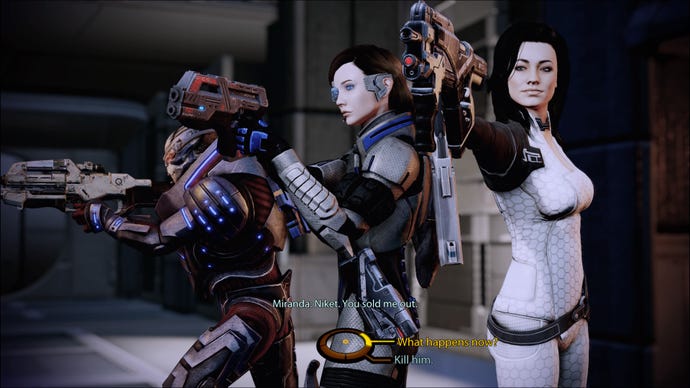
To answer that, we need to go back to the early days of Bioware (other RPG developers are available, but Bioware’s popularity and ubiquity makes for easy comparison.) I’m talking the time ofBaldur’s Gateand the aforementioned KotOR. There was a lot of talk about how RPGs presented a very simplistic, extreme moral binary. Do you give the beggar some gold or fireball him for his insolence? You’ve caught a criminal, make her your BFF, or ten thousand years in a dungeon? Okay, maybe I’m exaggerating, but only a little.
It’s a fair criticism. It’s always irritating when a game forces you down a particular route, especially when it’s a game that specifically invites you to inhabit a character. Having two options that feel wrong is barely better than no choice at all. At the same time, there’s only so many options a video game can provide. We’re still some way from being able to replicate the experience of a human GM.
Image credit:CD Projekt Red
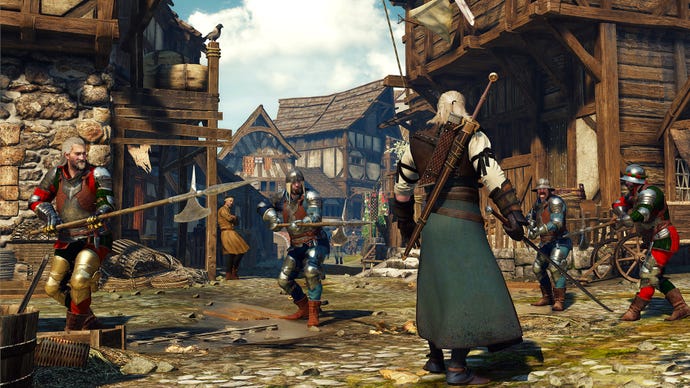
Bioware, on the other hand, have fared considerably less well. BothDragon Ageand Mass Effect offer the choice between playing the hero or the pragmatist, though it’s more explicit in Mass Effect’s Paragon/Renegade system. Save the princess/kill the princess has become save the princess/kill the princess because if you save her billions of people might die! On the surface, this is a perfectly valid approach, but it falls apart as soon as you realise that there’s rarely, if ever, any consequences for taking the moral high ground.
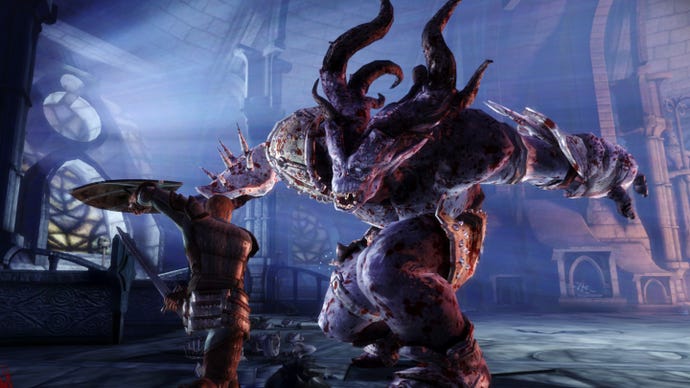
The result is that the alternative to playing a hero isn’t some anti-hero getting their hands dirty for what they think is the greater good, it’s being a misanthropic bully who uses violence and intimidation to get what they want and that, in my humble opinion, isn’t a fun time. It doesn’t even properly address the original complaint about simplistic moral choices, since you can still be a shiny hero doing the right thing all the time and everything will work out okay. And if that option is still on the table, why not bring back truly villainous protagonists?
