HomeReviewsFootball Manager 2022
Football Manager 2022 review: a small but notable evolution of one of the finest management sims aroundRecord keeper
Record keeper
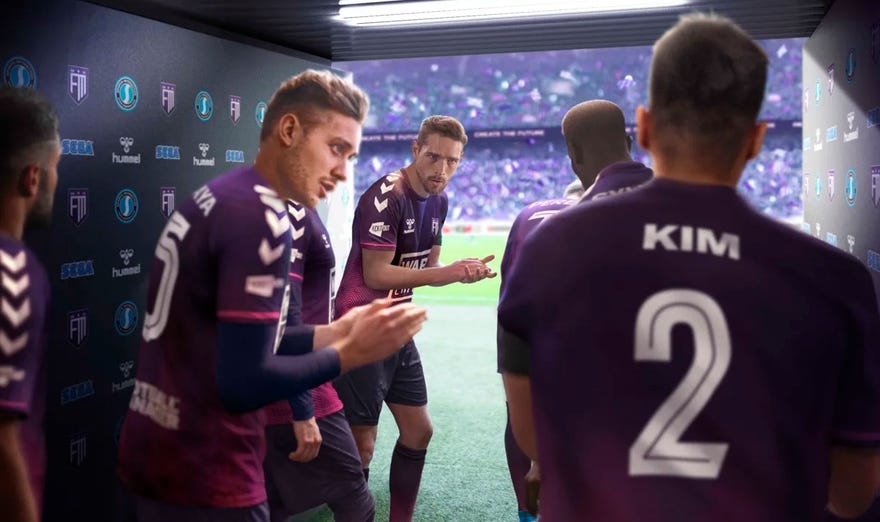
Barry Hattrick has just signed a two-year contract with Stockport County FC. The 36-year-old former full-back, a Stockport native and lifelong fan of the Vanarama National League club, has a tactical style best described as ‘my dad after three pints’. Route-one, 4-4-2, and no ‘larking about’. He thinks a gegenpress is something you use to get the creases out of your trousers.
Hattrick is a quintessentially English anachronism, whose ignorance of the modern game represents my own unfamiliarity with modernFootball Manager. It’s been quite some time since I last sported the greying temples and Fray-Bentos paunch of football’s favourite scapegoat, and returning to Football Manager is a bit like meeting up with an old girlfriend after they’ve had their consciousness uploaded into an all-knowing AI. I vaguely recognise the face behind all the ones and zeroes, but that person I once snuggled up with on winter evenings has ascended into something vast, intimidating, and utterly obsessed with data.
Football Manager 2022 | Launch Trailer | #FM22 OUT NOWWatch on YouTube
Football Manager 2022 | Launch Trailer | #FM22 OUT NOW

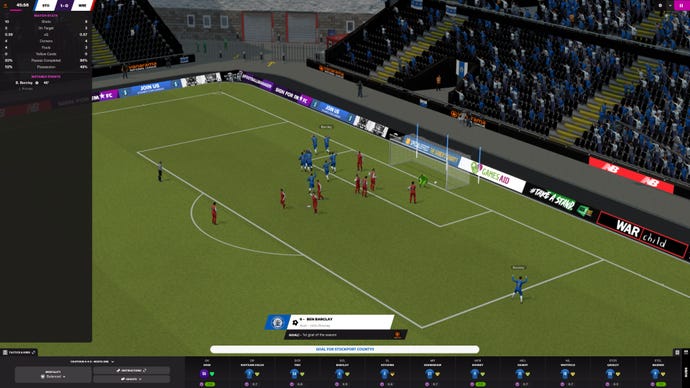
But Football Manager never gives you anything for free. You must balance tactical changes against your own team’s preferred playstyle, which builds in effectiveness the more you use it. When I came across a team that was strong against 4-4-2, I opted to switch to a 4-3-3 formation. The result was a dead first half, with neither team making any ground. In the second half I switched back to 4-4-2, and the following 45 minutes were far more active, with both teams creating and conceding a lot of chances. In the end I came away with a 2-1 victory, Stockport’s effectiveness in the formation winning out against my opponent’s ability to exploit it.
It’s thrilling to see your tactical changes play out on the pitch, watching as play extends to the wings when you instruct your players to attack with greater width, or pushing up your defensive line to thwart a team that likes to shoot from distance. In one game, a team I should have been beating comfortably was creating a worrying number of chances. The half-time analytics showed they were attacking almost exclusively down the wings, so I instructed my defence to force their wide plays inside, smothering their forward impetus for most of the second half.
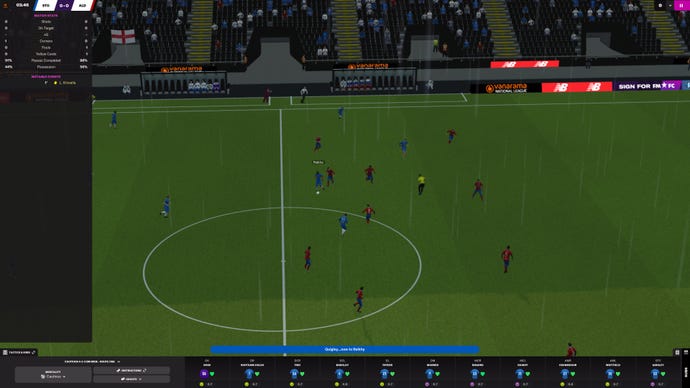
Beyond sharpening up events on the pitch, FM 2022 also adds more depth to backroom managerial duties. Foremost among these changes are weekly staff meetings, where you meet up with your non-jersey wearing staff to adjust training schedules, assess player and team morale, and discuss the viability of new hires. Meanwhile, the transfer market has been livened up with the introduction of Deadline Day. Wrapping the UI in fluorescent yellow banding like some terrible crime scene, Deadline Day opens up a bespoke menu for last-minute deals while time briefly switches its countdown to hours rather than days.
I like Deadline Day. It isn’t massively relevant to a club with a transfer budget of the average annual household income, and frankly I have all the negotiating skills of a tourist lost in the souks of Marrakech, but it’s a pleasing bit of flair in a game that’s otherwise flatly presented. While the data-handling side of FM is highly reflective of top-tier football, the sterile UI and lumpen character models are much more Sunday league. The manager creator has apparently been overhauled, but customisation options are still limited. You can’t dress your manager in a tight-fitting sweater like Pep Guardiola, for example, or stick them in Arsene Wenger’s obscenely padded sports coat. You get a suit and tie and enough stress to turn a bird of paradise grey, and you’ll like it.