HomeFeatures
Fallout 76’s lead artist is building a creepy single-player open world in The Axis Unseen“Skyrim was awful to play for the longest time.”
“Skyrim was awful to play for the longest time.”
Image credit:Just Purkey Games
Image credit:Just Purkey Games
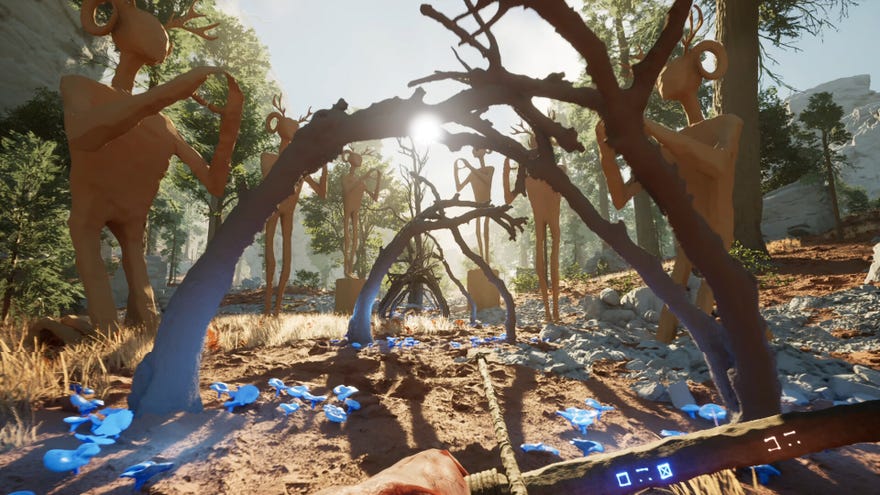
Look at any image of heavy metal horror gameThe Axis Unseenand you’ll recognise an archetype: the stealth archer. For a certain sort of Elder Scrolls player, it’s the only way to travel through a fantasy open world - perma-crouched, bow stretched lazily across the lower third of the screen. And it’s an appeal that creator Nate Purkeypile understands perfectly, having spent the larger portion of his career working on Bethesda’s RPGs, fromFallout 3andSkyrimall the way through toFallout 76.
“It’s probably not the best idea for most people to do a solo open world,” he says. “But at the same time, this is like my sixth one. I’m pretty sure what goes into these.”
The Axis Unseen - Open World Gameplay TrailerWatch on YouTube
The Axis Unseen - Open World Gameplay Trailer

You can observe the effects of this approach over time on Bethesda’s games. While dungeon delving in Oblivion, it wasn’t uncommon to experience déjà vu. Often you’d step into a crypt seen somewhere else in Cyrodiil, the sarcophagi placed just as they were the last time. “The copied and pasted rooms were because there was technically not even a level design department at the time,” Purkeypile says. “It was basically the artists who made the kits who were tasked to make 30 dungeons. And when Joel came over, he started that level design department.”
Wasting a Draugr in Skyrim
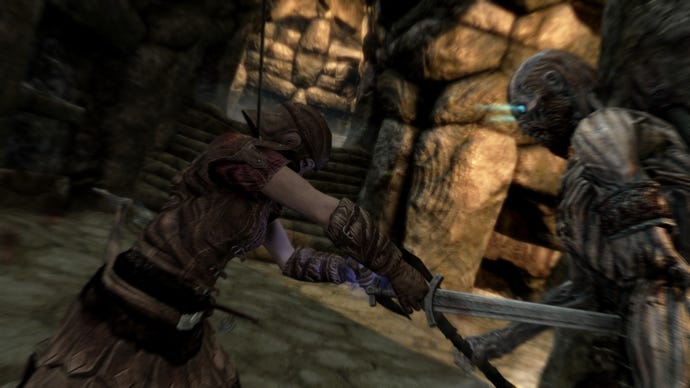
“It’s not really guided in a lot of cases,” Purkeypile says. “People will just get tasked to ‘clutter’ somewhere, and in a lot of ways, all those stories that you see are artists entertaining themselves.” Yet these bitesize stories are supposed to be found as players pick over the ruins, looking for valuable gear. There’s a reason important pickups don’t glow in Bethesda RPGs: “You’re meant to pay attention and look around at the world.”
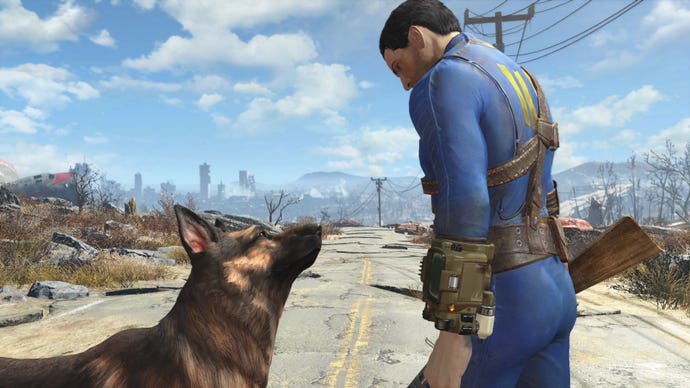
There’s a strong argument to be made that clutter is the primary story delivery system of these games - and the most effective one. Plus a less pretentious case to be made for the amusingly-positioned skeletons. “When you’re making a space, you’re like, ‘What would be something funny? A teddy bear watching a guy who’s dead in the toilet?’”
But joining Bethesda in the wake of Oblivion was not the victory lap you might imagine. “We as a company still felt like we had a lot to prove,” Purkeypile says. “Skyrim was awful to play for the longest time, and it just didn’t work. So many bugs. But that’s really true for almost all games, especially when you’re talking about these open worlds where you need all these pieces in place before it actually plays right. It can just be a boring, empty, broken mess forever, and that can take getting used to.”
Nevertheless, Purkeypile was attracted to the surprisingly small scale of Bethesda’s development teams, which relied on experience over weight of numbers. “People would joke about the new guy in the studio. And he’s like, ‘I’ve been here seven years!’” Early on, Burgess and Purkeypile led the making of trippy Fallout 3 DLC Point Lookout. “We did that whole thing in four months,” he says. “That was a pretty sizeable landmass, and with, like, 20 people and zero programming support.”
A lack of resources creates obvious problems. But a tight-knit team brings its own rewards. “You can trust people a little bit more when it’s at that scale,” Purkeypile says. “I would argue that a lot of the best things in Fallout and Skyrim were just people going off and doing their own thing. You need to set some boundaries there, but one of the more well-known examples is how [cavernous underground city] Blackreach wasn’t even supposed to be in Skyrim. Me and Joel just did it.”
Image credit:Bethesda
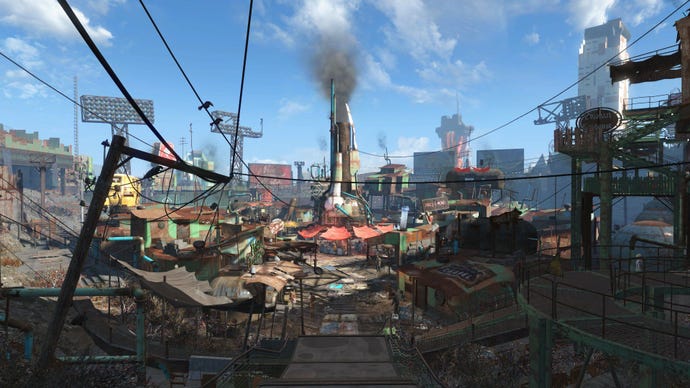
“There’s telephone wires to help lead your eye to the power core in the middle.” And if you’ve ever felt grateful for the fact that there are no doors to introduce loading screens between the central square’s shopkeepers, you’ve got Nate to thank. “I made a lot of decisions to make it fun for players, because I knew they were gonna go there so many times,” he says. “I had to fight with Design over that.” One of the Commonwealth’s most visible landmarks, the imposing Corvega assembly plant, was a joint Purkeypile creation with Jeff Browne, who built it using Purkeypile’s kit. It came about because he needed a test bed to try out the art team’s industrial-themed building kit. “Had to make sure it works.”
A series of prototypes led ultimately to The Axis Unseen. “Around that time I had been playing a lot of theHunter: Call Of The Wild,” Purkeypile says. “It seemed like a really good opportunity to add monsters to that type of thing.” As with Point Lookout and Fallout 76 - the latter heavily focused on cryptids rumoured to be local to West Virginia - Purkeypile has leaned into horror. “Here is where it goes full nutso with giant skulls and all these weird monsters,” he says. “It’s nice to double down on that. It makes sense to me to make a game about hunting Bigfoot, listening to heavy metal.” The Axis Unseen’s soundtrack comes from Bryant Clifford Meyer of post-metal titansIsis, and is partly played on “primitive instruments.”
Image credit:Just Purkey Games
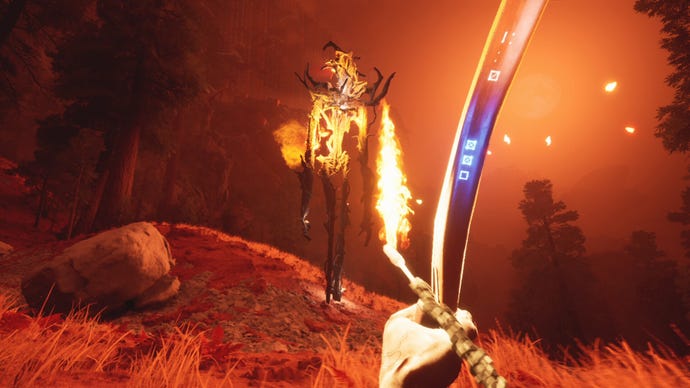
Image credit:Just Purkey Games
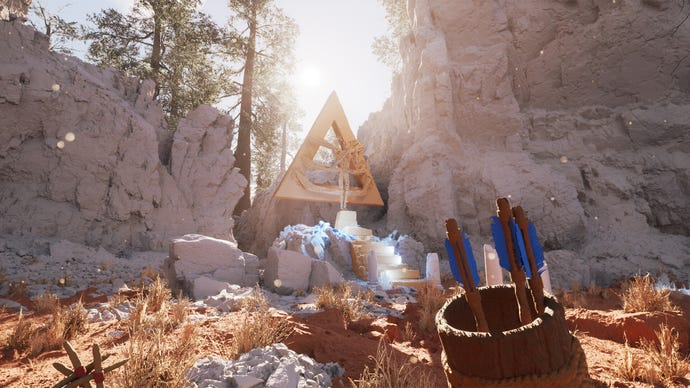
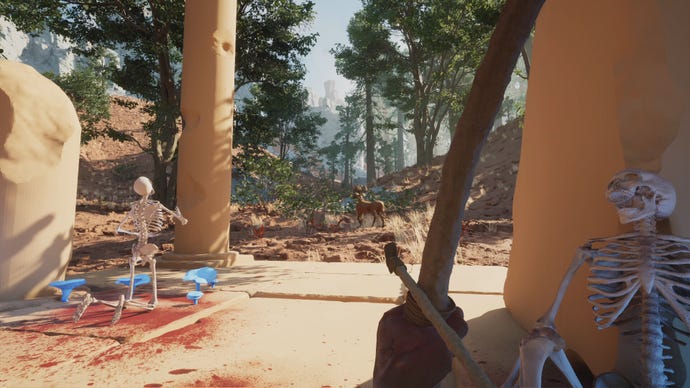
Bringing dark fantasy creatures to the hunting simulation genre opens up an extra phase to their core gameplay loop, Purkeypile reckons. “In the hunting games, you have to pay attention to tracks and wind direction and stuff, but you only have so much that happens after that,” he says. “You’re either gonna get a deer, or it’s gonna get scared and run away. But in my case, those creatures attack you.” In this nightmarish world drawn from folklore, creatures will follow your tracks, just as you follow theirs. “You have to pay attention if you’re walking on the rocks or the dirt,” Purkeypile explains. “And you have to be careful with stone because stone is also louder.”
It’s a welcome return to the floor-based-thinking that distinguished the Thief series. As are the elemental arrows, which are designed to be combined in lots of different ways. “You can make a fire and then shoot a wind arrow to make a wall of flame,” Purkeypile explains. “Either the creatures are gonna have to find a way around that wall, or if that’s the best way, they might just run through it and catch on fire. Then you have this flaming creature attacking you, and you’ve got to watch out for that, too.”
