HomeReviewsCyberpunk 2077
Cyberpunk 2077 reviewA big, beautiful and broken mess
A big, beautiful and broken mess
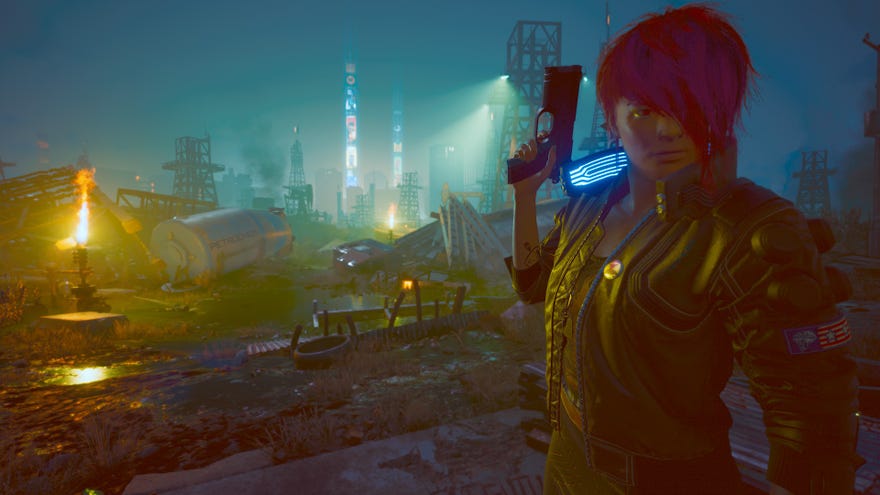
Developer:CD Projekt RedPublisher:CD Projekt RedRelease:Out nowOn:WindowsFrom:Steam,GOG,Humble,EpicPrice:£50/$60/€60
I was in an NPC’s car as she drove us across Night City when a thought occurred to me. We were driving at night to perform a risky stealth mission, which required me to break into a compound filled with military security so we could, to put it briefly, hack the planet. On the drive, two cars spawned out of thin air in front of us, blocking the road, but my driver didn’t react. We plowed into one of the cars as if it wasn’t there, sending it twirling into the air like it was stuffed with helium. Our own car wasn’t even slowed down.
The thought:Cyberpunk 2077has as much in common with early ’00s Eurojank as it does with the Rockstar games it aspires to. I’m OK with this. If it’s a choice between a less polishedGrand Theft Autoor a high budget Boiling Point, I’d choose the latter every time.
To see this content please enable targeting cookies.Manage cookie settings
Eurojank games like Boiling Point, ThePrecursors, or even arguably the Stalker series, aimed for vast open worlds and absurd systemic complexity. It was an ambition far beyond their means and I’d not recommend most of these games to anyone, but the messy results were always exciting. While we now live in an era when open world games are commonplace, they’re mostly too sensibly scoped and carefully produced to swing for the fences.

The other two options are Nomad, which starts you in the badlands outside of the city, and Corpo, which has you already living a life of corporate espionage in the offices of the city’s glittering skyscrapers. Whichever you choose, however, the game’s story will shunt you onto an identical path within the first couple of hours. Beyond those dialogue options, which do not change the story, there appears to be little that’s unique between the three paths.
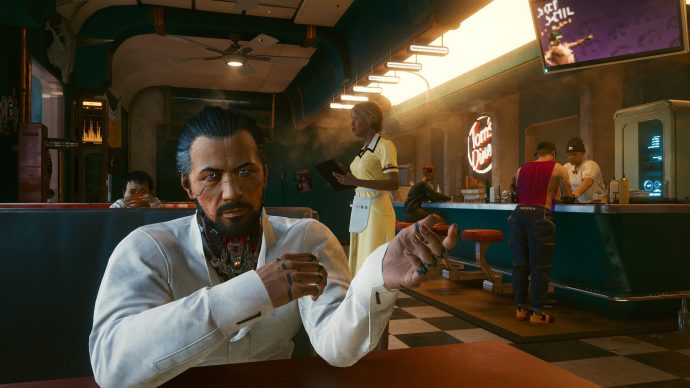
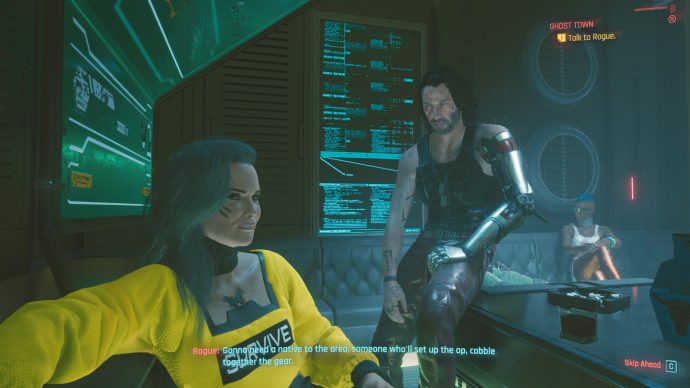
These opening hours are the game at its best, however - and make no mistake, Cyberpunk 2077’s best is very good. The intro quickly introduces you to Jackie Welles, your partner in crime. Jackie showcases CDPR’s talent for writing loveable brutes, and your missions with him over the first ten hours are some of the most fun in the game.
There’s a rip-roaring momentum to these missions as well, pulling you through a large chunk of the main story better than any other open world singleplayer game in recent memory. This is in spite of, or maybe because of, the stakes always being personal. The cyberpunk genre owes as much to noir detective stories as it does to science fiction, and as in those stories, Cyberpunk 2077 pitches against a world you have little hope of changing. You want to survive, you want to be remembered - or, a lot of the time, you just want to help your friends.
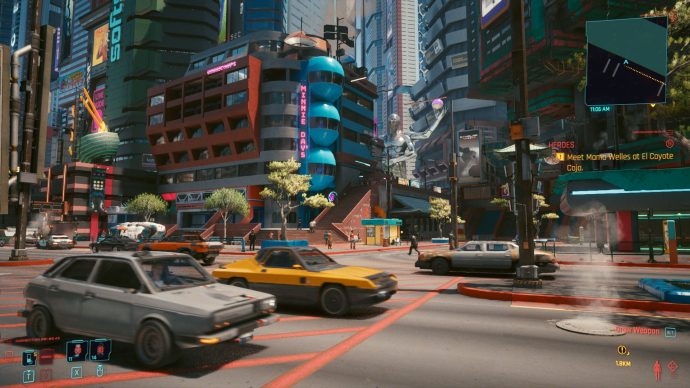
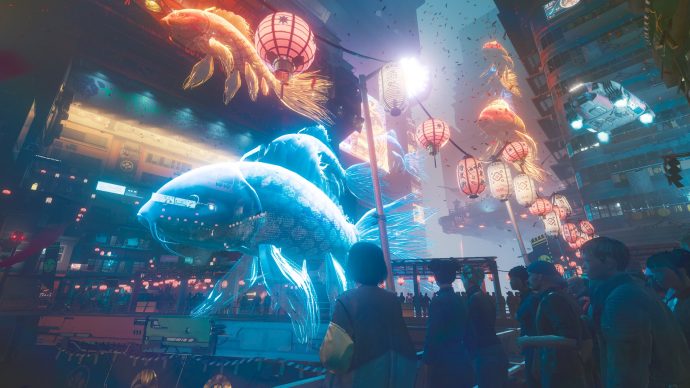
When the momentum breaks at the ten hour mark, it’s an opportunity to explore Night City. Around the same time, your car will be damaged and inaccessible for a while. Resist the temptation to buy a new one or fast travel and walk everywhere instead. Wander down the back alleys to find lantern-lit markets, gaze up at greeble-covered skyscrapers and staggering statues. The world is built upon decades of worldbuilding already done on Mike Pondsmith’s Cyberpunk TTRPG, and it shows in the detail and history visible in each of the city’s districts. It’s maybe the best walking sim ever made.
The other reason for this slowed pace is to nudge you towards the game’s side quests. There are dozens, including every kind you’d expect from a modern open world game, but among them are three chains of optional missions that are as involved as anything in the main plotline, and which can have a bearing on the game’s story. Structurally, I think this is a great idea - Cyberpunk 2077’s main story can be completed in a zippy 20 hours if you want it to be, but these critical side quests can almost double its length.
Unfortunately, this is where the most serious bugs reared their heads for me. RPS was not provided with early review code (“the review they didn’t want you to read” - 7/10), and so all my play time was after the day one patch, yet there were two chains of side quests that bugs rendered completely or partially unplayable. One simply did not trigger at all, while I had to abandon the other because it would crash to desktop at the same point on every attempt.
This is on top of several other game stopping bugs that forced me to reload old saves, as when critical NPCs would get stuck on scenery, and possibly hundreds more superficial glitches. I’ve seen NPCs phase through walls, I’ve been catapulted 200 meters while trying to climb through a window. I’ve had phone calls where the ‘answer’ button wouldn’t work, and some that happened on top of other phone calls that were already ongoing, with bits of mission critical dialogue crashing into each other. Objects floating in mid-air, characters fixed in T-poses, pedestrians who can’t walk up stairs…
Ultimately, these affected my enjoyment of the game only a little. Of greater impact were all the other systems that seem incomplete or poorly designed.

Then there’s attribute points, which can be spent across five categories and grant access to the perks inside. I initially focused on the “Cool” attribute, where the stealth perks lie, but the game’s systems for sneaking often feel too thin to make this a valid way of approaching the game. Enemy sight cones are hard to discern, alerting one person often alerts everyone, and there’s rarely an opportunity to reset guards to an unalert state short of reloading an older save. Instead, I more often than not fell back on straightforward combat when my attempts at sneaking were rumbled.
Most disappointing are the perks themselves. There are seemingly a hundred of them or more, spread across several trees under each attribute, but they’re almost all tiny stats changes that I can never bring myself to be excited about. ‘Handguns do 3% more damage’, ‘5% increase in chance to crit when attacking from stealth’, ‘10% movement speed increase after stealth takedown.’ The perks for hacking, engineering, gunning and movement are all similarly uninspiring. I ended up keeping my points in reserve for when specific opportunities arose to use a particular skill, such as when a door required a minimum level of Body or of Engineering to be broken or hacked open.
I’d bet good money there’s a way to spend your points surgically and stack them towards a particular, extreme and powerful build, one that combines with certain weapons and certain cyberware to do ridiculous things. I don’t know how you’d know how to do that short of waiting forthe guide artiststo tell you, particularly given there’s no way to re-assign attribute points and re-assigning perk points costs a staggering 100,000 of the in-game currency.
Not that it matters, ultimately. The game doesn’t want to tie your ability to advance the story to these progression systems anyway, meaning your choices in how you engage with them are broadly meaningless. I was 25 hours in before I realised that I should probably switch from the clothes I found in the first hour to items with a higher armour rating, but after I dropped casual trousers with an armour rating of 4 and hiked up a business skirt with an armour rating of 40, I didn’t really notice any difference. As an RPG or a Deus Ex, it’s one big shrug.
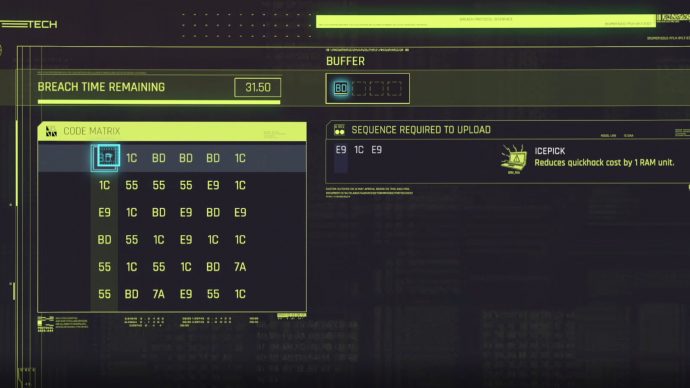
You can also ‘breach’ enemies or jack into certain machinery to play a hacking minigame, which asks you to pick chains of alphanumeric characters from a grid within a time limit. It’s mostly optional, and mostly rewarding, at least until you find the upgrades that make it trivial.
It’s not quite hacking, but lastly on the cyberfront, there are braindances, or BDs. These are Cyberpunk’s detective mode, first-person recordings of people’s lived experiences which you can visit in virtual reality when the plot requires it. You drop into an editor mode during playback that lets you scrub through the timeline and scan visual, audio and heat information from the scene, delivering clues which further whatever crime you’re investigating or preparing to commit. It’s straightforward stuff, but using it to plot a heist is also fantastically cool. I’d have gladly played with it another half dozen times than the handful the story allowed me - though be warned that at release the intro to these sequenceswas a seizure risk, and I can’t confirm that subsequent updates have addressed it.
At this point I feel like I’m just listing stuff in the game, desperate to cover it all. Cyberpunk 2077 is huge, sprawling, complex, and deeply flawed. It’s at its best as a fairly straightforward singleplayer action game, with likable characters and thrilling capers in a fascinatingly detailed open world that looks better than any game before it. It’s at its worst if you want it to be an RPG, an approach-as-you-please Deus Ex successor, or a polished piece of software. I enjoyed my time with it a lot, and I even want more of it, though I’m going to spend years complaining about its flaws. I’ll enjoy the complaining, too.
It reminds me of the Eurojank games of yore, then, but maybe it’s fairer to say that it reminds me of the previous games from developers CD Projekt Red. After eight years of one of the most grating marketing campaigns imaginable, Cyberpunk 2077 is here, its ambitions beyond its means. Cyberpunk 2077: Enhanced Edition when?
