HomeReviewsCrusader Kings III
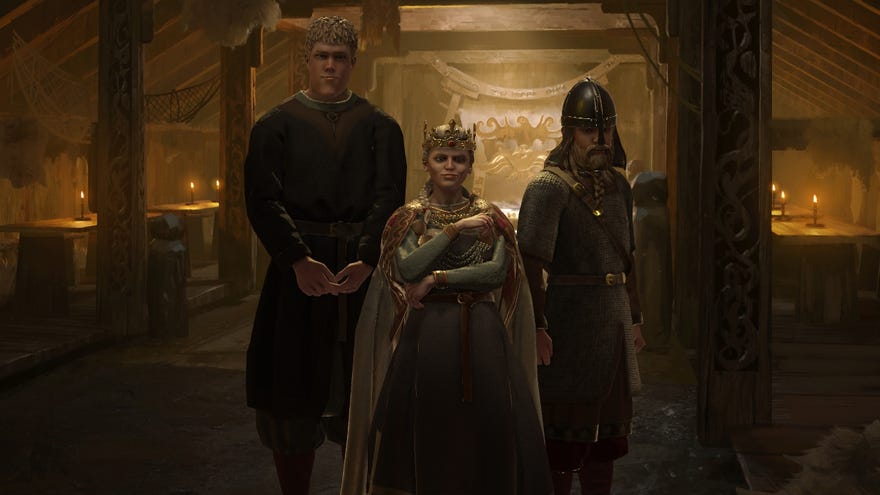
The way I’d summariseCrusader Kings 3depends heavily on where you’re coming at the game from. If you never playedCrusader Kings 2, but were always interested, then I heartily recommend this extremely long, in-depth strategy/RPG hybrid about managing the successive lives of a dynasty of medieval problem people. It’s very complex, but it does a better job than its predecessor of explaining itself, and offers more rewards along the learning curve. Similarly, if you tried CK2 but bounced off, now would be your cue to come back for another bite of the turkey leg.
If you have played CK2, however, then I honestly don’t know what to say to you. You might find that CK3 preserves the best of CK2, while losing some of the irritations. Or you might find that it has preserved the general structure, while losing the magic. Which end of that spectrum you skew towards will depend on what details of CK2 your particular devils resided in.
Watch on YouTube
Watch on YouTube
I started my CK3 journey in 1066 AD (although 867 AD was available), and as Bohemia, because I figured a shrewdly-played early game would give me the chance to take the Holy Roman Empire for a joyride.
The HRE is about as massive and complex as anything gets in the world of CK3, so it seemed like my best bet for testing how various systems performed at scale. It would also, I figured, let me get embroiled in all the classic medieval misadventures: popes and heresies, interdynastic marriages, kinslaying, tons of baffling succession crises, and of course the crusades themselves, plus a whole salad buffet of sordid mitteleuropean border wars.
Holy Roman Empire, Batman!

I saw all of the things I would expect to see, and in general, I found the ‘core’ CK3 experience alone gives you more to do than CK2 did at launch. There’s the 867 AD start date, for literal starters, plus the dynasty mechanic (which I talked about a lot, along with other new features, in mypreview), the skill-tree-growing lifestyle system, borrowed and augmented from CK2’s Way Of Life DLC, and of course customisable faiths, plus a long list of smaller new features.
I guess the point I’m making is that, while there’s obviously not as much in it as there was in CK2 after 15 expansions, you’d have a hard time calling CK3 sparse. My second playthrough, for example (which I’m saving for a diary), featured an Estonian clan obsessed with breeding a horde of well-read, horny giants. But there’s room for more, clearly. Will Paradox release more mechanics and systems as paid-for DLC? Of course. Does that mean the game isn’t “complete” on launch? I don’t think so at all.
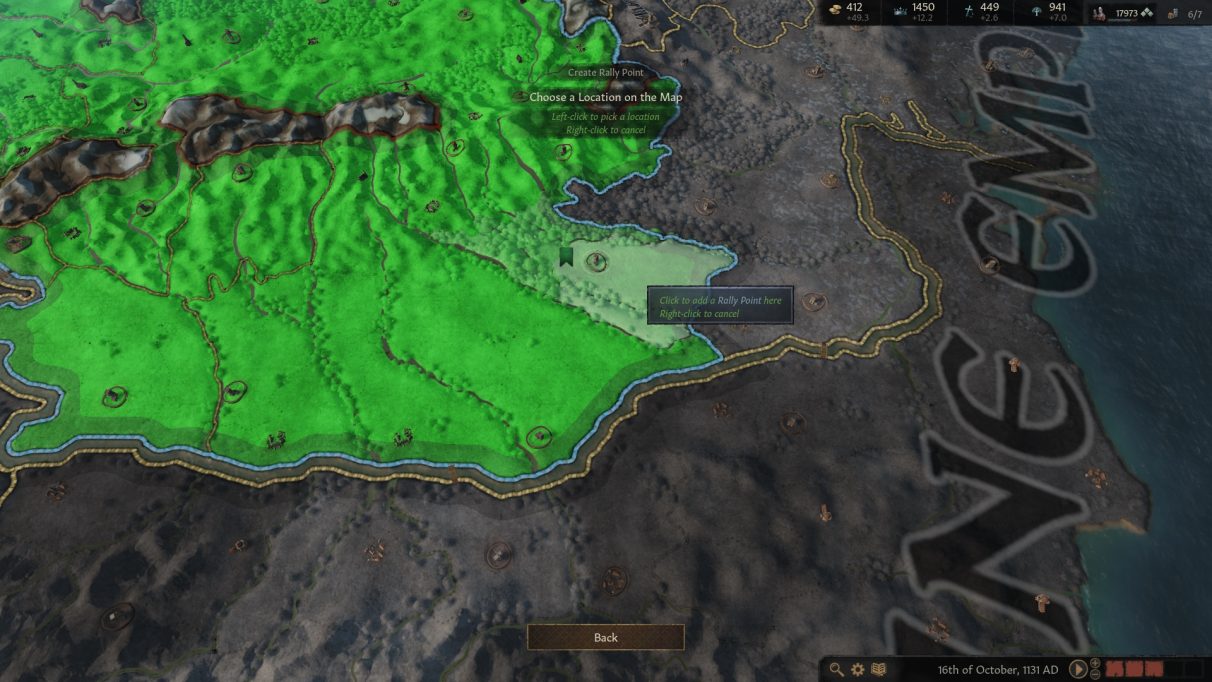
All of this adds more tactical depth to campaigning, and because of the reduction in micromanagement I spent less war-time micromanoeuvring my armies, and had more time to think carefully about things like river crossings, terrain types, unit counters and embedded characters. After a few extremely successful campaigns, however, I began to wonder whether my triumphs were entirely down to having more mental room for tactical thinking. Was I just suddenly much better at war in Crusader Kings 3? I found that hard to believe, so I started to really pay attention to AI troop moves, and began to notice some odd decisions.
Because now only the castles in a territory need to be captured to bring it under your control, invasions are far less grindy, repetitive affairs. But the knock-on effect is that blitzkrieg conquests have become extremely viable. Indeed, if you can kite enemy forces away from core territories, you can gut enemy realms virtually overnight, and I don’t think the AI is quite aware of the danger. I took to sending my main force on a beeline to the border nearest the enemy capital, only to have it sit tight while a smaller force scampered round to the opposite border to besiege some inconsequential territory. The enemy would invariably send all their troops rushing to the aid of Mount Bumnose or whatever, leaving my main force free to hop over the border and take the capital.

And of course, if you beef it on a succession and end up with a family member who inherited all the good stuff, there are always solutions…

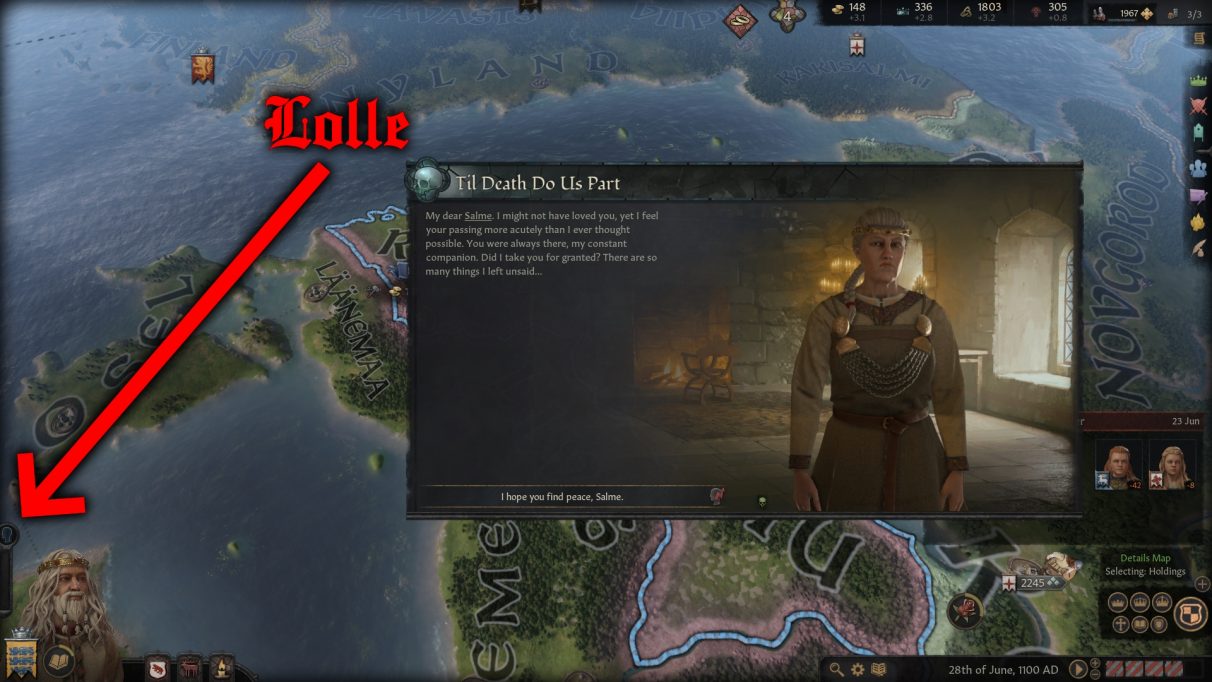
My mouse cursor is pointing to the section of the screen from which I had to infer where that pesky Carpathian Empire kept coming from when my ruler died, and I can’t even begin to explain the chain of deduction that led me to a solution.
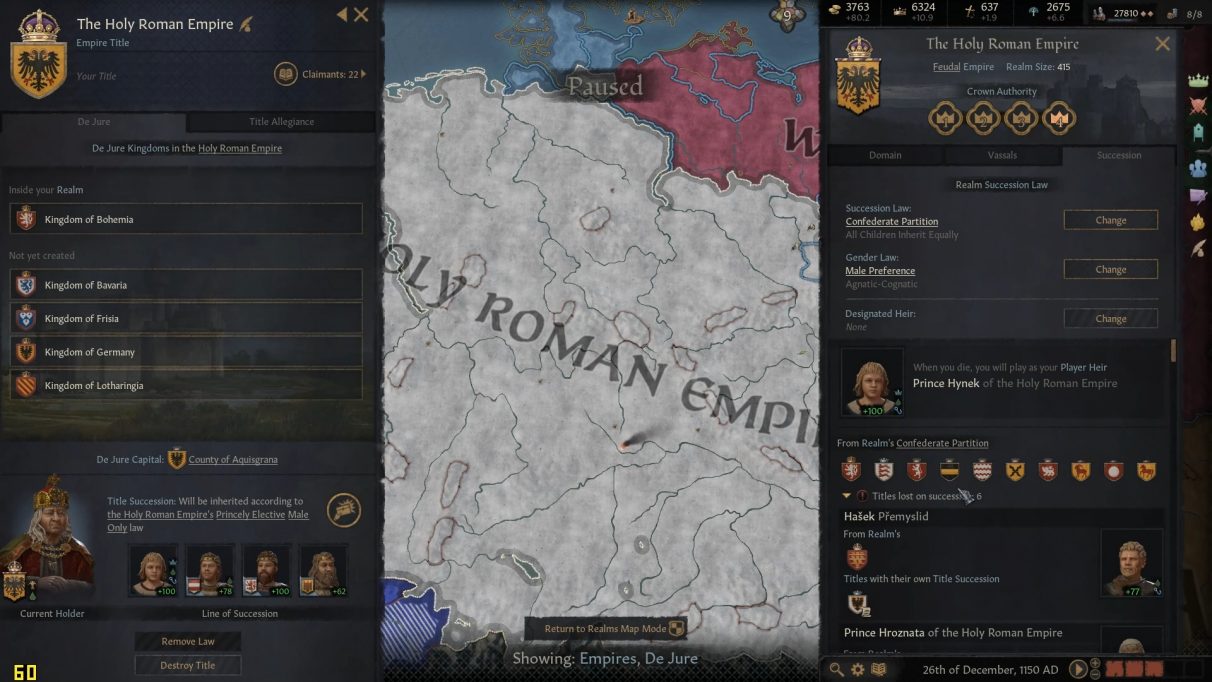
And besides, given the sheer amount of critical information you need to access in a game of CK3, it’s a wonder that so much of it is exactly where you want it to be at any given time. The redesign of CK2’s UI was always going to be a nightmarish brief, but it’s been tackled admirably, and on the whole the new layout is both intuitive and pleasant to look at (which it needs to be, given that you spend way more time in menu windows than you do actually looking at the pretty new 3D map).
Spot the ‘stress’ indicator.

And the UI irritations are certainly fixable. So easily fixable, in fact, that I’m fully prepared to feel mortified if I’m told thereisactually a stress tracker that I missed. But then, if I missed it after 25 or so hours of play and several committed searches for it, then that’s a bit of a design issue in itself. Same goes for the bug/feature issue, if I’m honest - a “your dude can’t marry because he’s a mercenary captain” flag would have saved me a lot of head-scratching.
Note after publication: Yep, there was an easily visible stress tracker. Ah well. But to be fair, it was on the main screen rather than the character info window, and I managed to miss it for a long, long time.
I mean, in my defence, it doesn’t hit the eye like a hammer, does it.
There are so many more little good things about Crusader Kings 3 that I’d like to talk about. So many strange little intricacies, and delightful, unexpected moments of satisfaction, of the kind CK2 delivered so well. And that’s the thing. Because if this game came out of nowhere, with nothing like it having graced the PC before, I would be speechless at its ingenuity. But of course, Crusader Kings 2 has been gracing our PCs, for eight years now, and it’s a bloody hard act to follow (you have to realise just how hard it is not to swerve into a concluding metaphor about royal succession here. Rest assured, I’m not going to do it).
In truth, there was no way that Crusader Kings 3 was ever going to live up to what every different camp of CK2 fans wanted from a sequel. And in all honesty, howcanyou make a sequel to a game which - even though it was a sequel itself - is widely acknowledged as having been a true one-of-a-kind?
If such a thing was possible, I guess, then the best form for it to take would have been a sort of iterative remake of CK2, taking the best simple concepts from its many expansions, and easing out some of the more forbidding elements of its information architecture. It wouldn’t have been perfect, and it would have had to make a few compromises in order to provide any innovation beyond the purely visual. But it would have been a damn solid game all the same, with the potential to eclipse its source material in time.
In fact, thinking about it, I just described Crusader Kings 3. I think I’ll need another year of playing it to work out exactly what I think of it. But that’s another way of saying I want to play it for a year, so it must be pretty good.
