HomeHardwareNews
CES 2022: More Intel 12th Gen CPUs revealed for gaming laptops and cheaper PCsAlder Lake reinforcements include budget chips without E-cores
Alder Lake reinforcements include budget chips without E-cores
The vanguard of Intel’s12th Gen Alder LakeCPUs had some seriously good chips in it – including two of thebest CPUs for gamingoverall – though there weren’t many models for aspiring PC builders on tight budgets. Now, though, Intel has usedCES 2022to launch the rest of the 12th Gen desktop lineup, adding loads of more affordable Core i5 and Core i3 processors on top of new Core i7 and Core i9 options. Intel also unveiled its new H-series, 12th Gen gaming laptop chips, which use the same hybrid architecture (combining powerful P-cores with smaller, less energy-intensive E-cores) as their Alder Lake desktop cousins.
12th Gen Intel Core DDR5 Memory and More Explained | Intel TechnologyWatch on YouTube
12th Gen Intel Core DDR5 Memory and More Explained | Intel Technology

There’s a honking great 22 desktop chips joining the range (the initial Alder Lake launch had six), for which the full specs are listed below. As you can tell from the lack of Ks in the names, none of these are unlocked for overclocking, though some variants offer the choice of F- and T-series models. F-series CPUs are identical to their suffix-deprived versions, save for a lack of integrated graphics and a slightly lower price, while T-series chips trade away a little bit of clock speed for better overall efficiency. Notably, all of these – even the 16-core Intel Core i9-12900 – have drastically lower base power usage ratings than their closest equivalents from the first, more enthusiast-focused round of Alder Lake CPUs.
Click to embiggen!
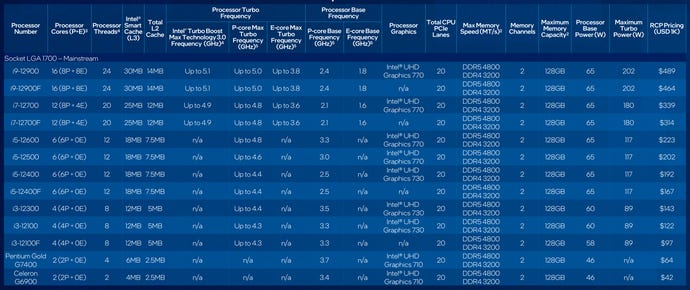
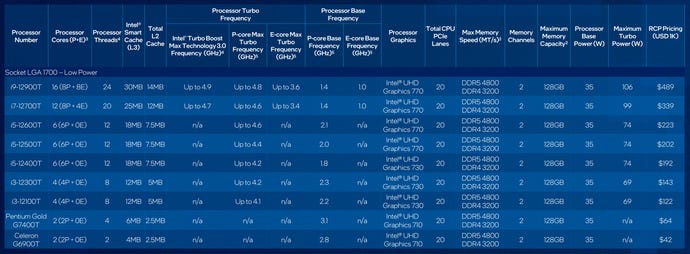
Potential highlights include the i5-12600, a locked, less PSU-hungry version of the outstandingCore i5-12600K, and the i5-12400F, which hopefully continues the tradition of Intel’s ‘400F’ chips being good-all-round gaming CPUs for those with limited upgrade funds. Speaking of which, the 12th generation finally has some Core i3 representation, albeit entirely without E-cores.
Still, the entire lineup features other Alder Lake additions, including bonus PCIe lanes for more extensive expansion support, and compatibility with both DDR4 and DDR5 RAM. Though, uh,don’t feel obliged to switch to DDR5if you’re upgrading.
As for the new H-series mobile CPUs, these introduce Intel’s P-core/E-core architecture to gaming laptops while making other key improvements on the previous 11th Gen Tiger Lake’s feature set. Intel Thread Director, for example, feeds Windows extra data so that the OS’s task scheduler can more effectively assign workloads to the different threads. LPDDR5 support is also included, something that failed to materialise for Tiger Lake.
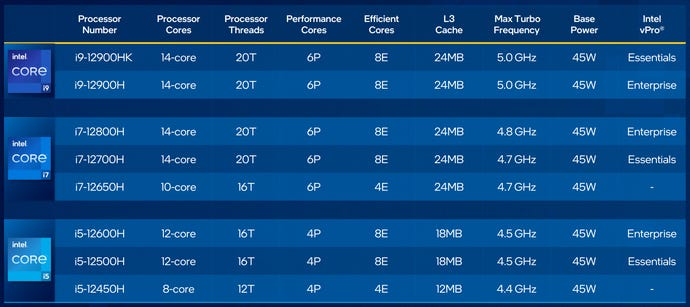
At the top of the stack is the Core i9-12900HK, which with its six P-cores and eight E-cores should take the place of the old Core i9-11980HK in top-tier gaming laptops like theMSI GE76 Raider. There’s also a non-overclockable version of the same chip, alongside six more split evenly between Core i7 and Core i5 models. All eight have a base power rating of 45W, though I’m curious to see how such core-heavy designs fare with battery life. It’s not like they’re skimping on speeds either, though in fairness, it’s long been standard procedure for gaming laptops to conk out after a couple of hours away from the mains anyway.
