HomeHardwareNews
AMD FSR 2.0 is a more demanding, higher-quality upscaling upgradeHow AMD’s performance-boosting tech is getting smarter and sharper
How AMD’s performance-boosting tech is getting smarter and sharper
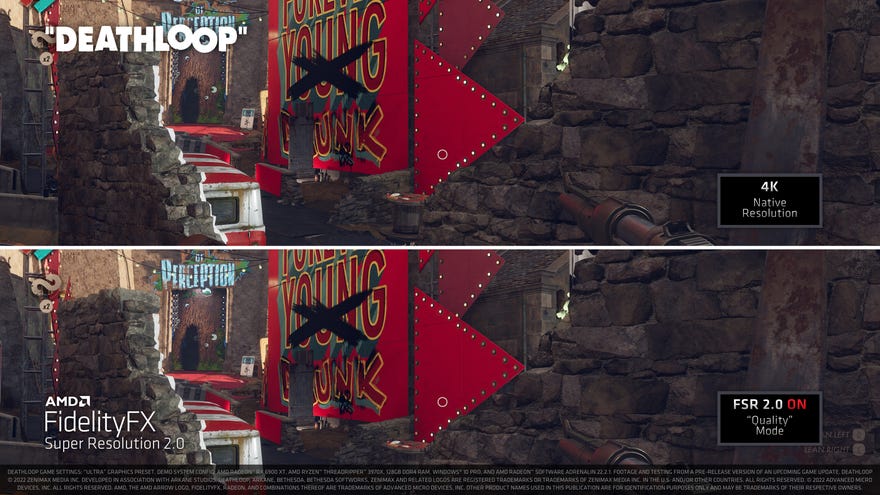
AMD have revealed more about FSR 2.0, the major overhaul of its FidelityFX Super Resolution upscaling tech, after adetail-light announcement last week. FSR 2.0 will represent a switch from simple spatial upscaling to more closely match the advanced temporal upscaling techniques of its rival, NvidiaDLSS– and while it won’t use DLSS-style machine learning, AMD say the trick to FSR 2.0’s improved performance is down to some good-old-fashioned human brainpower.
To see this content please enable targeting cookies.Manage cookie settings
To see this content please enable targeting cookies.Manage cookie settings
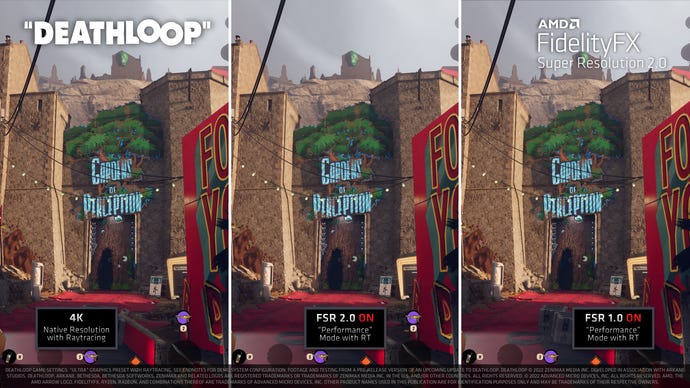
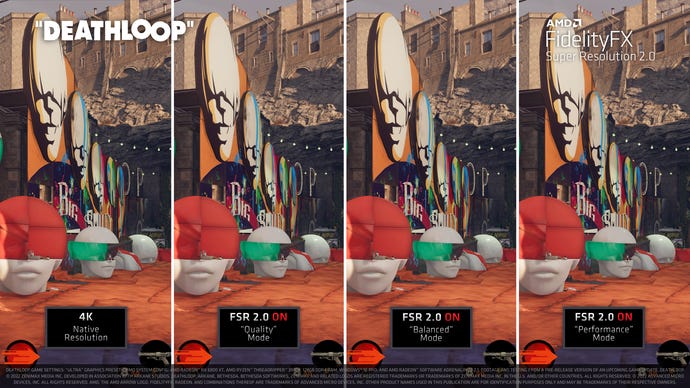
FSR 2.0 will use temporal upscaling too, albeit with purely human-designed algorithms to crunch data from multiple frames, rather than machine learning. The result, on paper, is vastly improved image quality compared to the spatial FSR 1.0, without need of dedicated machine learning hardware like that of the RTX series. AMD revealed comparison images forDeathloop, one of the first games that will support FSR 2.0 when it launches, showing the sharpness difference between the old and new upscalers:
Click to embiggen!
In acommunity blog post, AMD software product marketing specialist Alex Blake-Davies explained why machine learning was deemed unnecessary: “Broadly speaking, machine learning (ML) is an incredibly useful set of tools and techniques that can aid and accelerate this process. However, the results that ML achieves can sometimes not be the most optimal, lacking the spark of human imagination that can often lead to breakthroughs for complex problems. “
“Often, ML-based real-time temporal upscalers use the model learned solely to decide how to combine previous history samples to generate the upscaled image: there is typically no actual generation of new features from recognizing shapes or objects in the scene. AMD engineers leveraged their world-class expertise to research, develop, and optimize a set of advanced hand-coded algorithms that map such relationships from the source and its historical data to upscaled resolutions.”
However, the post also says FSR 2.0 will be more demanding on graphics cards than FSR 1.0. It will still be usable on both AMD and Nvidia GPUs (handy if you’ve already invested in one of thebest graphics cardsfrom the GeForce lineup), but unlike with version 1.0, AMD will recommend certain models for certain resolutions. When upscaling to 4K, for instance, at least a Radeon RX 5700 or GeForce RTX 2060 are suggested, while upscaling to 1440p comes with recommendations for a Radeon RX 5600, a GTX 1080, or better.
In fairness, these are the kinds of cards you’d want to play at those respective resolutions anyway. More aged models like the Radeon RX 470 or GeForce GTX 970 aren’t listed among the recommendations, though they might still work - just not as well as newer, more powerful cards.
FSR 2.0 is due to launch in Q2 2022 (April to the end of June). So far only Deathloop andForspokenare confirmed to support it, and the latter isn’tout until Octoberitself, though AMD are working directly with others developers to get FSR 2.0 up and running on “as many games as possible”.
