HomeHardwareNews
AMD announced the first Radeon RX 7000 GPUs at RTX 4080-beating pricesEverything you need to know about the Radeon RX 7900 XT and Radeon RX 7900 XTX
Everything you need to know about the Radeon RX 7900 XT and Radeon RX 7900 XTX

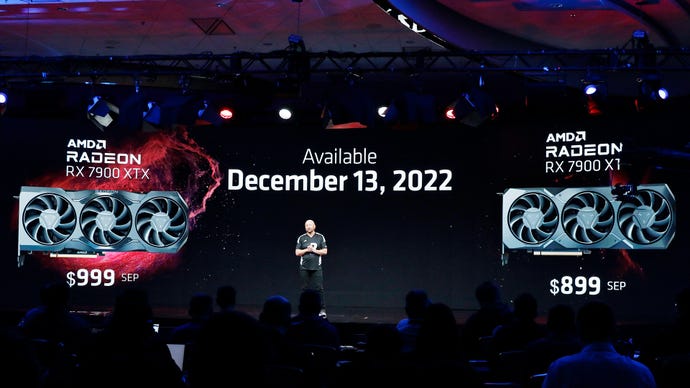
We finally have AMD’s answer to theNvida RTX 40 series: the Radeon RX 7900 XT and Radeon RX 7900 XTX, the red team’s firstgraphics cardsbuild on the RDNA 3 architecture. These are both high-end GPUs, set to cost $899 and $999 respectively when they release on December 13th, but you’ll note those prices are oodles cheaper than the £1269 / $1199 RTX 4080 and the £1679 / $1599RTX 4090.
They’re also structurally distinct from the currentRadeon RX 6000cards to an extent that, frankly, is quite surprising to see from AMD GPUs. RDNA 3 uses a Ryzen CPU-inspired chiplet design, where the GPU is split up into different sections, and the new media engine is engineered for the4K gaming monitorsof the future as much as it is for current PC hardware.
Introducing AMD Radeon™ RX 7900 XTXWatch on YouTube
Introducing AMD Radeon™ RX 7900 XTX

How exactly these two cards will perform in games remains to be (reliably) seen, though AMD also announced a helping hand in FSR 3. This new version of theFidelityFX Super Resolutionupscaler will not only reduce the strain of rendering frames, but will likely add its own ‘Fluid Motion Frames’, in what looks like a direct challenge toNvidia DLSS 3and its AI frame generation tech.
There’s a lot to chew on here, so let’s do just that, with all the newly announced Radeon RX 7900 XT and RX 7900 XTX specs and availability deets.
AMD Radeon RX 7000 series prices
UK prices are TBD, but AMD confirmed the flagship RX 7900 XTX will launch with an MSRP of $999, while the RX 7900 XT is set at $899. Expect more expensive versions of both, due to board partners making additions like factory overclocks or upgraded coolers.
The fact that these are the only two official RX 7000 graphics cards may disappoint those who were hoping for more affordable, 1080p/1440p-focused graphics cards, given Nvidia also launched their newest GPU generation with luxury 4K engines. But both the RX 7900 XT and RX 7900 XTX are hundreds of dollars less than their new-gen GeForce rivals, and undercut older premium cards like the RTX 3090 and RTX 3090 Ti as well. Theirvaluewill depend on how well they perform in comparison, but it’s at least encouraging that you won’t have to break four figures for AMD’s top tier.

AMD Radeon RX 7000 series release date
Both the RX 7900 XT and RX 7900 XTX will go on sale on December 13th 2022 – no staggered launches here. That said, it’s maybe worth noting that FSR 3 won’t be available until early 2023. That’s contrast to DLSS 3, which was ready to go – albeit with limited game support – when the RTX 4090 released back in October.
No word yet on any future mid-range or low-end RX 7000 graphics cards, though since the RX 7900 XT and RX 7900 XTX are only releasing with a couple of weeks left in the year, don’t expect any more additions to the RDNA 3 family until 2023.

AMD Radeon RX 7000 series specs
If you’re just here for the core specs, here, have a table. You can see how both the RX 7900 XT and Radeon RX 7900 XTX are overflowing with VRAM, while the extra hundred bucks on the Radeon RX 7900 XTX buys you slightly faster clock speeds and a handful of extra compute units (core clusters). The Radeon RX 7900 XTX also, I spy, has a significantly lower power rating than the 450W RTX 4090.
Chiplet designs aren’t inherently better than monolithic GPUs, and AMD has had to come up with an incredibly fast 5.3TB/s interconnect just to make sure that the different parts can communicate with each other quickly enough. But there are advantages: chiefly, it allows the GPUs to benefit from more efficient 5nm hardware, but only where it counts most, with the MCDs using a cheaper manufacturing process with better yields. In theory this should mean next-gen performance while still keeping costs down, with savings passed on to the consumer. Hopefully.
The new GCD is also aiming to close the gap with Nvidia on ray tracing performance, with AMD promising “1.5x more rays in flight” and improvements to how RDNA 3 processes newly generated rays.
As for how these changes translate into actual performance, we’ll have to wait for some benchmarks outside of AMDs own. The company say the RX 7900 XTX is between 1.5x and 1.7x faster than the RX 6950 XT in games likeCall of Duty: Modern Warfare 2,Cyberpunk 2077and ray-tracedMetro Exodus, though a more important comparison would surely be against the RTX 4090. Or the RTX 4080, at least.
Speaking of, anyone who picks up an RX 7000 series card won’t have to worry about needing an RTX 40 series-style power adapter, as they’ll take your PSU’s regular 8-pin power cables as they are. A relief, perhaps, consideringhow many RTX 4090 adapters have been melting lately.

AMD Radeon RX 7000 series features
The RX 7900 XT and RX 7900 XTX will be the first graphics cards to support the DisplayPort 2.1 connection standard, meaning they’ll be able to fully supportgaming monitorsthat are largely theoretical – think 4K/480Hz and 8K/165Hz.
The RX 7000 also reaches parity with the RTX 40 series on supporting AV1 encoding. This isn’t a gaming featureper sebut could be useful for streaming, or capturing game footage to edit later; AV1 is miles better than other mainstream encoders at balancing high quality with low data usage.
AMD FSR 3: a new DLSS 3 rival
AMD also used their Radeon RX 7900 XT/RX 7900 XTX reveal event to tease their upcoming FSR 3 upscaler. It’s unfortunate that this won’t be ready in time for the new cards’ release day, as it sounds like it’s gunning for the same kinds of massive FPS gains as DLSS 3 – and not just from the core temporal upscaling.
Interestingly, AMD never suggested that RDNA 3 hardware would be essential to FSR 3, so like previous versions it could potentially become available on older cards as well – and not just Radeon models, but Nvidia andIntel graphics cardstoo. Again, just speculating at this point, but that could be a huge deal in terms of boosting performance on aging PCs. If only in the games that add support for FSR 3 on their end, of course, and those haven’t been announced yet either.
