HomeReviewsAgainst The Storm
Against The Storm review: a roguelite citybuilder awash with great ideasLet the weather get you down
Let the weather get you down
Image credit:Rock Paper Shotgun/Hooded Horse
Image credit:Rock Paper Shotgun/Hooded Horse
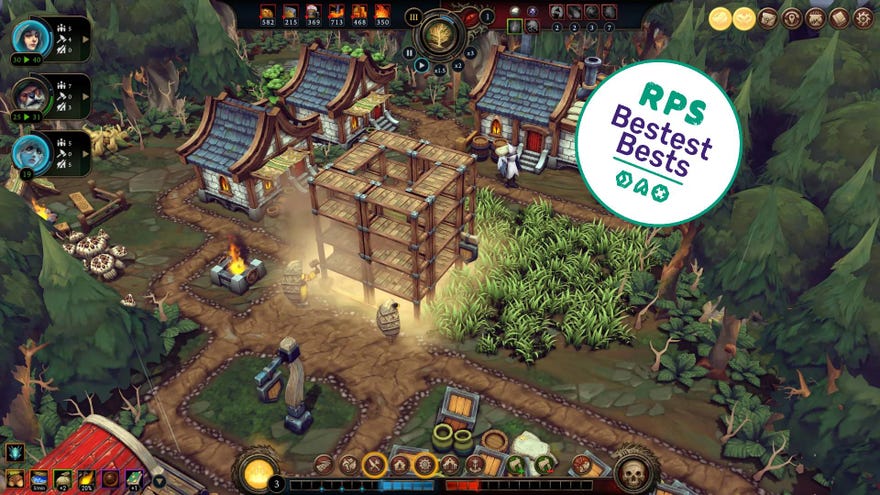
Following two years in early access, roguelite citybuilderAgainst The Stormhas finally reached its 1.0 milestone. It’s a combination of genres that seem to pair together as naturally as sausages and strawberry jam. Don’t get me wrong, I’m a fan of both of these things as separate entities, but together? My assumption was that they would prove too strange to stomach, but much like the cursed pork and berry snack that became a staple of my university diet, the result is a thrilling concoction that delights the palette. I’ll say it right up top: Against The Storm is one of this year’s best.
As the Queen’s Viceroy, it’s your job to establish villages in an endless forest that surrounds the Smouldering City, civilisation’s last remaining bastion after a cataclysmic event known as the Blightstorm destroyed the world. This dense wilderness is fraught with danger, a corruption that whispers through the trees and fractures the resolve of those that linger within its shaded glades.
Each species of villager has a list of things they like (pickles, jerky, religion, etc.) that, if satisfied, makes them happier and less likely to leave your settlement. Make them really happy and you’ll earn additional reputation points, ferrying you quickly towards success. |Image credit:Rock Paper Shotgun/Hooded Horse
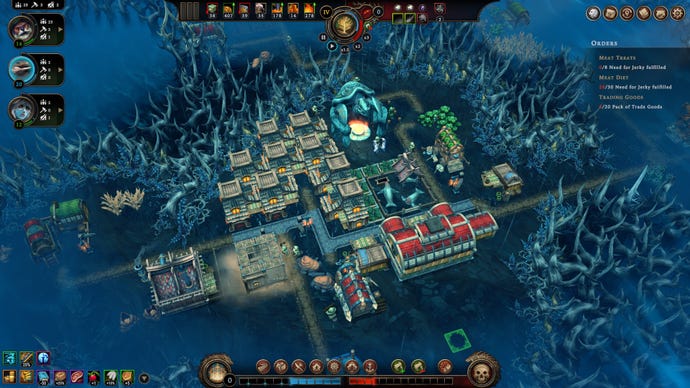
Unlike most citybuilders, the aim of Against The Storm is to push through the wilderness a settlement at a time, selecting a node from a world map before beginning construction within a procedurally generated patch of trees. Once a handful of hamlets have been successfully managed, the blightstorm returns, washes them away and twists the forest’s overworld map into a different layout. As an economy-based citybuilder, you’ll create production lines that transform resources gathered from the surrounding forest into more complex items that can then be consumed or sold. Think The Settlers, before Ubisoft decided it needed lads with swords on the cover to appeal more to teenagers.
There is no combat here, though. Instead of vikings or (shudder) the English, your main antagonists are abstract concepts. Hunger. A sustainable source of fuel. A raging storm that arrives in phases, the harshest of which reduces your citizen’s happiness substantially. Fail to feed them nice biscuits or slices of pie, and there’s a chance your entire workforce will wander off back home.
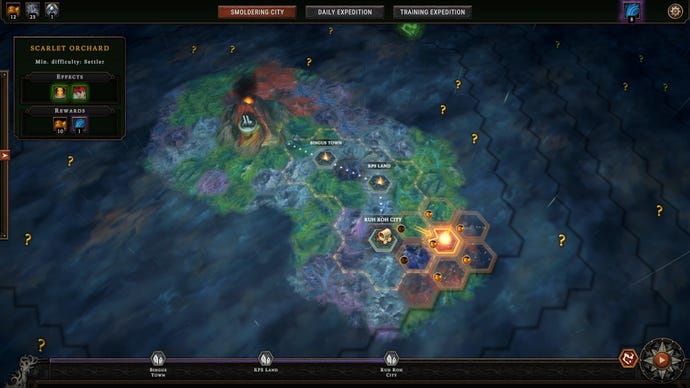
Ignoring my (brilliant) village names, the world map consists of multiple types of biome. Each biome has a different effect on your village, alongside the randomly assigned forest mysteries. No two games ever play the same as a result. |Image credit:Rock Paper Shotgun/Hooded Horse
Does that all sound a bit complicated? It is, to be honest, and your first few hours will probably be spent squinting a lot at menus as you try to figure out your next move. Although a long period in early-access has led to the addition of a healthy number of tutorials and tooltips, there is an initial sense that there is almost too much at play here.
Let’s talk about my 15 skewer odyssey. In my last run, my lizards snarfed down roasted meaty chunks until the queen came home, thanks to an abundant meat pile that spawned near my base and a meathouse dedicated to spitting out the skewers. Another time, I wasn’t so lucky. Not only was meat in scarce supply (my poor humans survived on a diet of roots, which is as funny as it was grim) the gods of randomness had yet to give me a single building that could poke a bit of wood through a couple of old prawns. Minutes away from losing, I realised I could convert my excess wooden planks into tradable bundles that could be exchanged for my scaly friends’ favourite dish, fulfilling the request and securing me a win.
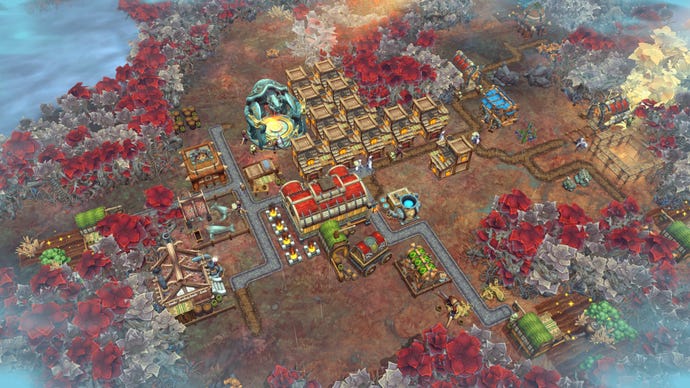
It’s not all doom and gloom. Some biomes, such as the scarlet orchard pictured here, are suprisingly beautiful. Albeit in the brief moments of drizzle that occur between long stretches of torrential rain. |Image credit:Rock Paper Shotgun/Hooded Horse
It’s difficult, but never unfair. As much as Against The Storm throws curveballs at you, it does so knowing full well that there are systems in place to knock them clean out the park. Production lines allow you to swap out base ingredients, rather than forcing you to hunt for a specific thing. Buildings can be moved. Resources can be purchased. Goods can be sold. The pace is breathless, but there is always room to breathe.
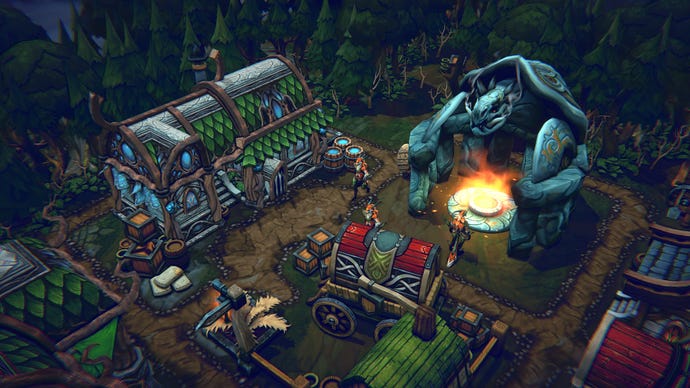
Your bitesize builds are all wrapped up in this dark fantasy dressing that drips with dread. Meat is sliced from the decaying carcasses of enormous leeches. Buildings are ramshackle, understandably designed for their function and not longevity. Although your population is made up from different, visually distinct species, they all walk through your settlement with the same familiar hunch, covering themselves from the unrelenting rainfall after a long day toiling in the gloom. The forest itself is palpably sinister. Depending on the biome trees can be blood red, skeletal, knotted like roots or vibrant like coral. The glowing fire of the hearth is the only comforting visual in the entire game. None of it is pleasant, but it adds a sense of grim fatigue to your excursions.
Image credit:Rock Paper Shotgun/Hooded Horse
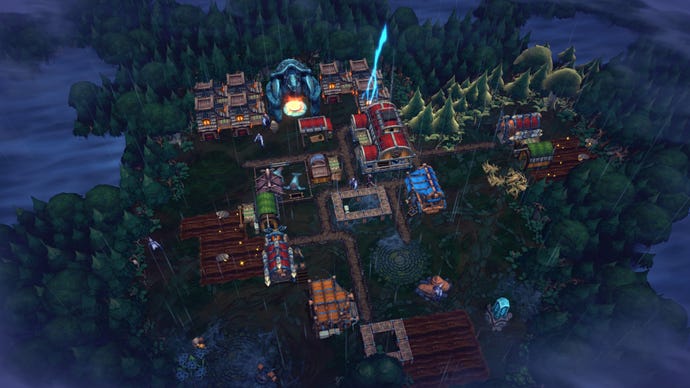
For those who have already sunk countless hours into the game’s early-access version, 1.0 introduces an ultra hard mode designed for veteran viceroys. The Queen’s Hand Trial challenges you to complete the game’s most difficult task (finding - and then gluing - bits of a broken seal back together) within a single storm phase. Failure to do so results in losing all of the upgrade items you acquire during your time with the mode. Personally, I found this a bit too tough to experience in earnest, but it’s nice to know it’s there if I ever manage to reach the point of mastery it’s clearly designed to test.
There is - somehow - even more to it than this. Little details like Storm phases, villager preferences, and a skill tree that’s abstracted as a lightweight citybuilder in itself. Like most games in its genre, Against The Storm is designed to be returned to time and time again, except here a fresh start is always seen as progress. It makes for a construction game that wraps up at precisely the moment it begins to lose momentum. It is a wonderful, wonderful thing.
Sausages and jam is a silly example, because it’s obvious why they work together so well. Pork and apple sauce is a cornerstone of this island’s cursed cuisine, and what is jam if not another sweet accompaniment. But someone has to be the first to put these things together, right? Someone has to be brave enough to see the reasons why a particular pairing makes such a beautiful pairing. This is exactly the reason why Against The Storm is so exciting. It just makes sense.
